Short answer
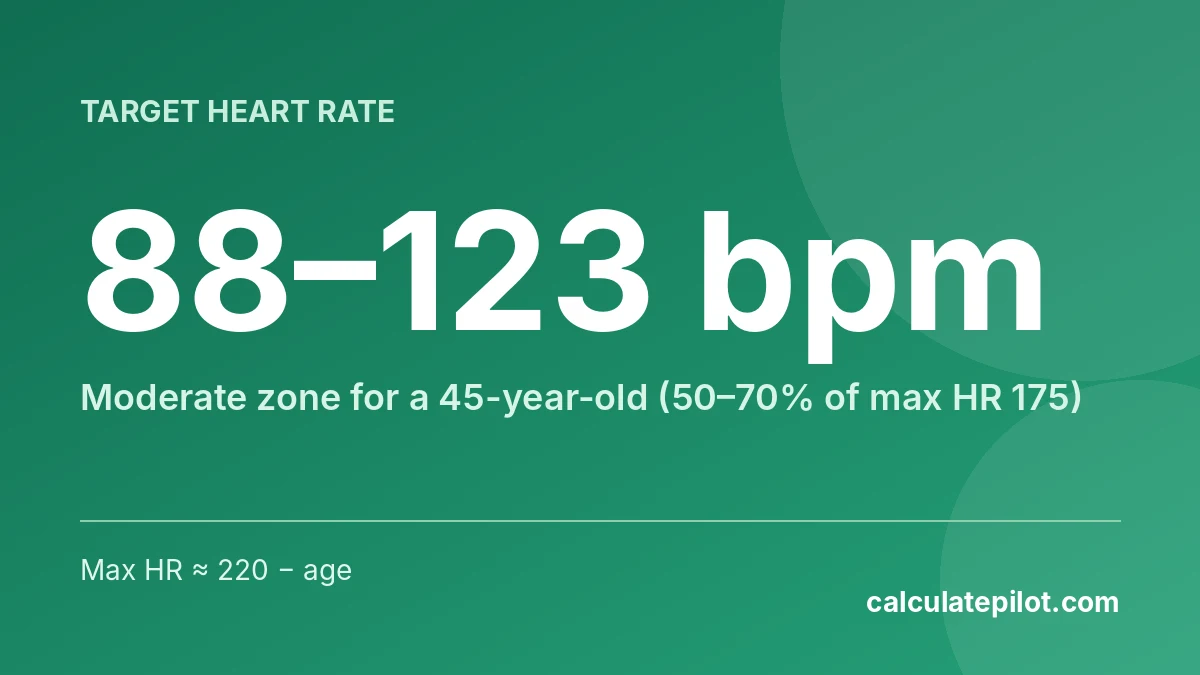
Estimate your maximum heart rate as 220 minus your age, then aim for 50–70% of it for moderate exercise and 70–85% for vigorous exercise. A 45-year-old has a max of about 175 bpm, a moderate zone of about 88–123 bpm and a vigorous zone of about 123–149 bpm.
Put in your age and resting heart rate and the Target Heart Rate Calculator shows both methods side by side.
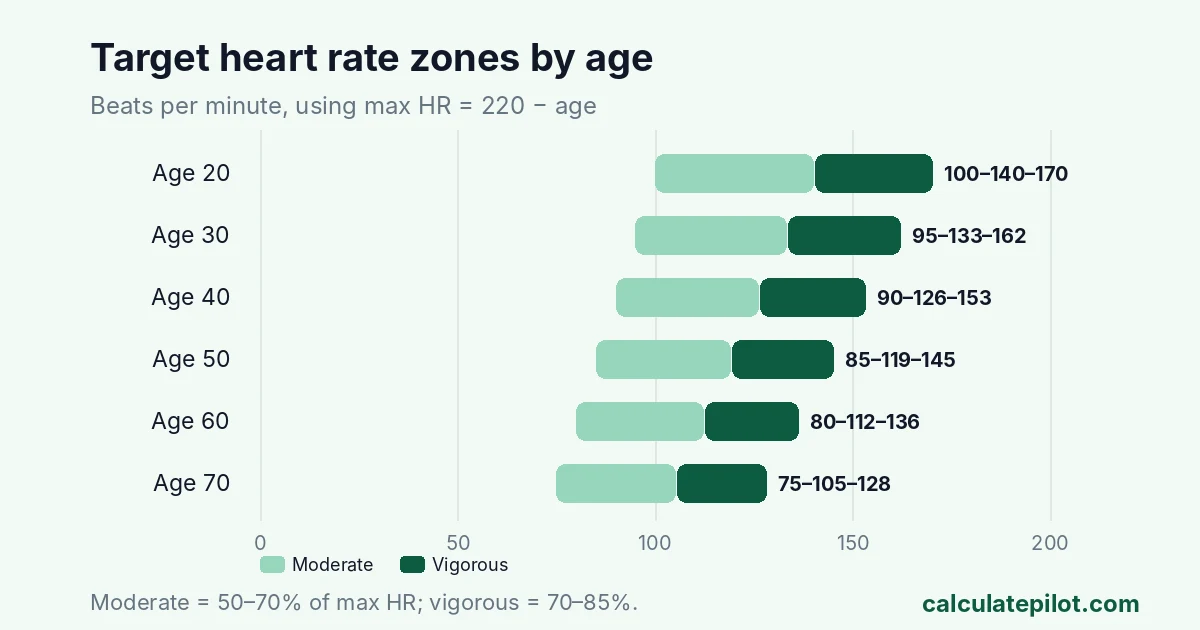
1. Target heart rate chart by age
| Age | Max HR | Moderate (50–70%) | Vigorous (70–85%) |
|---|---|---|---|
| 20 | 200 | 100–140 | 140–170 |
| 30 | 190 | 95–133 | 133–162 |
| 40 | 180 | 90–126 | 126–153 |
| 50 | 170 | 85–119 | 119–145 |
| 60 | 160 | 80–112 | 112–136 |
| 70 | 150 | 75–105 | 105–128 |
2. A more personal method: Karvonen
The Karvonen method uses your heart rate reserve (max minus resting heart rate), so it adjusts for fitness. The American College of Sports Medicine classes 40–59% of reserve as moderate and 60–89% as vigorous.
- 1A 45-year-old with a resting heart rate of 65 and a max of 175.
- 2Reserve = 175 − 65 = 110 bpm.
- 3Moderate zone (40–59%) = 65 + 110 × 0.40 to 0.59 = 109–130 bpm.
- 4Vigorous zone (60–89%) = 131–163 bpm.
3. Is 220 minus age accurate?
It is a population average, so an individual can be 10 or more beats off. The Tanaka (208 − 0.7 × age) and Gellish (207 − 0.7 × age) equations fit large datasets better, especially over 40. For a 45-year-old, Tanaka gives about 176 instead of 175. A supervised test is the only way to know your true maximum.
4. How much exercise do you need?
Adults are advised to get 150–300 minutes of moderate or 75–150 minutes of vigorous activity a week. Moderate sessions build an aerobic base and are easy to repeat. Vigorous sessions give more fitness per minute but are harder to sustain. Most plans mix both. Estimate the calories from a session with the Calories Burned Calculator, and track fitness over time with the VO2 Max Calculator or the Running Pace Calculator.
5. Quick habits
- Use the talk test. If you can talk but not sing, you are probably at a moderate effort.
- Check your resting heart rate on waking, three mornings in a row, and take the average.
- Start with brisk walks. See how many steps burn 100 calories.
6. Frequently asked questions
What is my target heart rate by age?expand_more
Using 220 minus age for maximum heart rate, moderate exercise is about 50 to 70 percent and vigorous exercise about 70 to 85 percent. At 45, moderate is roughly 88 to 123 beats per minute.
How do I calculate maximum heart rate?expand_more
The common estimate is 220 minus your age. The Tanaka formula (208 minus 0.7 times age) fits large datasets better, especially after 40, and a supervised test gives a true value.
What is the Karvonen method?expand_more
It uses heart rate reserve (max minus resting heart rate): target = resting heart rate + reserve x intensity. Because it uses your resting rate, it adjusts for fitness.
What heart rate is best for fat burning?expand_more
Both moderate and vigorous exercise burn fat. What matters most is total weekly activity, so pick an intensity you can repeat consistently.
Do medicines change my target heart rate?expand_more
Yes. Beta-blockers and some other medicines lower heart rate, so these zones can be inaccurate. Ask your doctor what to use if you take heart medication or have a heart condition.
7. Sources
- menu_bookAmerican Heart Association. Target heart rates chart.
- menu_bookAmerican College of Sports Medicine. ACSM's Guidelines for Exercise Testing and Prescription (heart rate reserve intensity classification).
- menu_bookKarvonen MJ, Kentala E, Mustala O. The effects of training on heart rate; a longitudinal study. Ann Med Exp Biol Fenn 1957;35:307–315.
- menu_bookTanaka H, Monahan KD, Seals DR. Age-predicted maximal heart rate revisited. J Am Coll Cardiol 2001;37:153–156.
- menu_bookGellish RL, Goslin BR, Olson RE, et al. Longitudinal modeling of the relationship between age and maximal heart rate. Med Sci Sports Exerc 2007;39:822–829.
This is general information, not medical advice. Check with a healthcare professional before changing your diet, exercise or fluid intake.