Short answer
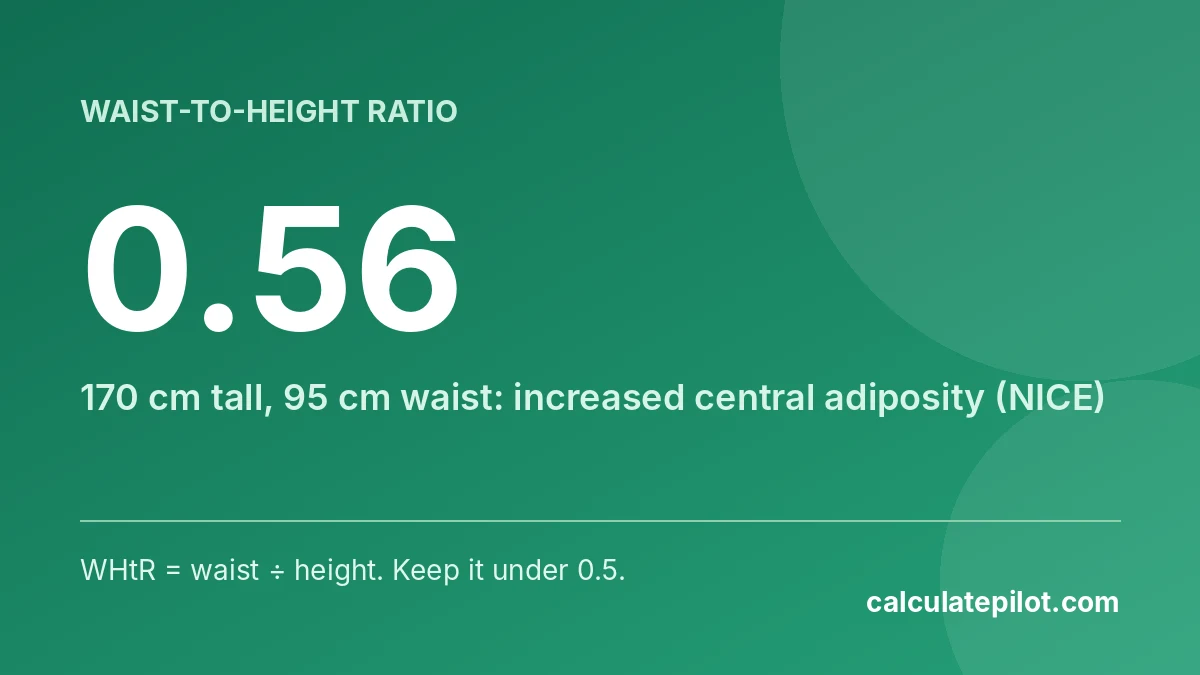
Divide your waist by your height. A ratio under 0.5 (waist less than half your height) is the usual target. Someone 170 cm tall with a 95 cm waist has a ratio of 0.56, which NICE classes as increased central adiposity.
Enter your measurements in the Waist-to-Height Ratio Calculator to see your category instantly.
1. Waist-to-height ratio chart
| Ratio | NICE category |
|---|---|
| 0.4 to 0.49 | Healthy central adiposity, no increased health risks |
| 0.5 to 0.59 | Increased central adiposity, increased health risks |
| 0.6 or more | High central adiposity, further increased health risks |
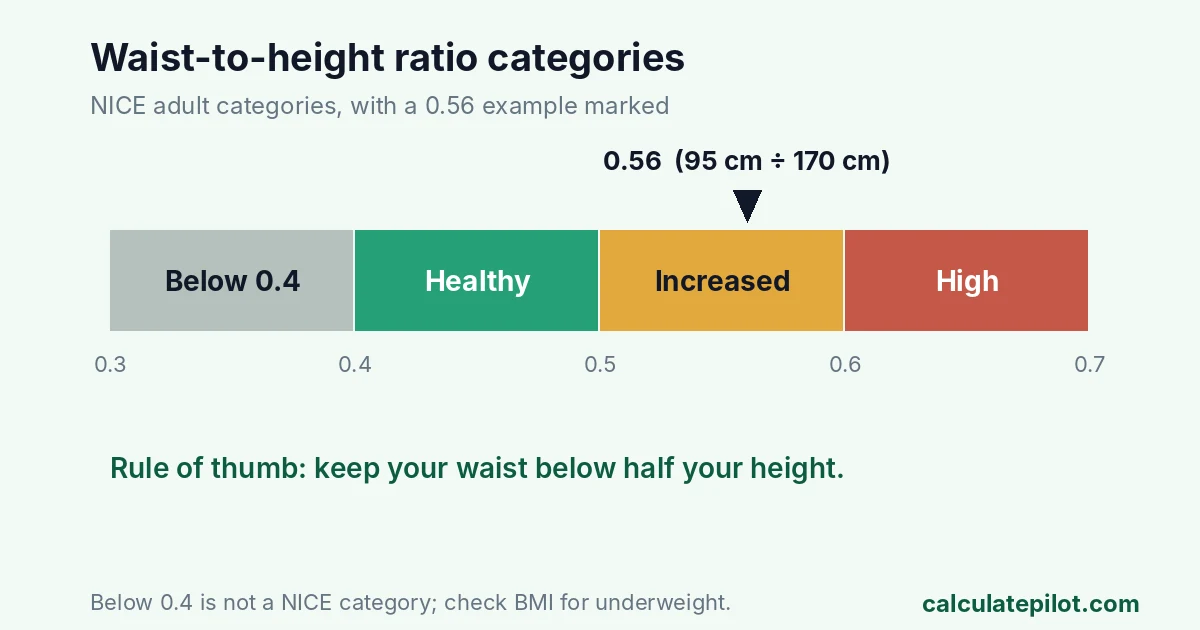
Ratios below 0.4 are not a NICE category. If yours is that low, check your BMI to make sure you are not underweight.
2. Waist size to stay below half your height
| Height | Waist to stay under (ratio 0.5) |
|---|---|
| 150 cm (4'11") | 75 cm (30 in) |
| 160 cm (5'3") | 80 cm (31 in) |
| 170 cm (5'7") | 85 cm (33 in) |
| 180 cm (5'11") | 90 cm (35 in) |
| 190 cm (6'3") | 95 cm (37 in) |
3. Worked example
- 1Someone 170 cm tall with a 95 cm waist.
- 2Ratio = 95 ÷ 170 = 0.56, in the “increased” category.
- 3Half their height is 85 cm, so a waist below 85 cm would bring the ratio under 0.5, a reduction of 10 cm.
4. How to measure your waist correctly
- Stand relaxed and breathe out normally.
- Place the tape at the midpoint between your lowest rib and the top of your hip bone.
- Keep it level and snug without pressing into the skin.
- Measure height without shoes, standing against a wall.
5. How it compares with BMI and waist-to-hip ratio
No single measure tells the whole story. WHtR focuses on fat carried around the middle, BMI looks at overall size, and the Waist-to-Hip Ratio Calculator looks at fat distribution. NICE suggests using WHtR alongside BMI. See our BMI guide and the Body Fat Calculator for more on body composition. This is a screening tool, not a diagnosis.
6. Quick habits to reduce your waist
- Walk after meals. Ten minutes helps, and see how many steps burn 100 calories.
- Set a modest calorie deficit. Your TDEE is the starting point.
- Do strength training twice a week to protect muscle while fat falls.
- Sleep seven or more hours and cut back on alcohol.
7. Frequently asked questions
What is a healthy waist-to-height ratio?expand_more
NICE classes 0.4 to 0.49 as healthy central adiposity, 0.5 to 0.59 as increased, and 0.6 or more as high. The simple rule is to keep your waist below half your height.
How do I calculate waist-to-height ratio?expand_more
Divide your waist circumference by your height, both in the same unit. A 95 cm waist at 170 cm tall gives 0.56.
Is waist-to-height ratio better than BMI?expand_more
A 2012 systematic review found it a better screening tool for cardiometabolic risk than BMI or waist circumference alone, but the two measures are best used together.
Does the same ratio apply to men and women?expand_more
Yes. NICE recommends the same categories for adults of both sexes and all ethnicities, for adults with a BMI under 35, including those with high muscle mass.
How do I reduce my waist size?expand_more
There is no way to burn fat from one spot, but a steady calorie deficit, regular walking and strength training reduce overall fat, including around the middle.
8. Sources
- menu_bookNational Institute for Health and Care Excellence. Overweight and obesity management (NG246): waist-to-height ratio recommendations.
- menu_bookAshwell M, Gunn P, Gibson S. Waist-to-height ratio is a better screening tool than waist circumference and BMI for adult cardiometabolic risk factors: systematic review and meta-analysis. Obes Rev 2012;13:275–286.
- menu_bookWorld Health Organization. Waist circumference and waist–hip ratio: report of a WHO expert consultation. Geneva, 2008.
This is general information, not medical advice. Check with a healthcare professional before changing your diet, exercise or fluid intake.