Short answer
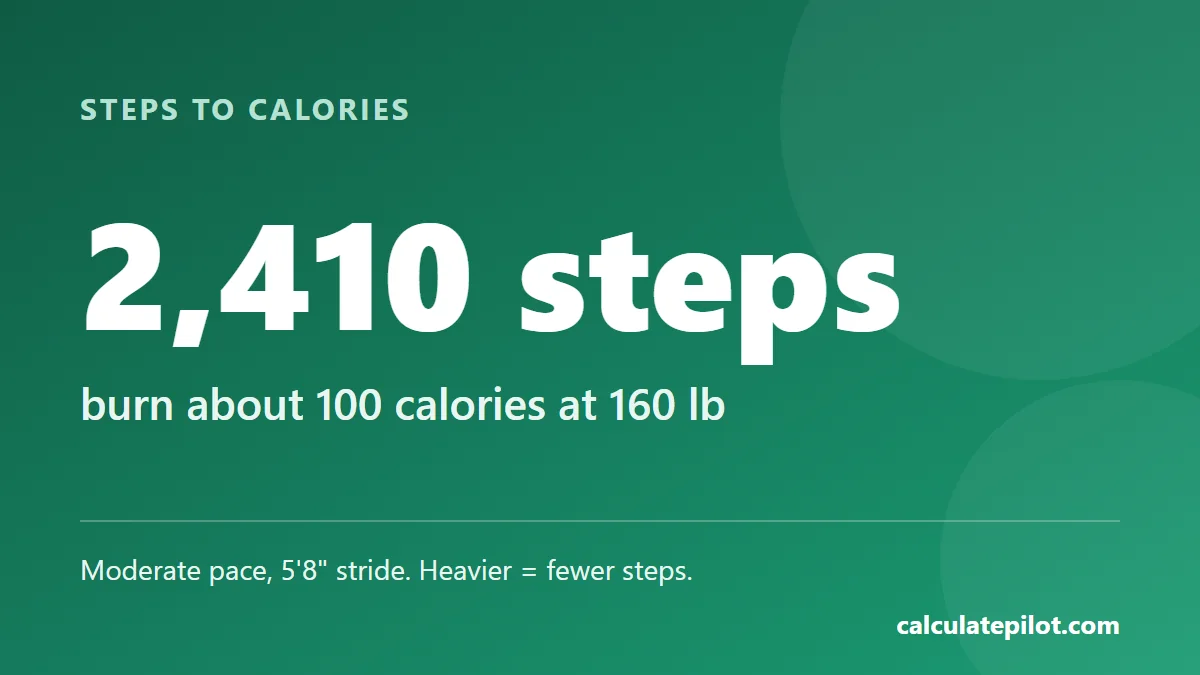
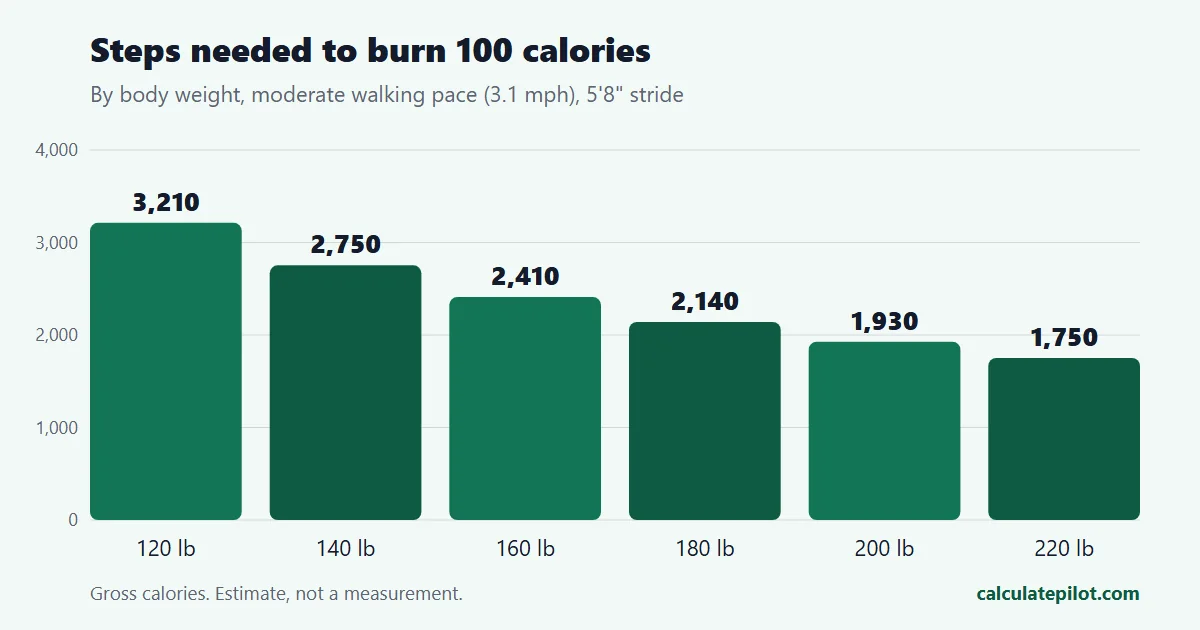
A 160 lb adult walking at a moderate pace burns about 100 calories in roughly 2,410 steps. A lighter walker (120 lb) needs about 3,210 steps and a heavier one (220 lb) about 1,750. The number depends mostly on your body weight, then your pace and stride length.
The calculator behind this guide uses that formula, with walking MET values from the 2024 Adult Compendium of Physical Activities. It turns steps into distance with your stride length, distance into minutes with your pace, and minutes into calories.
1. Steps to burn 100 calories, by body weight
These figures assume a 5′8″ walker (stride about 28.2 inches, so roughly 2,250 steps per mile) at a moderate 3.1 mph pace.
| Body weight | Calories per 1,000 steps | Steps for 100 calories | Calories per 10,000 steps |
|---|---|---|---|
| 120 lb (54 kg) | 31 | 3,213 | 311 |
| 140 lb (64 kg) | 36 | 2,754 | 363 |
| 160 lb (73 kg) | 42 | 2,409 | 415 |
| 180 lb (82 kg) | 47 | 2,142 | 467 |
| 200 lb (91 kg) | 52 | 1,928 | 519 |
| 220 lb (100 kg) | 57 | 1,752 | 571 |
Weight matters because moving more mass takes more energy. A 220 lb walker burns roughly 1.8 times the calories of a 120 lb walker over the same 1,000 steps.
2. How pace changes the answer
Faster walking has a higher MET value, so each minute burns more. Because a faster pace covers the same steps in less time, the gain per step is smaller than the gain per minute. The table shows a 160 lb walker with the same stride.
| Walking pace | MET | Calories per 1,000 steps | Steps for 100 calories |
|---|---|---|---|
| Slow stroll (2.5 mph) | 3.0 | 41 | 2,461 |
| Moderate (3.1 mph) | 3.8 | 42 | 2,409 |
| Brisk (3.7 mph) | 4.8 | 44 | 2,277 |
| Fast (4.2 mph) | 5.5 | 44 | 2,255 |
3. Worked example
A 160 lb (72.6 kg), 5′8″ walker takes 1,000 steps at 3.1 mph.
- 1Stride = 68 in × 0.414 = 28.2 in, so 1,000 steps = 28,150 in ≈ 0.444 mile.
- 2Time = 0.444 mile ÷ 3.1 mph × 60 ≈ 8.6 minutes.
- 3Calories = 3.8 × 3.5 × 72.6 ÷ 200 × 8.6 ≈ 42.
- 4Steps for 100 calories = 1,000 × 100 ÷ 42 ≈ 2,410.
4. Gross vs. net calories
The figures above are gross calories, which include what your body burns at rest anyway. Net calories subtract one MET for resting burn. For the 160 lb walker at a moderate pace the net figure is about 31 per 1,000 steps, so 100 net calories takes about 3,270 steps. Use net calories if you are trying to measure the extra energy a walk adds.
5. How to measure your own stride
The calculator estimates stride as 41.4% of your height. For a better figure, walk 10 normal steps on a flat surface, measure the distance, and divide by 10. A shorter stride means more steps per mile, so more steps for the same distance but the same calories per mile.
6. Common mistakes
- Using one number for everyone. A flat calories-per-step figure ignores weight, stride and speed.
- Counting gross calories as a deficit. Part of the burn would have happened anyway.
- Treating a wearable's total as exact. Wrist devices estimate steps and calories, and errors vary by device and wrist movement.
- Eating the walk back. About 440 calories from 10,000 steps is roughly one snack-sized treat.
To enter your own weight, height and pace, use the Steps to Calories Calculator. To estimate calories for other activities, try the Calories Burned Calculator, or set a daily target with the Calorie Calculator.
7. Frequently asked questions
How many steps burn 100 calories?expand_more
For a 160 lb adult walking at a moderate pace, about 2,410 steps. It ranges from about 1,750 steps at 220 lb to about 3,210 at 120 lb.
How many calories is 10,000 steps?expand_more
Roughly 311 to 571 gross calories for adults between 120 and 220 lb at a moderate pace, about 415 for a 160 lb adult.
Do I burn more calories per step if I walk faster?expand_more
Slightly. Faster walking has a higher MET, but you also finish the steps sooner, so the gain per step is small. The gain per minute is larger.
Are gross or net calories more useful?expand_more
Net calories show the extra energy from walking, because they remove the calories you would have burned at rest. Gross calories include that resting burn.
8. Sources
- menu_book2024 Adult Compendium of Physical Activities — Walking (Herrmann SD et al. J Sport Health Sci 2024;13:6–12)
- menu_bookAmerican College of Sports Medicine. ACSM's Guidelines for Exercise Testing and Prescription (MET energy equation)
This is an educational estimate, not medical advice. Actual calorie burn varies by person.