Short answer
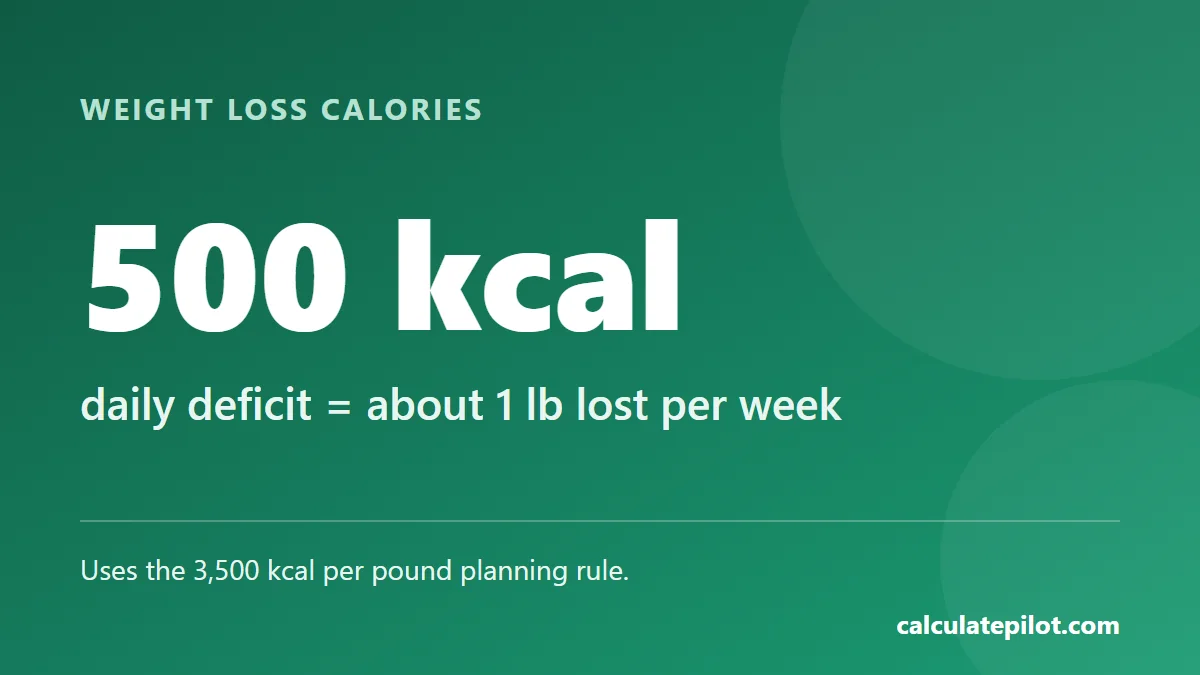
To lose about 1 pound a week, eat about 500 calories a day below your maintenance level (your TDEE). If you maintain your weight at 2,200 calories, that means about 1,700 a day. The rule behind it is that a pound of body weight is roughly 3,500 calories.
1. Daily calories by maintenance level and weekly loss
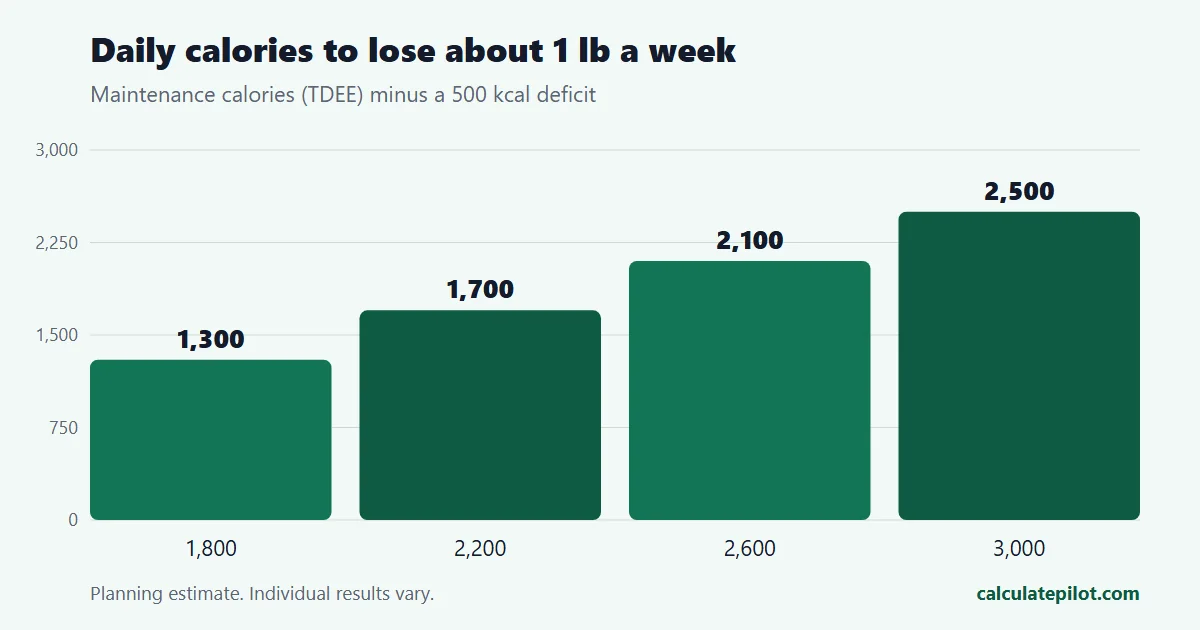
| Your maintenance (TDEE) | 0.5 lb / week | 1 lb / week | 1.5 lb / week | 2 lb / week |
|---|---|---|---|---|
| 1,800 kcal | 1,550 | 1,300 | 1,050 * | 800 * |
| 2,200 kcal | 1,950 | 1,700 | 1,450 | 1,200 |
| 2,600 kcal | 2,350 | 2,100 | 1,850 | 1,600 |
| 3,000 kcal | 2,750 | 2,500 | 2,250 | 2,000 |
* Below 1,200 calories a day. Guidelines generally advise against intakes this low without medical supervision; the AHA/ACC/TOS guideline suggests roughly 1,200–1,500 kcal a day for women and 1,500–1,800 for men on a weight-loss plan.
2. Worked example
- 1Your maintenance is 2,200 calories (find yours with the TDEE Calculator).
- 2For 1 lb a week, the deficit is 1 × 3,500 ÷ 7 = 500 calories.
- 3Daily target = 2,200 − 500 = 1,700 calories.
- 4Losing 20 pounds at 1 lb a week takes about 20 weeks.
3. Why the real timeline is often longer
The 3,500-calorie rule is a useful planning tool, but it overestimates long-term loss. As you get lighter, your maintenance calories fall, so a fixed intake creates a smaller deficit over time. Research by Hall and colleagues at the NIH shows weight loss slows for this reason. Recalculate your TDEE every few weeks as your weight changes.
4. How fast is too fast?
The CDC notes that people who lose weight gradually and steadily, about 1 to 2 pounds a week, are more likely to keep it off. Faster plans mean bigger deficits, which can be hard to sustain and may leave you short on nutrients.
5. Common mistakes
- Guessing maintenance calories. Start from an estimate of your own TDEE, not a generic 2,000.
- Setting the deficit too large. A very low target is hard to sustain and may be unsafe.
- Not adjusting over time. Maintenance falls as you lose weight.
- Counting exercise calories twice. If your TDEE already includes activity, don't add it back.
Plan your own deficit with the Weight Loss Calorie Calculator, or get a week-by-week projection with the Calorie Calculator. You can also check your BMR and see how many steps burn 100 calories.
6. Frequently asked questions
How many calories should I cut to lose 1 pound a week?expand_more
About 500 calories a day below your maintenance level, based on the 3,500 calories-per-pound planning rule.
How many calories should I eat to lose weight?expand_more
Subtract your target deficit from your TDEE. With a 2,200 calorie maintenance and a 500 calorie deficit, that is about 1,700 calories.
Is the 3,500 calorie rule accurate?expand_more
It is a useful approximation but overestimates long-term loss, because your maintenance calories fall as you lose weight.
What is the safest rate of weight loss?expand_more
The CDC notes that about 1 to 2 pounds a week is a gradual, steady rate linked with keeping weight off. Talk to a healthcare professional before starting a diet.
7. Sources
- menu_bookJensen MD, Ryan DH, Apovian CM, et al. 2013 AHA/ACC/TOS guideline for the management of overweight and obesity in adults. Circulation 2014;129(25 Suppl 2):S102–S138.
- menu_bookHall KD, Sacks G, Chandramohan D, et al. Quantification of the effect of energy imbalance on bodyweight. Lancet 2011;378:826–837.
- menu_bookCenters for Disease Control and Prevention — Losing weight
This is general information, not medical advice. Check with a healthcare professional before changing your diet.