Short answer
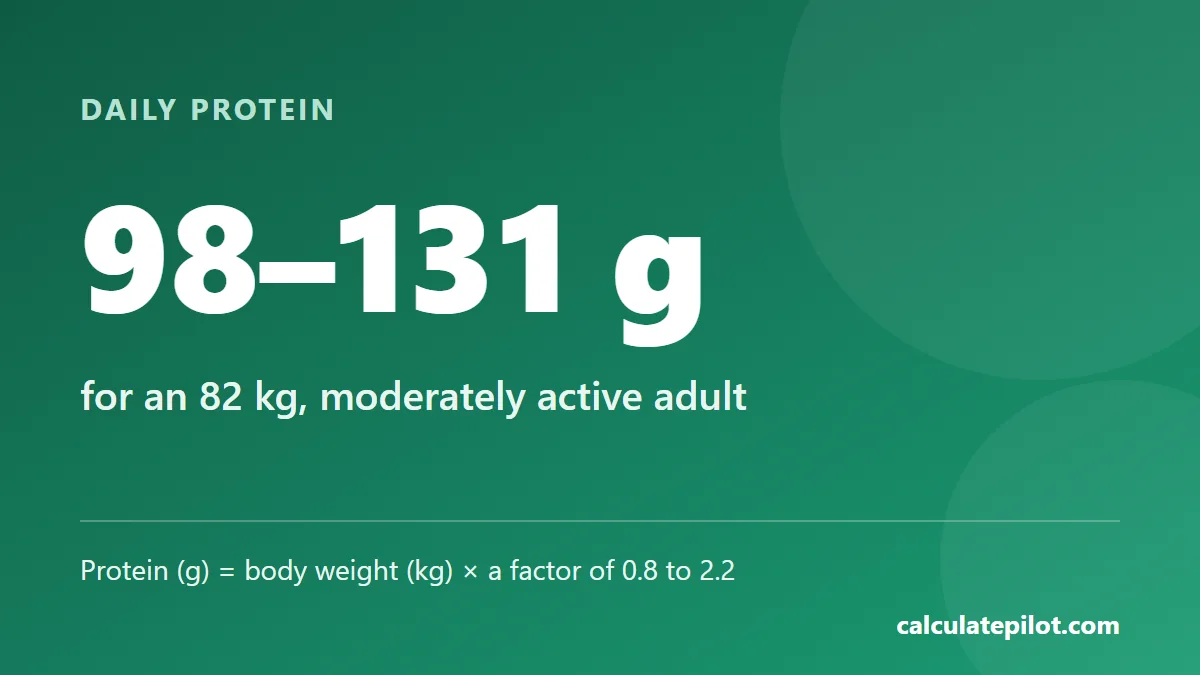
Multiply your body weight in kilograms by a factor that depends on your activity. For a moderately active adult the range is 1.2 to 1.6 grams per kilogram a day, so an 82 kg person needs roughly 98–131 g. The 0.8 g/kg RDA is the minimum to prevent deficiency, not a target.
To convert pounds to kilograms, divide by 2.2046.
1. Daily protein by body weight and activity
| Body weight | Sedentary (0.8–1.0 g/kg) | Moderately active (1.2–1.6) | Athlete (1.6–2.2) |
|---|---|---|---|
| 60 kg (132 lb) | 48–60 g | 72–96 g | 96–132 g |
| 70 kg (154 lb) | 56–70 g | 84–112 g | 112–154 g |
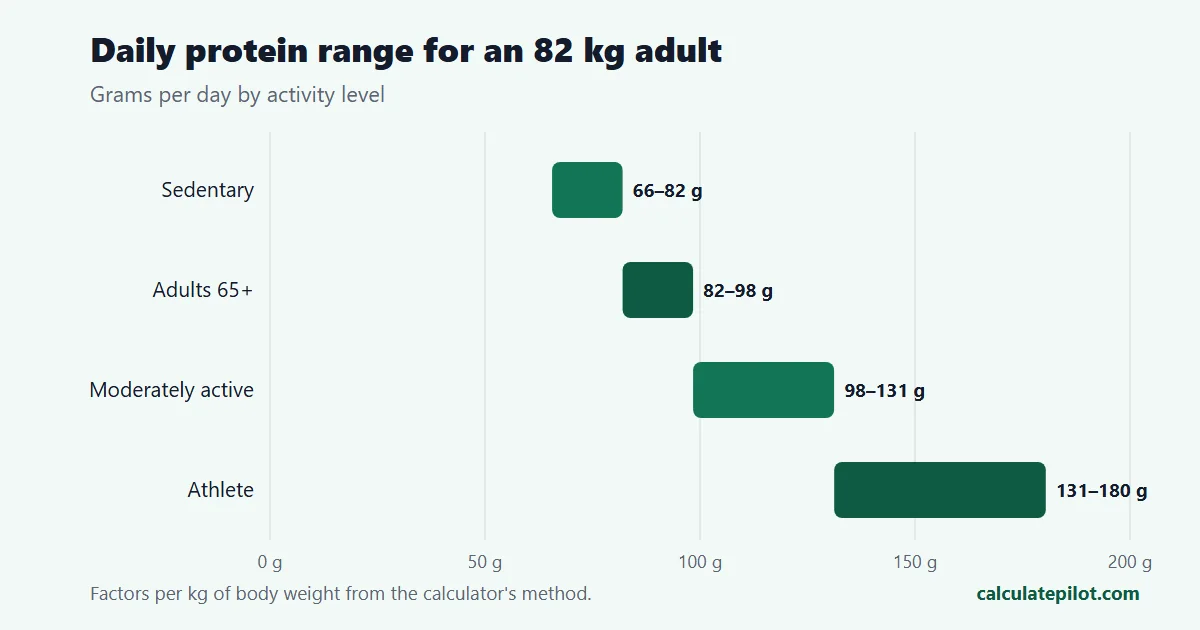
| 82 kg (181 lb) | 66–82 g | 98–131 g | 131–180 g |
| 95 kg (209 lb) | 76–95 g | 114–152 g | 152–209 g |
2. Worked example
- 1An 82 kg, moderately active person: 82 × 1.2 = 98 g to 82 × 1.6 = 131 g a day.
- 2The same person training seriously: 82 × 1.6 = 131 g to 82 × 2.2 = 180 g a day.
- 3That is nearly 50 g more at the top of the range.
For comparison, the calculator cites the Dietary Guidelines for Americans 2025–2030, which set a general protein goal of 1.2–1.6 g per kg a day, above the 0.8 g/kg RDA.
3. How to spread protein across the day
Many guidelines suggest spreading intake over three or four meals with about 20–40 g each, roughly 0.4 g per kg of body weight per meal (33 g for an 82 kg person), rather than eating it all in one meal. Needs also tend to rise during calorie restriction to help preserve muscle, which is why the upper end of a range is often recommended while dieting.
4. Protein quality
Complete proteins contain all the essential amino acids. They are found in most animal products and soy, and in some plant combinations such as rice and beans. They are generally considered more effective for maintaining muscle than incomplete sources alone.
5. Common mistakes
- Using pounds as if they were kilograms. Divide pounds by 2.2046 first.
- Treating the RDA as a goal. 0.8 g/kg is a minimum to prevent deficiency.
- Ignoring health conditions. People with kidney disease should follow their care team's advice on protein.
Enter your own weight and activity level in the Protein Calculator. Combine it with your calorie target from the Calorie Calculator, the Macro Calculator and the calories-to-lose-a-pound guide.
6. Frequently asked questions
How much protein do I need per day?expand_more
It depends on weight and activity: about 0.8–1.0 g/kg if sedentary, 1.2–1.6 g/kg if moderately active and 1.6–2.2 g/kg for athletes.
How much protein does an 82 kg person need?expand_more
Roughly 98–131 g a day if moderately active, or 131–180 g a day when training as an athlete.
Is the RDA the right target?expand_more
The 0.8 g/kg RDA is the minimum to prevent deficiency rather than a target. Many guidelines suggest more for active people.
How should I split protein across meals?expand_more
Many guidelines suggest three or four meals with roughly 20–40 g each, about 0.4 g per kg of body weight per meal.
7. Sources
- menu_bookDietary Guidelines for Americans, 2025–2030 (protein goal cited by the CalculatePilot protein calculator)
- menu_bookRecommended Dietary Allowance for protein: 0.8 g per kg of body weight
This is medical information, not medical advice. People with kidney disease or other conditions should follow their care team's guidance.