Short answer
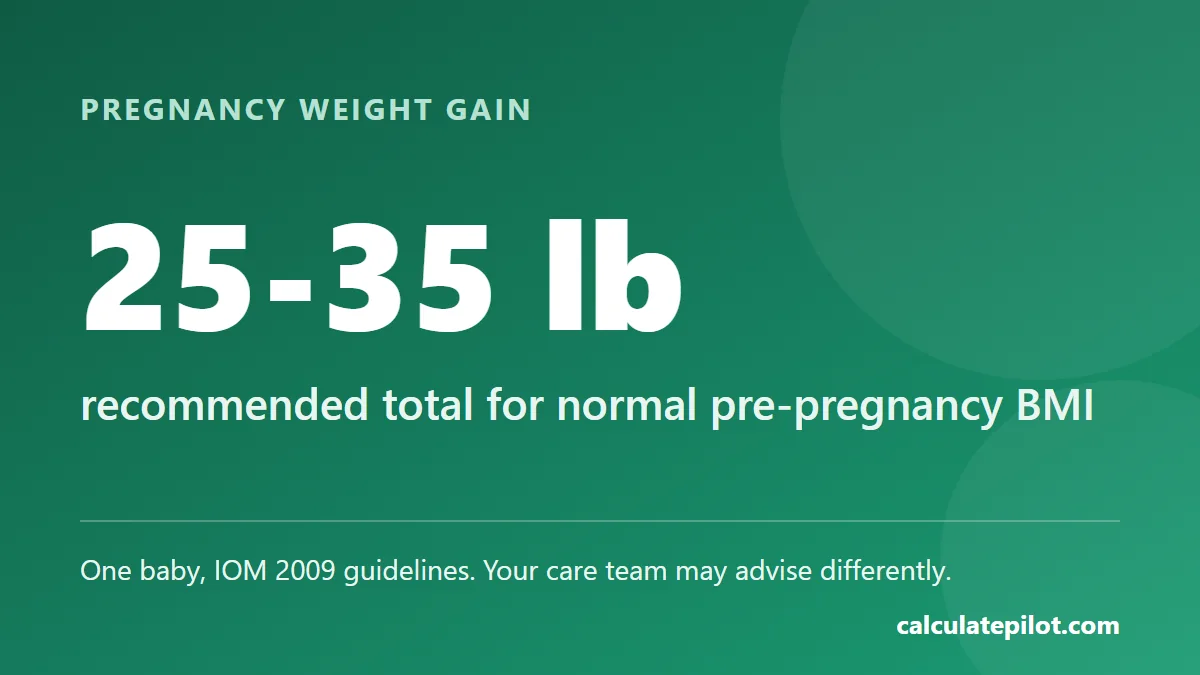
The amount to gain depends on your pre-pregnancy BMI. For a normal-weight person with one baby, the Institute of Medicine (IOM) recommends 25–35 lb in total, with about 1.1–4.4 lb in the first trimester and roughly 0.8–1 lb a week after that. At 20 weeks, that works out to about 7–12 lb gained so far.
1. Recommended total gain by pre-pregnancy BMI (one baby)
| Pre-pregnancy BMI | Total gain | Weekly gain (2nd–3rd trimester) |
|---|---|---|
| Underweight (under 18.5) | 28–40 lb (12.5–18 kg) | 1–1.3 lb (0.44–0.58 kg) |
| Normal (18.5–24.9) | 25–35 lb (11.5–16 kg) | 0.8–1 lb (0.35–0.50 kg) |
| Overweight (25–29.9) | 15–25 lb (7–11.5 kg) | 0.5–0.7 lb (0.23–0.33 kg) |
| Obese (30 or more) | 11–20 lb (5–9 kg) | 0.4–0.6 lb (0.17–0.27 kg) |
Find your BMI before pregnancy with weight (kg) ÷ height (m)², or use the BMI Calculator.
2. Estimated gain so far, by week
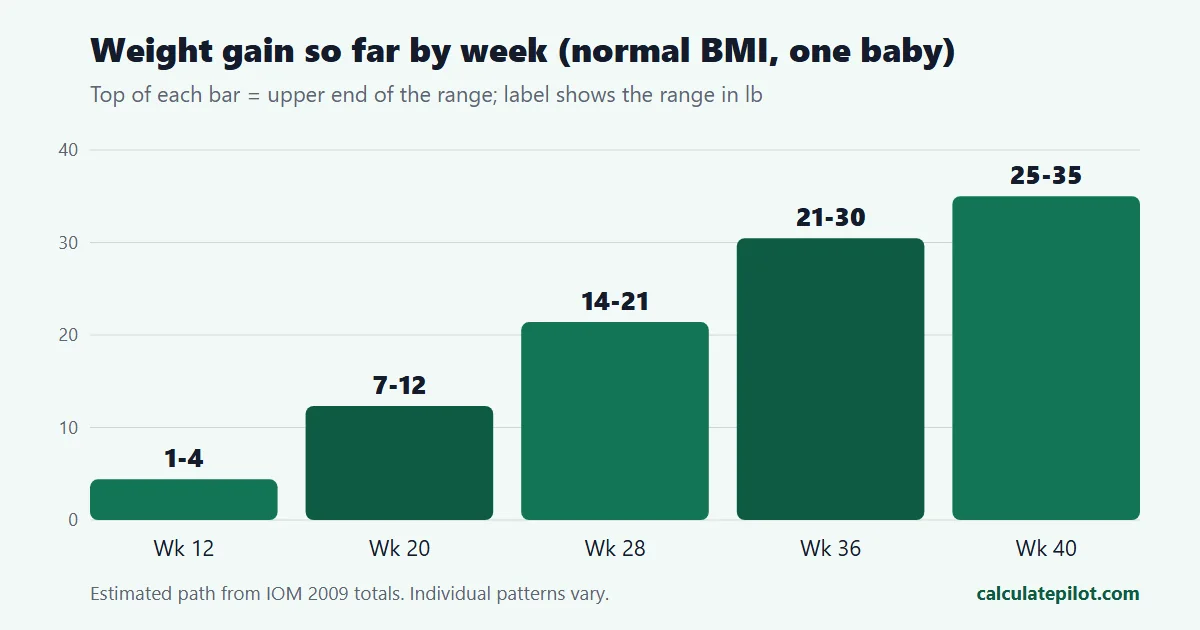
This table assumes about 1.1–4.4 lb in the first trimester, then a steady rise to the total range at week 40. It is the same path the calculator uses.
| Pre-pregnancy BMI | Week 12 | Week 20 | Week 28 | Week 36 | Week 40 |
|---|---|---|---|---|---|
| Underweight (BMI under 18.5) | 1–4 lb | 8–14 lb | 16–24 lb | 24–35 lb | 28–40 lb |
| Normal weight (BMI 18.5–24.9) | 1–4 lb | 7–12 lb | 14–21 lb | 21–30 lb | 25–35 lb |
| Overweight (BMI 25–29.9) | 1–4 lb | 5–10 lb | 9–16 lb | 13–22 lb | 15–25 lb |
| Obese (BMI 30 or more) | 1–4 lb | 4–8 lb | 7–13 lb | 10–18 lb | 11–20 lb |
Real pregnancies are uneven. A big jump one week and a plateau the next is common, so look at the trend over several weeks.
3. Example
At 5′5″ (1.651 m) and 140 lb (63.5 kg) before pregnancy, BMI = 63.5 ÷ 1.651² = 23.3, which is the normal range. The recommended total is 25–35 lb, so a final weight of about 165–175 lb. At week 28 the path suggests roughly 14–21 lb gained.
4. Twins
The IOM gives provisional ranges for twins: 37–54 lb for normal weight, 31–50 lb for overweight and 25–42 lb for obese. It did not set a range for underweight twin pregnancies because evidence was limited.
5. Common mistakes
- Using today's weight to find your range. The ranges depend on pre-pregnancy BMI.
- Applying the single-baby range to twins.
- Focusing on one week's number. Weigh under the same conditions and watch the trend.
- Dieting to stay under the range. The ranges are targets for a healthy pregnancy, not a cap to push below.
6. When to talk to your care team
Call your midwife or doctor if you are gaining well above or below the range for several weeks, or losing weight. Seek prompt advice if sudden weight gain comes with swelling in the face or hands, a severe headache or vision changes, which can be signs of high blood pressure conditions such as preeclampsia.
Enter your own height and weight in the Pregnancy Weight Gain Calculator. To estimate calorie needs by trimester, use the Pregnancy Calorie Needs Calculator, and to estimate your due date use the Due Date Calculator.
7. Frequently asked questions
How much weight should I gain in the first trimester?expand_more
The IOM report assumes about 1.1–4.4 lb (0.5–2 kg). Most of the gain comes in the second and third trimesters.
How much weight should I gain each week?expand_more
After the first trimester, about 0.8–1 lb a week for normal pre-pregnancy BMI, 1–1.3 lb for underweight, 0.5–0.7 lb for overweight and 0.4–0.6 lb for obese.
What if I'm gaining more or less than the range?expand_more
Weight gain varies week to week. If you are consistently above or below the range, talk to your care team.
Are these recommendations the same for twins?expand_more
No. The IOM twin ranges are higher and provisional, and no range was set for underweight twin pregnancies.
8. Sources
- menu_bookInstitute of Medicine. Weight Gain During Pregnancy: Reexamining the Guidelines. National Academies Press, 2009.
- menu_bookACOG Committee Opinion No. 548 — Weight Gain During Pregnancy (2013, reaffirmed)
This is information, not medical advice. Your care team may set a different target for you.