Short answer
Add 280 days (40 weeks) to the first day of your last menstrual period (LMP). This is Naegele's rule. A last period that started on 1 March 2026 gives a due date of 6 December 2026. Only a small share of babies arrive on the exact day, so treat it as an estimate.
1. Due dates for different last-period dates
For a regular 28-day cycle.
| First day of last period | Estimated due date |
|---|---|
| 1 January 2026 | 8 October 2026 |
| 1 March 2026 | 6 December 2026 |
| 15 May 2026 | 19 February 2027 |
| 20 August 2026 | 27 May 2027 |
2. If your cycle isn't 28 days
Ovulation shifts with cycle length, so adjust by the difference from 28 days. A 30-day cycle adds 2 days; a 32-day cycle adds 4. With a last period starting 1 March 2026 and a 32-day cycle, the estimate moves from 6 December 2026 to 10 December 2026.
3. Dating from conception or IVF
- Conception date: add 266 days (38 weeks).
- IVF transfer: add 266 days and subtract the embryo's age: 263 days for a day-3 transfer, 261 for day 5, 260 for day 6. A day-5 transfer on 15 March 2026 gives 1 December 2026.
Gestational age is counted from the first day of your last period, so at conception you are already about two weeks pregnant.
4. Trimesters and term definitions
| Stage | Gestational age |
|---|---|
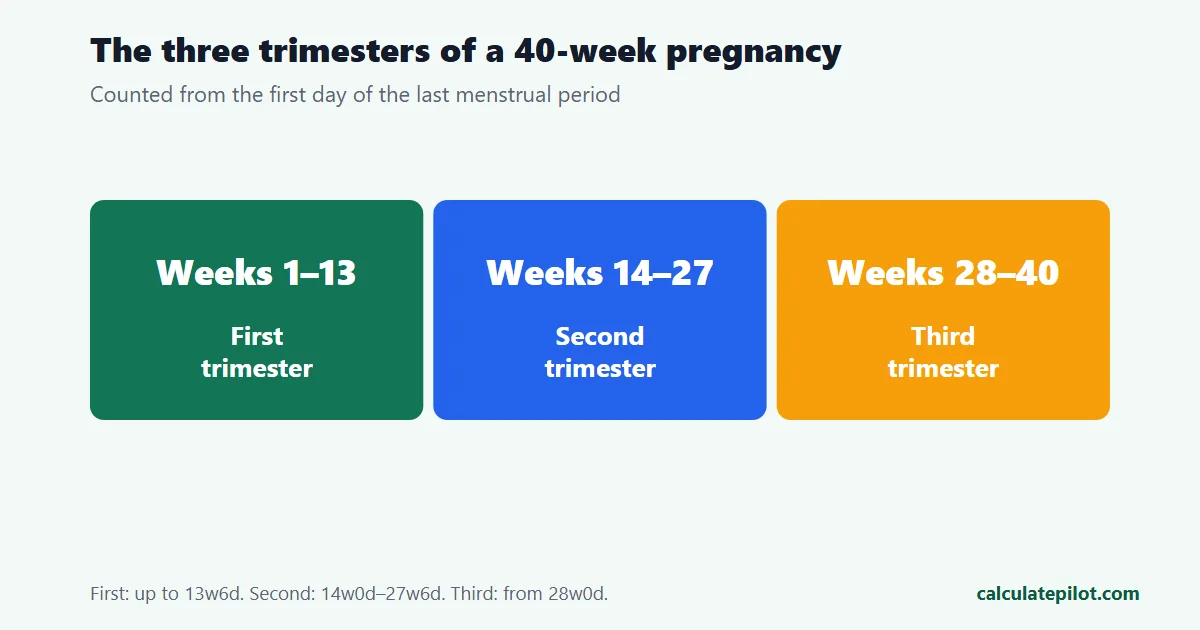
| First trimester | Up to 13 weeks 6 days |
| Second trimester | 14 weeks 0 days to 27 weeks 6 days |
| Third trimester | From 28 weeks |
| Early term | 37w0d to 38w6d |
| Full term | 39w0d to 40w6d |
| Late term | 41w0d to 41w6d |
| Post-term | 42w0d and later |
5. How accurate is a due date?
Relatively few babies arrive exactly on their due date; most are born within a couple of weeks either side. The American College of Obstetricians and Gynecologists (ACOG) considers a first-trimester ultrasound the most accurate way to date a pregnancy, and a provider may change your due date if the scan and your LMP date differ by more than a set number of days. IVF dates are the most precise because the embryo's age is known.
6. Common mistakes
- Counting from conception instead of your last period. The 280-day rule starts at the first day of the LMP.
- Ignoring cycle length. A longer or shorter cycle moves the estimate.
- Treating the date as exact. It is a midpoint of a range, and your care team confirms your dates.
Get your own date from the Due Date Calculator, which also lists prenatal milestones. See the pregnancy weight gain by week guide and the Pregnancy Calorie Needs Calculator.
7. Frequently asked questions
How do you calculate a due date?expand_more
Add 280 days (40 weeks) to the first day of your last menstrual period. For a 28-day cycle, that is Naegele's rule.
How do you calculate a due date from conception?expand_more
Add 266 days (38 weeks) to the conception date.
How accurate is a due date?expand_more
It is an estimate. Most babies are born within a couple of weeks of it, and a first-trimester ultrasound is considered the most accurate way to date a pregnancy.
Does cycle length change the due date?expand_more
Yes. Adjust by the difference from a 28-day cycle, for example +2 days for a 30-day cycle.
8. Sources
- menu_bookACOG Committee Opinion No. 700 — Methods for Estimating the Due Date (2017)
- menu_bookACOG Committee Opinion No. 579 — Definition of Term Pregnancy (2013)
This is information, not medical advice. Your care team confirms your dates and schedule.