Short answer
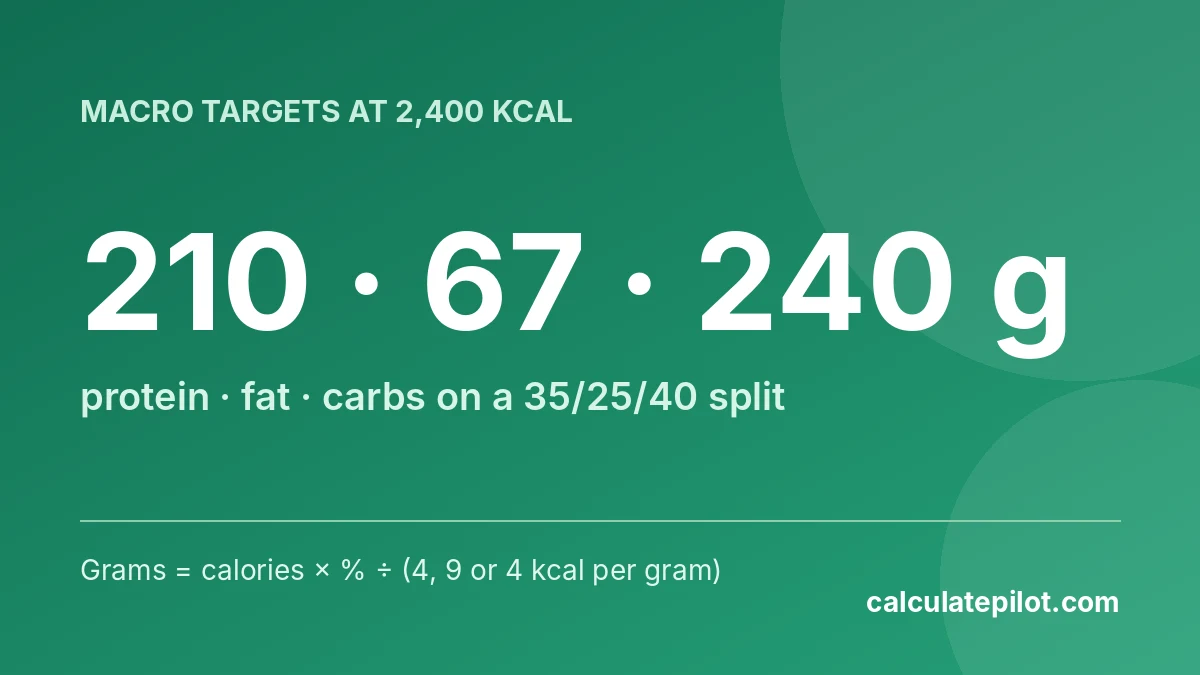
A higher-protein split such as 35% protein, 25% fat and 40% carbohydrate is a common fat-loss starting point. At 2,400 calories that is about 210 g protein, 67 g fat and 240 g carbs. Calories decide whether you lose weight; the split helps with hunger and keeping muscle.
Pick a split and your calorie target in the Macro Calculator and it converts it into grams for you.
1. Macro splits compared at 2,400 calories
| Split (P/F/C) | Protein | Fat | Carbs | Notes |
|---|---|---|---|---|
| 30/30/40 | 180 g | 80 g | 240 g | Balanced general default |
| 35/25/40 | 210 g | 67 g | 240 g | Higher protein for fat loss |
| 40/30/30 | 240 g | 80 g | 180 g | Very high protein, lower carb |
| 25/30/45 | 150 g | 80 g | 270 g | Carb-focused, within AMDR |
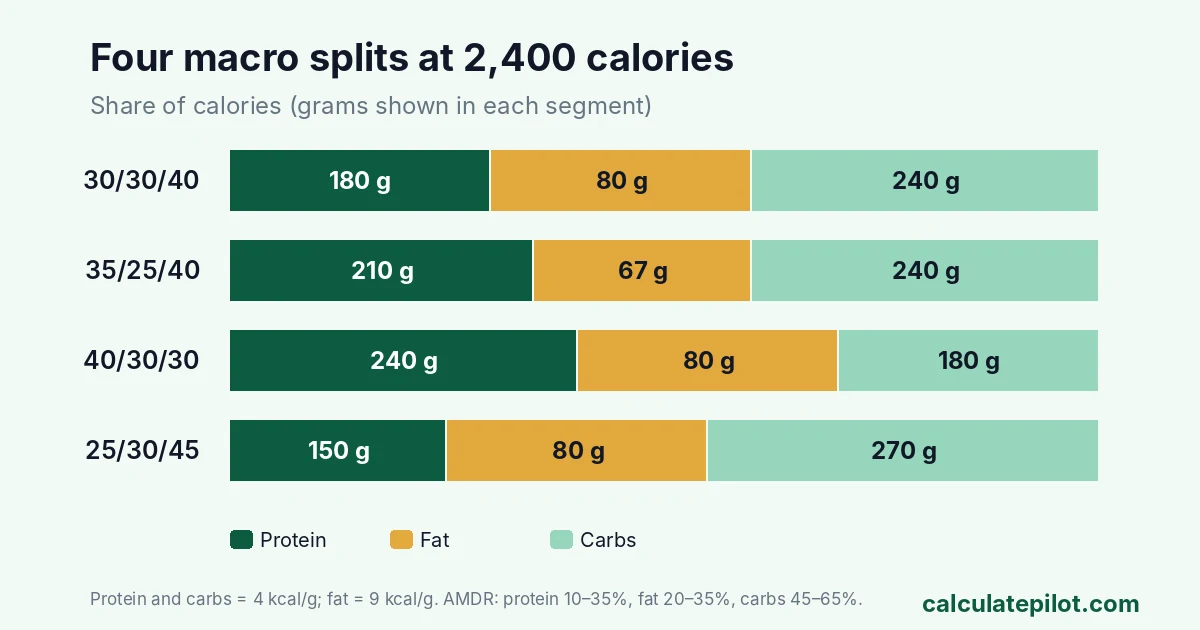
Note that 40% carbohydrate is just below the 45% lower end of the adult AMDR, and ketogenic splits fall outside general population guidance.
2. The AMDR guard rails
The Institute of Medicine's Acceptable Macronutrient Distribution Ranges, also used by the Dietary Guidelines for Americans, give adults these ranges:
- Protein: 10–35% of calories.
- Fat: 20–35% of calories.
- Carbohydrate: 45–65% of calories.
3. How to set your macros in three steps
- 1Get your calories. Start with your maintenance from the TDEE Calculator, then subtract a modest deficit with the Weight Loss Calorie Calculator. Our guide on how many calories to eat to lose 1 pound a week explains the limits of the 500-calorie rule.
- 2Set protein in grams. The International Society of Sports Nutrition suggests about 1.4–2.0 g per kg a day for people who exercise regularly; the general RDA is 0.8 g per kg. See how much protein you need per day and the Protein Calculator.
- 3Split the rest between fat and carbs by preference and how you feel.
4. Quick habits that make macros easy
- Build each meal around a protein. Eggs, yogurt, chicken, fish, beans or tofu.
- Weigh or measure for two weeks to learn portions, then eyeball.
- Prep protein in batches on one day a week.
- Do not fear carbs. They fuel training and help you stick to the plan.
5. Frequently asked questions
What is the best macro split for fat loss?expand_more
There is no single best split. A higher-protein split such as 35/25/40 (protein/fat/carbs) is common because it helps preserve muscle, but total calories matter most.
How many calories are in each macronutrient?expand_more
Protein and carbohydrate provide 4 calories per gram and fat provides 9 calories per gram.
What are the AMDR ranges?expand_more
The Acceptable Macronutrient Distribution Ranges for adults are protein 10 to 35 percent, fat 20 to 35 percent and carbohydrate 45 to 65 percent of calories.
Should I set protein as a percentage or in grams?expand_more
Grams per kilogram of body weight is usually better, because protein needs do not scale with total calories. The ISSN suggests about 1.4 to 2.0 g per kg for people who exercise regularly.
Do I have to count macros to lose weight?expand_more
No. Calories drive weight change. Macros help with fullness and muscle retention, and tracking them for a few weeks can teach portion sizes.
6. Sources
- menu_bookInstitute of Medicine. Dietary Reference Intakes for Energy, Carbohydrate, Fiber, Fat, Fatty Acids, Cholesterol, Protein, and Amino Acids. National Academies Press, 2005 (AMDR).
- menu_bookJäger R, et al. International Society of Sports Nutrition position stand: protein and exercise. J Int Soc Sports Nutr 2017;14:20.
- menu_bookU.S. Department of Agriculture and U.S. Department of Health and Human Services. Dietary Guidelines for Americans.
This is general information, not medical advice. Check with a healthcare professional before changing your diet, exercise or fluid intake.