Short answer
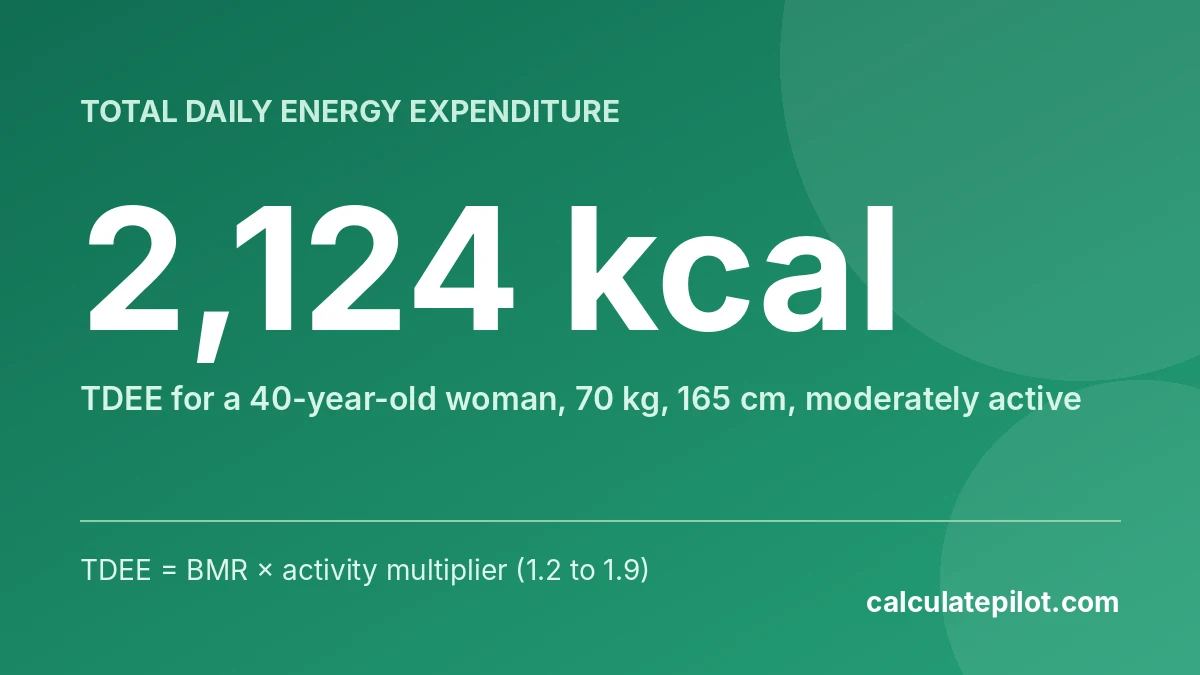
To calculate your TDEE, work out your resting calories (BMR) with the Mifflin-St Jeor equation, then multiply by an activity factor from 1.2 to 1.9. A 40-year-old woman, 70 kg and 165 cm, who exercises 3 to 5 days a week has a BMR of about 1,370 and a TDEE of about 2,124 calories a day.
BMR (women) = 10 × kg + 6.25 × cm − 5 × age − 161
Prefer not to do the math by hand? The TDEE Calculator runs these steps for you in seconds and shows your result for every activity level.
1. What TDEE is made of
TDEE stands for total daily energy expenditure: every calorie your body uses in 24 hours. It has three parts.
- Resting energy (BMR). Breathing, circulation, temperature control and cell repair. This is the largest share, and our BMR Calculator estimates it on its own.
- Digesting food. The thermic effect of food is commonly estimated at about 10% of daily energy use.
- Movement. Planned exercise plus everyday movement such as walking, standing and fidgeting.
Want to see how the first two compare? Read BMR vs TDEE: what is the difference.
2. Step 1: estimate your BMR
Use your weight in kilograms, height in centimeters and age in years. For the 40-year-old woman above (70 kg, 165 cm):
BMR = 10 × 70 + 6.25 × 165 − 5 × 40 − 161 = 700 + 1,031 − 200 − 161 = about 1,370 calories.
3. Step 2: choose an activity multiplier
| Activity level | What it looks like | Multiplier | TDEE for this example |
|---|---|---|---|
| Sedentary | Desk job, little or no exercise | 1.2 | 1,644 |
| Lightly active | Exercise 1–3 days a week | 1.375 | 1,884 |
| Moderately active | Exercise 3–5 days a week | 1.55 | 2,124 |
| Very active | Hard exercise 6–7 days a week | 1.725 | 2,364 |
| Extra active | Hard daily training or a physical job | 1.9 | 2,604 |
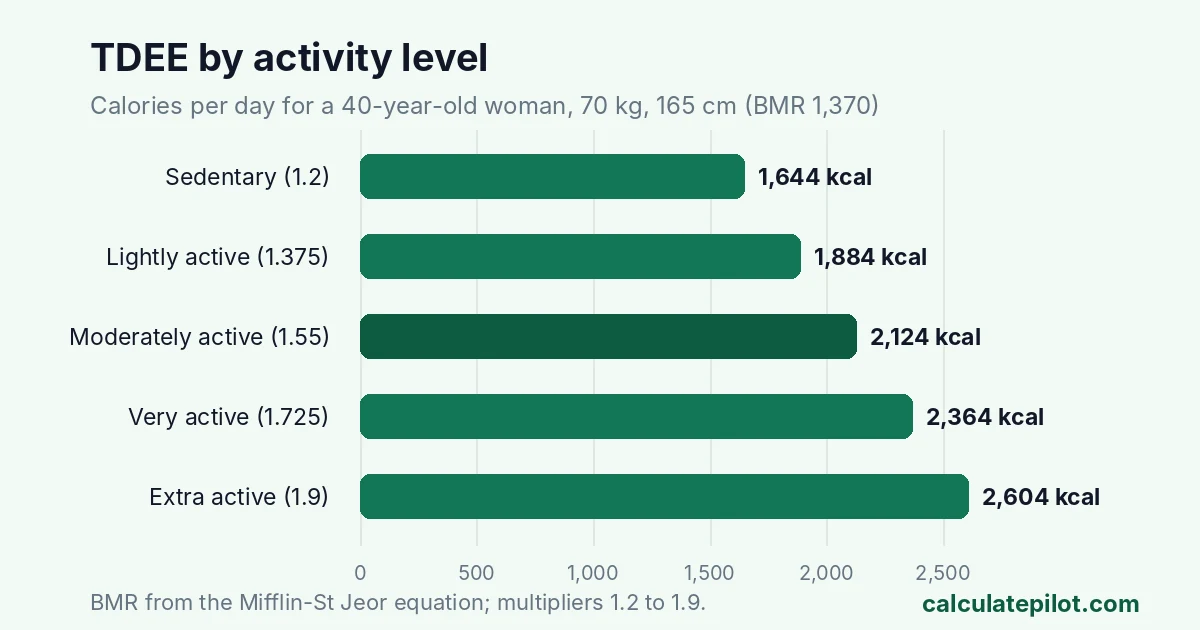
The gap between the lowest and highest row is almost 1,000 calories, so this single choice matters more than any other input. If you are between two levels, pick the lower one.
4. Step 3: multiply
TDEE = 1,370 × 1.55 = about 2,124 calories a day. Eating around that amount should keep this person's weight steady.
5. A second example: a man who trains lightly
- 1A 35-year-old man, 80 kg, 178 cm, exercising 1 to 3 days a week.
- 2BMR = 10 × 80 + 6.25 × 178 − 5 × 35 + 5 = about 1,743 calories.
- 3TDEE = 1,743 × 1.375 = about 2,396 calories a day.
6. Which BMR formula should you use?
Mifflin-St Jeor is the usual default for adults. A systematic review by Frankenfield and colleagues found it the most likely of the common equations to land close to measured resting energy use. If you know your body-fat percentage, the Katch-McArdle and Cunningham equations use lean body mass instead of weight, height and age. They are worth comparing for very lean or muscular people, though they are not guaranteed to be more accurate for any individual. You can switch between all four equations in the TDEE Calculator, and estimate your lean mass with the Lean Body Mass Calculator.
7. How to check your TDEE against real life
A TDEE figure is a starting estimate. To calibrate it:
- 1Eat roughly the calculated amount for two to three weeks and keep your routine steady.
- 2Weigh yourself under similar conditions and compare weekly averages, not single days.
- 3If your weight is rising, your true TDEE is probably lower than estimated. If it is falling, it is probably higher. Adjust by a small amount and repeat.
8. Using your TDEE for a goal
- Lose weight: start with a modest deficit below TDEE. The Weight Loss Calorie Calculator turns your TDEE into a daily target and timeline, and our guide explains how many calories to eat to lose 1 pound a week.
- Maintain: eat close to TDEE and re-check every few weeks.
- Build muscle: a small surplus alongside resistance training, with enough protein. See how much protein you need per day and split calories with the Macro Calculator.
9. Common mistakes
- Picking an activity level that is too high. Three gym sessions on top of a desk job is usually “lightly” or “moderately” active, not “very active”.
- Counting exercise twice. The multiplier already includes your workouts, so do not add calories from a fitness tracker on top.
- Treating the result as exact. Real needs vary from person to person.
- Never recalculating. TDEE falls as you lose weight and rises as you gain.
Quick habit: put your TDEE in your phone notes, then re-run the TDEE Calculator every time your weight moves by about 5 kg (10 lb).
10. Frequently asked questions
How do I calculate my TDEE?expand_more
Estimate your BMR with the Mifflin-St Jeor equation, then multiply it by an activity factor between 1.2 (sedentary) and 1.9 (extra active). The result is your estimated maintenance calories per day.
What activity multiplier should I use?expand_more
Most people choose too high. Use 1.2 for a desk job with little exercise, 1.375 for light exercise 1 to 3 days a week, 1.55 for moderate exercise 3 to 5 days a week, and only 1.725 or 1.9 if you train hard most days or have a physical job.
Is TDEE the same as maintenance calories?expand_more
Yes, in practice. TDEE is the estimated number of calories you burn in a day, so eating about that amount keeps your weight roughly stable.
How accurate is a TDEE calculator?expand_more
It is an estimate, not a measurement. Individual metabolism and daily movement vary, so compare your result with your average weight trend over two to three weeks and adjust.
How often should I recalculate TDEE?expand_more
Recalculate when your weight, activity or training changes meaningfully, and every few weeks during a weight-loss or weight-gain phase.
Should I eat my TDEE or below it?expand_more
Eating around your TDEE maintains weight. A modest deficit below it is a common starting point for weight loss, but the right size depends on you. See the guide on calories to lose a pound a week.
11. Sources
- menu_bookMifflin MD, St Jeor ST, et al. A new predictive equation for resting energy expenditure in healthy individuals. Am J Clin Nutr 1990;51:241–247.
- menu_bookRoza AM, Shizgal HM. The Harris Benedict equation reevaluated: resting energy requirements and the body cell mass. Am J Clin Nutr 1984;40:168–182.
- menu_bookFrankenfield D, Roth-Yousey L, Compher C. Comparison of predictive equations for resting metabolic rate in healthy nonobese and obese adults: a systematic review. J Am Diet Assoc 2005;105:775–789.
- menu_bookCunningham JJ. A reanalysis of the factors influencing basal metabolic rate in normal adults. Am J Clin Nutr 1980;33:2372–2374.
This is general information, not medical advice. Check with a healthcare professional before changing your diet, exercise or fluid intake.