Short answer
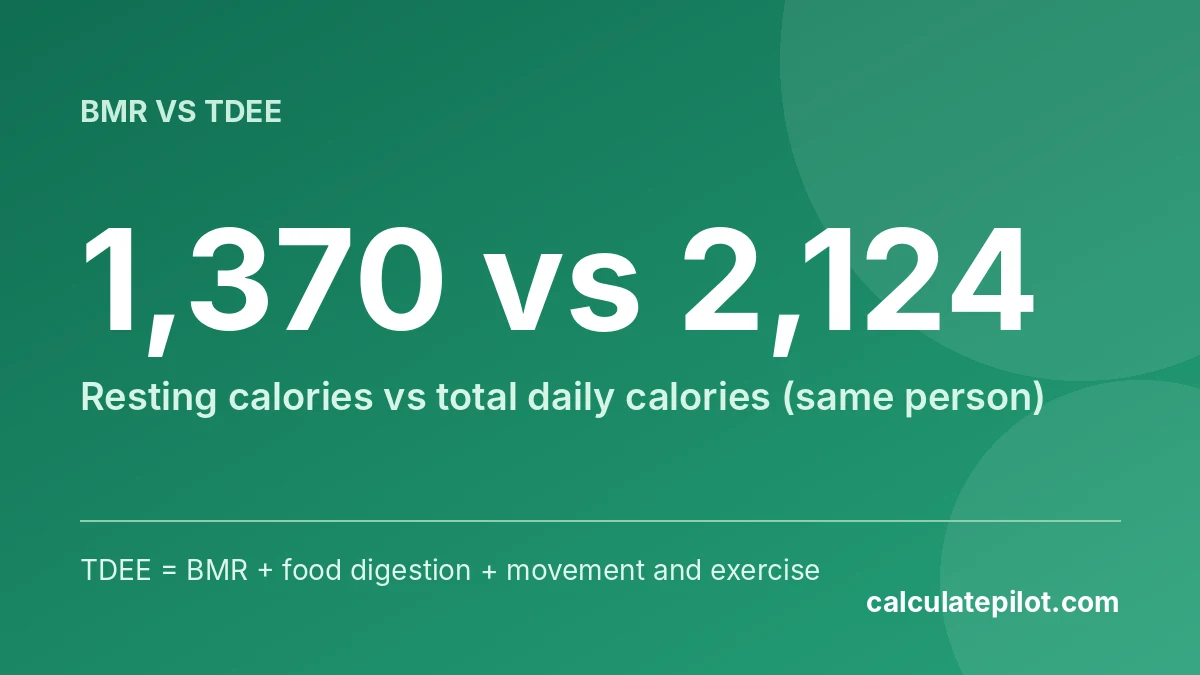
BMR is the calories you burn at complete rest, while TDEE is everything you burn in a day, including digestion, walking and exercise. For a 40-year-old woman, 70 kg and 165 cm, who is moderately active, BMR is about 1,370 and TDEE is about 2,124 calories. Plan your food around TDEE, not BMR.
1. BMR vs TDEE at a glance
| BMR | TDEE | |
|---|---|---|
| What it is | Calories burned at complete rest | Total calories burned in a day |
| Includes exercise and daily movement | No | Yes |
| Includes digesting food | No | Yes |
| Example (40-year-old woman, 70 kg, 165 cm) | about 1,370 | about 2,124 (moderately active) |
| Best used for | Understanding your baseline and the starting point for TDEE | Setting calorie targets |
| Calculator | BMR Calculator | TDEE Calculator |
2. Where the calories go
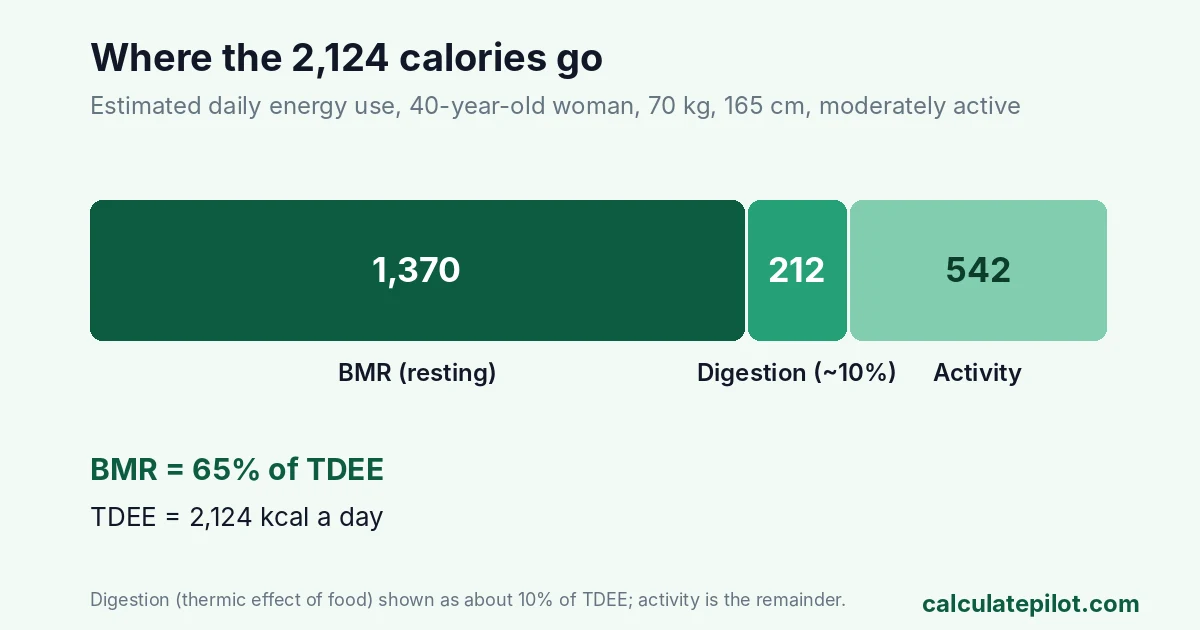
In this example, BMR is 1,370 calories (about 65% of TDEE), digestion accounts for roughly 10% (about 212 calories), and the remaining 542 calories come from movement and exercise. That last slice is the one you control most, which is why two people with the same BMR can have very different TDEE.
3. How BMR is calculated
The most common adult equation is Mifflin-St Jeor. Use weight in kg, height in cm and age in years:
For the example: 10 × 70 + 6.25 × 165 − 5 × 40 − 161 = about 1,370. To go from BMR to TDEE, multiply by your activity factor. The full walk-through, including the multiplier table, is in how to calculate your TDEE.
4. What changes your BMR
- Body size. Larger bodies burn more at rest.
- Muscle mass. Lean tissue uses more energy than fat tissue. Check yours with the Lean Body Mass Calculator.
- Age. BMR tends to decline with age, partly because of lost muscle.
- Sex. Men on average have higher BMR at the same weight because of body composition.
- Weight loss. A lighter body burns less, which is one reason weight loss slows over time.
5. Which number should you use?
Use TDEE for every food decision. BMR only tells you what a body would burn lying still all day, which no one does. From your TDEE you can set a target with the Calorie Calculator or build a deficit with the Weight Loss Calorie Calculator. If you want the numbers behind a typical deficit, read how many calories to eat to lose 1 pound a week.
6. Common mistakes
- Eating your BMR as a target. Your body uses more than that in a normal day.
- Expecting a big metabolism boost from a food or supplement. Evidence for large effects is weak.
- Ignoring movement. Everyday walking adds up. See how many steps burn 100 calories and use the Steps to Calories Calculator.
7. Frequently asked questions
What is the difference between BMR and TDEE?expand_more
BMR is the calories your body burns at complete rest. TDEE adds digesting food and all movement and exercise, so it is your total daily calorie burn.
Which should I use to plan my calories, BMR or TDEE?expand_more
Use TDEE. It reflects how many calories you actually use in a day, so it is the sensible starting point for maintaining, losing or gaining weight.
Is BMR the same as RMR?expand_more
They are very close. BMR is measured under strict resting conditions, while resting metabolic rate (RMR) is measured less strictly. Calculators use the two terms almost interchangeably.
How much of my TDEE is BMR?expand_more
For a moderately active adult it is commonly around 60 to 70 percent. In the worked example here BMR is 1,370 of 2,124 calories, or about 65 percent.
Can I raise my BMR?expand_more
Building and keeping muscle helps a little, and BMR drops with age and weight loss. Claims of big, quick metabolism boosts from foods or supplements are not well supported, so focus on training, protein and consistent sleep.
Should I ever eat below my BMR?expand_more
BMR is not a calorie target, and eating far below it for long periods can be hard to sustain and may carry health risks. Talk to a healthcare professional before using a very low calorie intake.
8. Sources
- menu_bookMifflin MD, St Jeor ST, et al. A new predictive equation for resting energy expenditure in healthy individuals. Am J Clin Nutr 1990;51:241–247.
- menu_bookWesterterp KR. Diet induced thermogenesis. Nutr Metab 2004;1:5.
- menu_bookFrankenfield D, Roth-Yousey L, Compher C. Comparison of predictive equations for resting metabolic rate in healthy nonobese and obese adults: a systematic review. J Am Diet Assoc 2005;105:775–789.
This is general information, not medical advice. Check with a healthcare professional before changing your diet, exercise or fluid intake.