Short answer
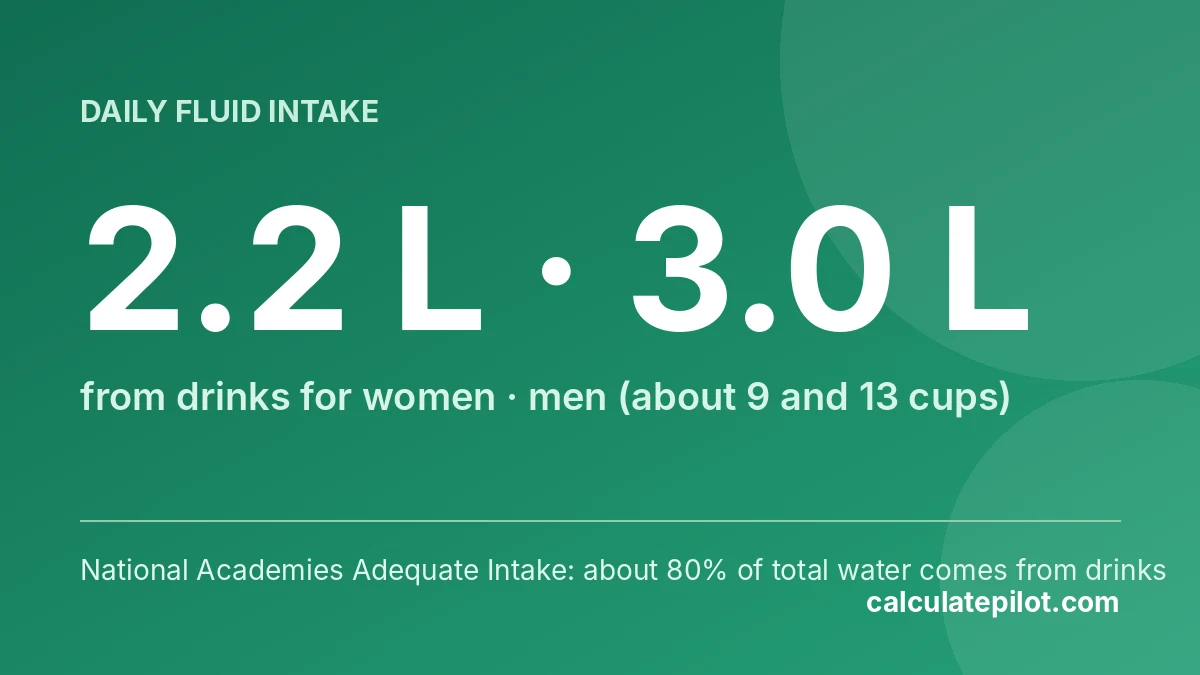
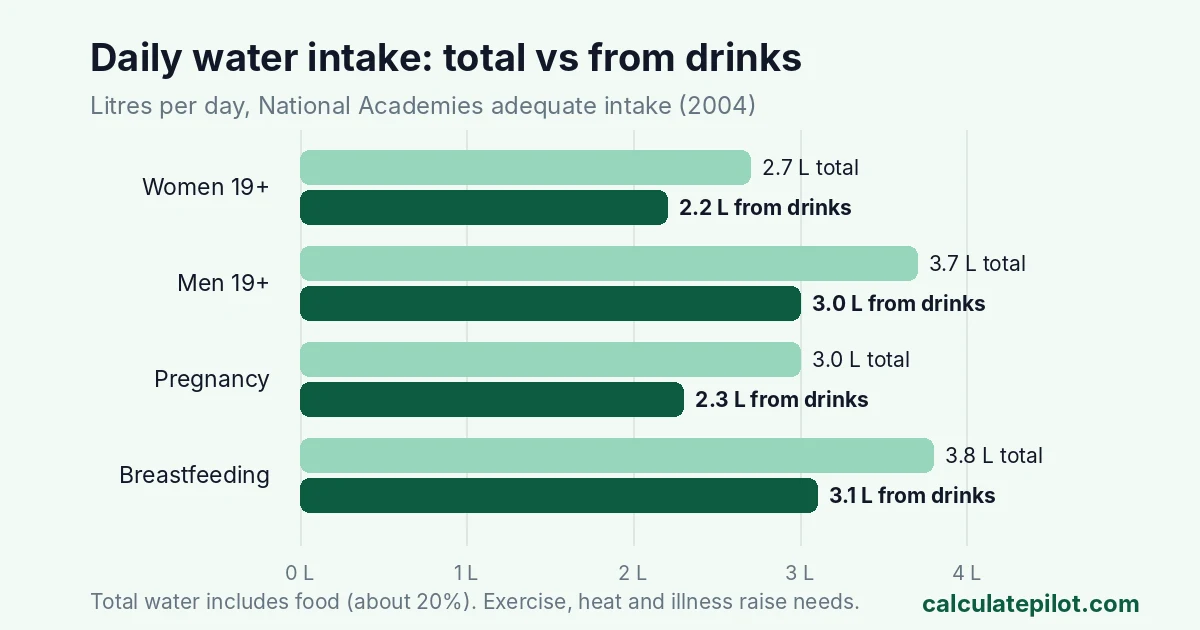
The National Academies set an adequate intake of about 2.7 liters of total water a day for women and 3.7 liters for men. About 80% comes from drinks, which works out to roughly 2.2 liters (9 cups) for women and 3.0 liters (13 cups) for men, plus more when you exercise or it is hot.
1. Daily water intake by group
| Group | Total water per day | From drinks (about 80%) |
|---|---|---|
| Women 19+ | 2.7 L | about 2.2 L (9 cups) |
| Men 19+ | 3.7 L | about 3.0 L (13 cups) |
| Pregnancy | 3.0 L | about 2.3 L |
| Breastfeeding | 3.8 L | about 3.1 L |
The European Food Safety Authority sets lower adult values (2.5 L for men and 2.0 L for women), so there is no single exact answer. Treat these as a starting point, then adjust to your body, climate and activity. The Water Intake Calculator does this for you, including extra fluid for exercise.
2. Adding water for exercise
Take a 30-year-old man who exercises 45 minutes a day. His drinks target is about 3.0 liters. At an assumed sweat rate of 0.5 L an hour, 45 minutes adds about 0.4 liters, so about 3.3 liters (113 oz, 14 cups) on exercise days. Sweat rates vary a lot, so to measure yours, weigh yourself before and after a workout. The American College of Sports Medicine advises drinking about 1.25 to 1.5 liters for every kilogram lost. Estimate the calories from your session with the Calories Burned Calculator.
3. Signs you are drinking enough
- Urine is pale yellow.
- You rarely feel very thirsty.
- You are not getting headaches or dizziness from heat or exercise.
Hot weather, high altitude, fever, vomiting or diarrhea, and pregnancy or breastfeeding all raise needs. People with heart, kidney or liver conditions may be told to limit fluids, so follow your doctor's advice.
4. Does coffee, tea, soda or food count?
Yes. Every beverage counts toward your total, and food supplies about 20% of the day's water, especially fruit and vegetables. Plain water is still the best default because it adds no sugar or calories. If you are cutting calories, drinks matter: check what your usual drinks add with the Alcohol Calories Calculator and see where drinks fit in your daily target with the Calorie Calculator.
5. Six quick habits to drink more water
- 1Drink a glass when you wake up before coffee.
- 2Keep a bottle at your desk and refill it at set times.
- 3Drink with every meal and snack.
- 4Add a glass for each workout, plus more when it is hot.
- 5Flavor it naturally with lemon, cucumber or mint if plain water is boring.
- 6Use your urine color as a check instead of counting every glass.
Pairing hydration with other small habits works well. A daily walk raises your energy use too, so see how many steps burn 100 calories and how your daily energy needs fit together in how many calories you should eat a day.
6. Frequently asked questions
How much water should I drink a day?expand_more
The National Academies set an adequate intake of about 2.7 liters of total water for women and 3.7 liters for men. About 80 percent comes from drinks, so roughly 2.2 liters (9 cups) for women and 3.0 liters (13 cups) for men.
Does coffee, tea and other drinks count?expand_more
Yes. All beverages, including coffee and tea, contribute to your total, and food supplies about 20 percent of daily water.
Is the 8 glasses a day rule accurate?expand_more
Eight 8-ounce glasses (about 1.9 liters) is a simple rule of thumb, not an official recommendation. The National Academies figure for drinks is higher for most adults.
How do I know if I am drinking enough?expand_more
Pale-yellow urine and rarely feeling thirsty are usual signs of good hydration. Darker urine suggests you need more.
Can you drink too much water?expand_more
Yes, though it is uncommon. Drinking very large amounts in a short time can dilute blood sodium (hyponatremia), mainly a risk in long endurance events.
How much extra water do I need when I exercise?expand_more
Add the fluid you sweat out. Sweat rates vary widely, roughly 0.3 to 2.4 liters an hour according to the American College of Sports Medicine, so weigh yourself before and after a workout to find yours.
7. Sources
- menu_bookInstitute of Medicine. Dietary Reference Intakes for Water, Potassium, Sodium, Chloride, and Sulfate. National Academies Press, 2004.
- menu_bookEFSA Panel on Dietetic Products, Nutrition and Allergies. Scientific opinion on dietary reference values for water. EFSA Journal 2010;8(3):1459.
- menu_bookAmerican College of Sports Medicine. Exercise and fluid replacement (position stand). Med Sci Sports Exerc 2007;39:377–390.
This is general information, not medical advice. Check with a healthcare professional before changing your diet, exercise or fluid intake.