Short answer
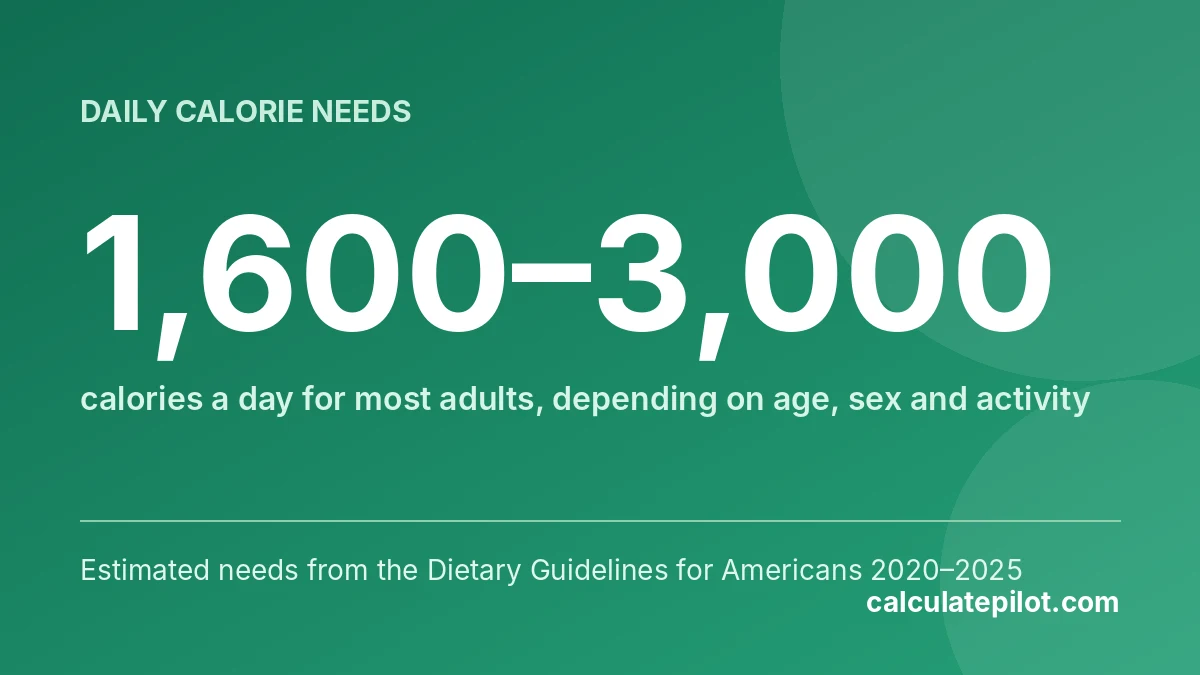
Most adults need about 1,600 to 3,000 calories a day. Moderately active women typically need about 1,800 to 2,200 and moderately active men about 2,200 to 2,800, depending on age. For a personal number, estimate your resting calories and multiply by your activity level, which is what the Calorie Calculator does.
1. Estimated calorie needs by age, sex and activity
The Dietary Guidelines for Americans 2020–2025 publish estimates for a reference-size adult:
| Age | Sedentary | Moderately active | Active |
|---|---|---|---|
| Women 19–30 | 1,800–2,000 | 2,000–2,200 | 2,400 |
| Women 31–50 | 1,800 | 2,000 | 2,200 |
| Women 51+ | 1,600 | 1,800 | 2,000–2,200 |
| Men 19–30 | 2,400–2,600 | 2,600–2,800 | 3,000 |
| Men 31–50 | 2,200–2,400 | 2,400–2,600 | 2,800–3,000 |
| Men 51+ | 2,000–2,200 | 2,200–2,400 | 2,400–2,800 |
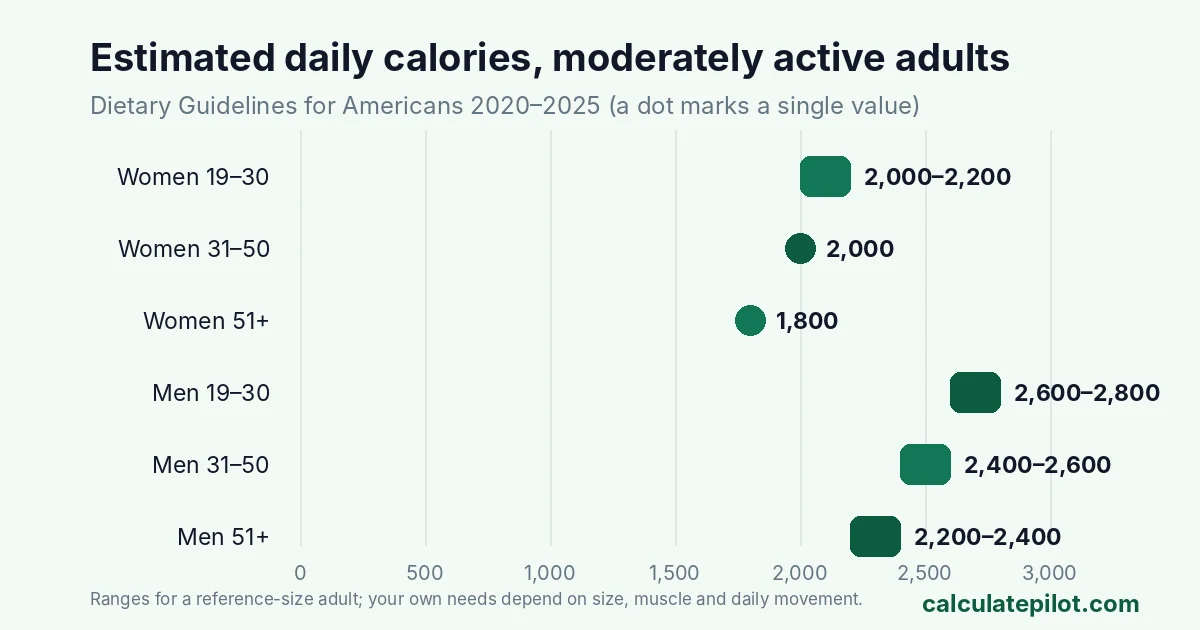
These figures assume an average-size adult. A taller, heavier or more muscular person needs more, and a smaller person needs less, which is why a personal calculation beats any table.
2. How to work out your own number
- 1A 35-year-old man, 80 kg, 178 cm, exercising 1 to 3 days a week.
- 2BMR = 10 × 80 + 6.25 × 178 − 5 × 35 + 5 = about 1,743 calories.
- 3Maintenance = 1,743 × 1.375 = about 2,396 calories a day.
For a woman, 70 kg, 165 cm and 40 who exercises 3 to 5 days a week, the same steps give about 2,124. The complete method is in how to calculate your TDEE, and the TDEE Calculator shows your number at every activity level.
3. Adjusting calories for your goal
| Goal | Adjustment to maintenance | Daily target if maintenance is 2,124 |
|---|---|---|
| Maintain weight | None | 2,124 |
| Lose about 0.5 lb a week | about −250 | about 1,874 |
| Lose about 1 lb a week | about −500 | about 1,624 |
| Gain about 0.5 lb a week | about +250 | about 2,374 |
These use the 3,500-calories-per-pound planning rule, which overestimates long-term change because maintenance falls as you lose weight. Recalculate every few weeks. Our guide on how many calories to eat to lose 1 pound a week covers the limits of the rule, and the Weight Loss Calorie Calculator builds a timeline for you.
4. How low is too low?
The AHA/ACC/TOS obesity guideline suggests roughly 1,200 to 1,500 calories a day for women and 1,500 to 1,800 for men on a weight-loss plan. Very low-calorie diets should be supervised by a healthcare professional. If you are pregnant or breastfeeding, needs are higher and different, so use the Pregnancy Calorie Needs Calculator.
5. Five quick habits that make calorie targets easier
- Track for two weeks, not forever. It teaches portion sizes and gives you a real baseline.
- Put protein first at each meal. It helps you feel full. See how much protein you need per day.
- Cut liquid calories first. Sugary drinks and alcohol add up fast without filling you up.
- Walk more. Everyday steps raise your maintenance. Try the Steps to Calories Calculator.
- Weigh yourself on a schedule. Compare weekly averages and adjust by small amounts.
6. Frequently asked questions
How many calories should I eat a day?expand_more
Most adults need roughly 1,600 to 3,000 calories a day. The Dietary Guidelines for Americans estimate about 1,800 to 2,200 for moderately active women and 2,200 to 2,800 for moderately active men, depending on age.
How many calories should a woman eat a day?expand_more
Estimated needs for adult women range from about 1,600 calories for sedentary women over 50 to about 2,400 for active women aged 19 to 30. Your own number depends on your size, age and activity.
How many calories should a man eat a day?expand_more
Estimated needs for adult men range from about 2,000 calories for sedentary men over 50 to about 3,000 for active men aged 19 to 30.
How many calories should I eat to lose weight?expand_more
Subtract a modest deficit from your maintenance calories. A common planning figure is about 500 calories a day for roughly 1 pound a week, but the right size depends on you and a lower-than-necessary intake is not a good idea.
Is 1,200 calories a day enough?expand_more
Guidelines such as the AHA/ACC/TOS report suggest roughly 1,200 to 1,500 calories a day for women and 1,500 to 1,800 for men on a weight-loss plan, and very low intakes should be supervised by a healthcare professional.
Why do calorie needs change with age?expand_more
Muscle mass and daily activity tend to fall with age, which lowers energy needs. Staying active and keeping strength can slow that change.
7. Sources
- menu_bookU.S. Department of Agriculture and U.S. Department of Health and Human Services. Dietary Guidelines for Americans, 2020–2025, Appendix 2: Estimated calorie needs per day by age, sex and physical activity level.
- menu_bookMifflin MD, St Jeor ST, et al. A new predictive equation for resting energy expenditure in healthy individuals. Am J Clin Nutr 1990;51:241–247.
- menu_bookJensen MD, Ryan DH, Apovian CM, et al. 2013 AHA/ACC/TOS guideline for the management of overweight and obesity in adults. Circulation 2014;129(25 Suppl 2):S102–S138.
- menu_bookHall KD, Sacks G, Chandramohan D, et al. Quantification of the effect of energy imbalance on bodyweight. Lancet 2011;378:826–837.
This is general information, not medical advice. Check with a healthcare professional before changing your diet, exercise or fluid intake.