Short answer
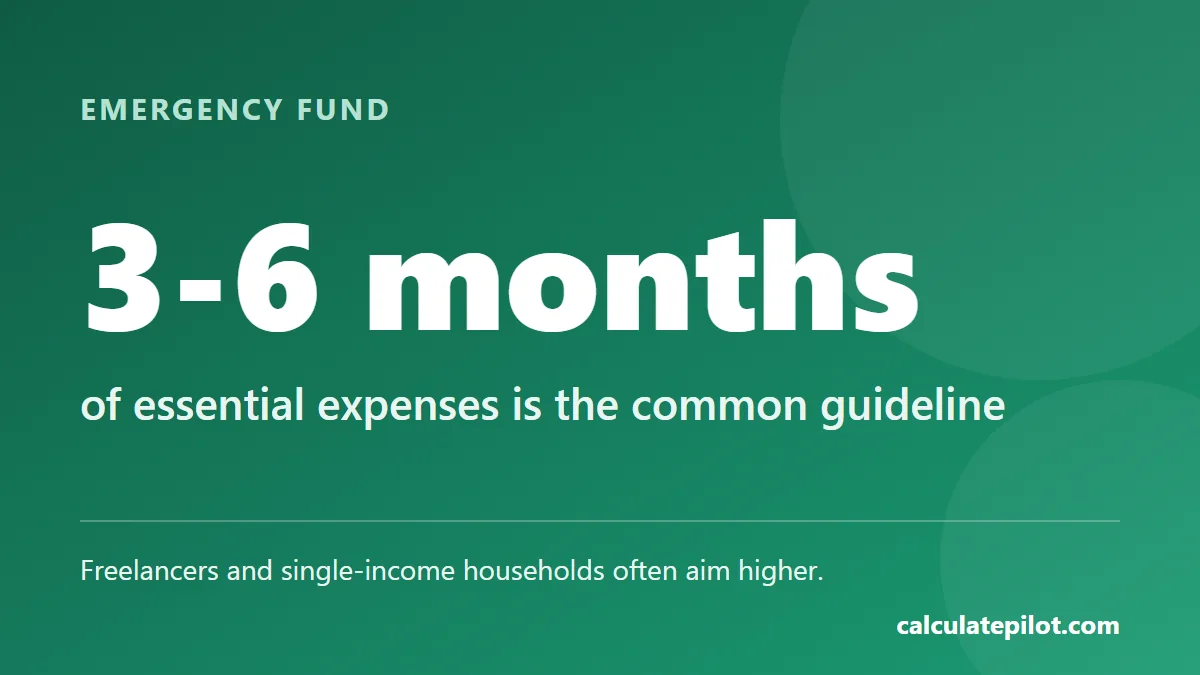
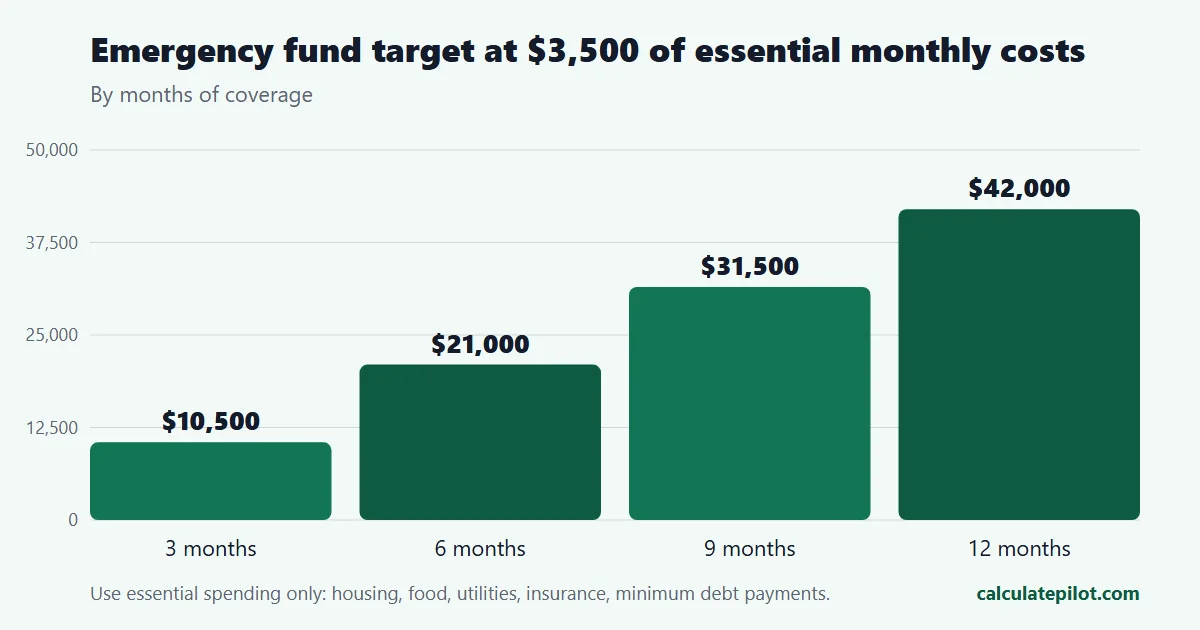
Most guidance suggests 3 to 6 months of essential expenses. Dual-income households with stable jobs often aim for the lower end, single-income households closer to 6 months, and freelancers or commission earners 9 to 12 months. If your essentials are $3,500 a month, that means roughly $10,500 to $21,000.
1. Emergency fund target by monthly essentials and months
| Monthly essentials | 3 months | 6 months | 9 months | 12 months |
|---|---|---|---|---|
| $2,500 | $7,500 | $15,000 | $22,500 | $30,000 |
| $3,500 | $10,500 | $21,000 | $31,500 | $42,000 |
| $4,500 | $13,500 | $27,000 | $40,500 | $54,000 |
| $6,000 | $18,000 | $36,000 | $54,000 | $72,000 |
2. How many months should you aim for?
| Situation | Common target |
|---|---|
| Dual income, salaried jobs | 3–6 months |
| Single income, salaried | About 6 months |
| Freelance, commission or 1099 income | 9–12 months |
| Dependents or a home to maintain | Lean to the upper end |
These are guidelines, not rules. Your own target depends on how stable your income is, how easily you could find work and what could go wrong, such as medical bills or home repairs.
3. Count essential expenses only
Base the number on what you must pay during an income gap: housing, utilities, groceries, insurance, transportation and minimum debt payments. Do not include dining out, subscriptions or other spending you could pause.
4. Worked example
- 1Rent $1,500 + utilities $250 + groceries $500 + insurance $300 + car and fuel $350 + minimum debt payments $300 = $3,200 a month.
- 2Target for 6 months = $3,200 × 6 = $19,200.
- 3If you have $8,000 saved, your runway is $8,000 ÷ $3,200 = 2.5 months.
5. Where to keep it
- High-yield savings account: FDIC-insured up to $250,000 per depositor, per bank, with access when you need it.
- Money market funds or short-term Treasury bills: low volatility, though money market funds are not FDIC-insured.
- Avoid stocks, long-term CDs with early withdrawal penalties, and crypto for this money.
6. Common mistakes
- Using total spending instead of essentials, which makes the goal larger than it needs to be.
- Waiting for the full target. Even one month of expenses helps, so build in steps.
- Investing the emergency fund. The money is needed when markets and job losses can both be bad.
Work out your own number with the Emergency Fund Calculator. To plan the saving, use the Savings Goal Calculator and read how long it takes to save $10,000. Compare places to keep it in the CD vs. high-yield savings guide.
7. Frequently asked questions
How many months of expenses should an emergency fund cover?expand_more
Most guidance suggests 3 to 6 months of essential expenses. People with variable income or dependents often aim for 9 to 12 months.
How much should my emergency fund be if my expenses are $3,500 a month?expand_more
About $10,500 for 3 months and $21,000 for 6 months.
Should I use total spending or essential expenses?expand_more
Use essential expenses: housing, utilities, food, insurance, transportation and minimum debt payments.
Where should I keep an emergency fund?expand_more
Somewhere safe and accessible, such as an FDIC-insured high-yield savings account. Avoid investments that can fall when you need the money.
8. Sources
- menu_bookFDIC — Deposit insurance coverage, up to $250,000 per depositor, per insured bank, per ownership category
- menu_bookConsumer Financial Protection Bureau — guidance on building emergency savings
Targets are general guidelines. Your situation may call for more or less. Not financial advice.