Short answer
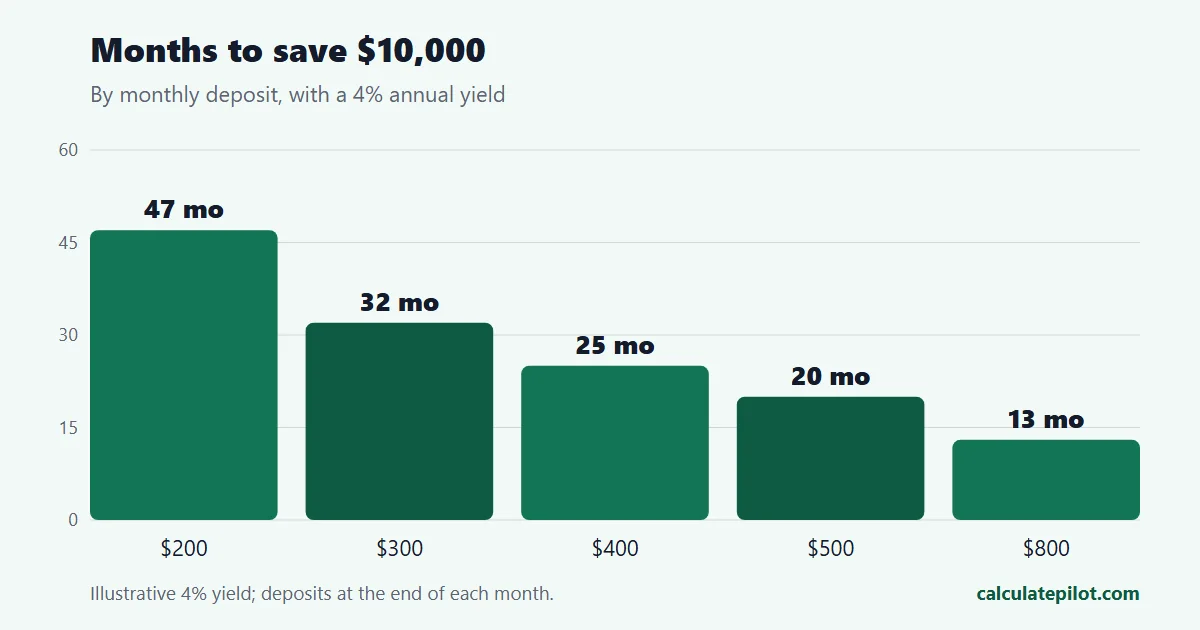
Divide $10,000 by what you can save each month. At $500 a month it takes 20 months, and a 4% annual yield barely changes that. Interest matters more on slower plans: at $200 a month, 50 months becomes 47.
Here r is the monthly rate (annual yield ÷ 12) and n the number of months, with deposits made at the end of each month.
1. How long to save $10,000, by monthly deposit
| Monthly deposit | Months with 0% interest | Months with 4% yield |
|---|---|---|
| $200 | 50 months | 47 months |
| $300 | 34 months | 32 months |
| $400 | 25 months | 25 months |
| $500 | 20 months | 20 months |
| $800 | 13 months | 13 months |
2. How much to save each month to hit a deadline
| Deadline | Deposit needed (0%) | Deposit needed (4% yield) |
|---|---|---|
| 12 months | $833 | $818 |
| 18 months | $556 | $540 |
| 24 months | $417 | $401 |
| 36 months | $278 | $262 |
| 60 months | $167 | $151 |
For example, to reach $10,000 in 24 months you need about $417 a month with no interest or $401 a month at a 4% yield, so interest saves roughly $16 a month on that plan.
3. Worked example: $400 a month at 4%
- 1r = 4% ÷ 12 = 0.3333% per month.
- 2Each month the balance grows by r, then your $400 is added.
- 3The balance first passes $10,000 in month 25; without interest it also takes 25 months, because the interest earned is small on a short plan.
4. Ways to reach $10,000 sooner
- Automate the transfer. Move the money the day after payday so saving does not depend on what is left over.
- Use a high-yield savings account instead of a checking account that pays little or no interest.
- Add windfalls. A tax refund or bonus of $1,000 shortens a $400-a-month plan by about two and a half months.
- Raise the deposit when you can. The gap between $300 and $500 a month is 12 months.
5. Common mistakes
- Counting interest you are not earning. Set the yield to 0% for a plain checking account.
- Forgetting that rates change. Savings account yields are variable, so treat the timeline as an estimate.
- Mixing goals. If you do not yet have an emergency fund, build that first so a surprise bill doesn't empty this one.
Enter your own goal, deposit and yield in the Savings Goal Calculator. To see how a lump sum plus deposits grows, use the Savings Calculator, or compare account types with the CD vs. high-yield savings guide.
6. Frequently asked questions
How long does it take to save $10,000?expand_more
At $500 a month it takes 20 months, with or without a 4% yield. At $250 a month it takes about 40 months without interest.
How much do I need to save each month to have $10,000 in a year?expand_more
About $833 a month with no interest, or about $818 a month at a 4% yield.
Does interest make much difference when saving $10,000?expand_more
On short plans very little. At $500 a month it makes no difference to the month count; at $200 a month it saves 3 months.
Should I save $10,000 or pay off debt first?expand_more
It depends on the interest rate on the debt. High-rate debt such as credit cards often costs more than savings earn, so many people balance the two. Not financial advice.
7. Sources
- menu_bookFuture value of an annuity formula (see the CalculatePilot methodology)
- menu_bookFDIC — Deposit insurance coverage, up to $250,000 per depositor, per insured bank, per ownership category
The 4% yield is an illustration, not a current quote. Not financial advice.