Short answer
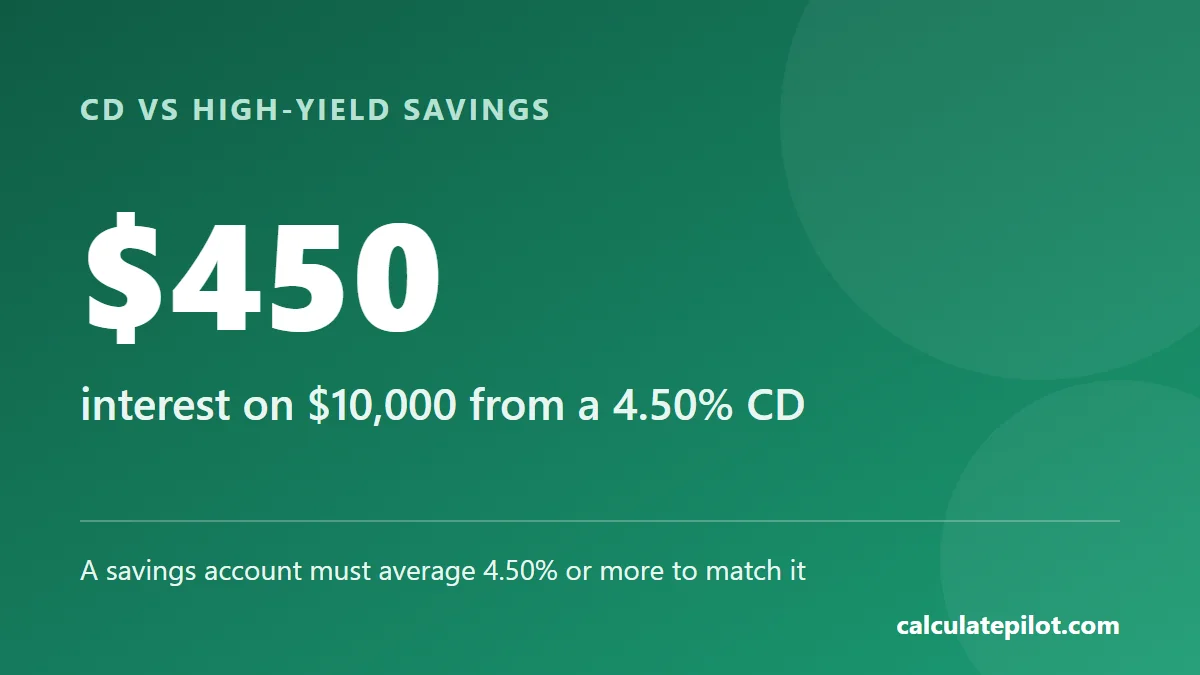
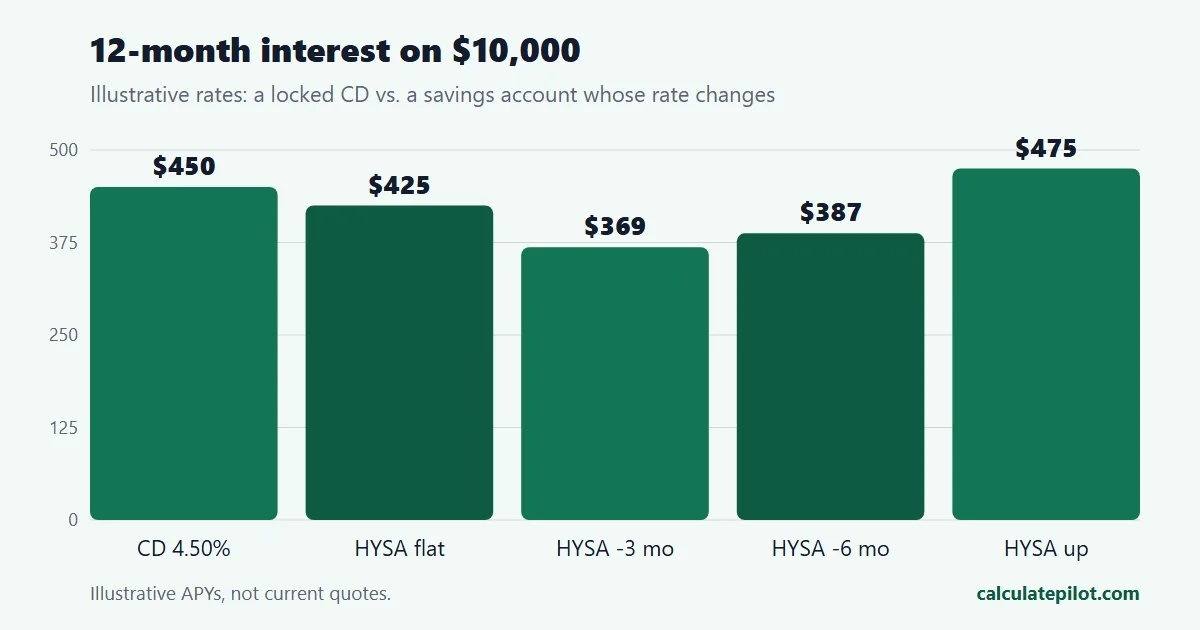
A CD locks a rate, so it earns more when rates fall; a high-yield savings account (HYSA) lets you withdraw at any time, but its rate can change. The savings account only wins if its rate, averaged over the period, matches or beats the CD's rate. With the illustrative rates below, a locked 4.50% CD earns $450.00 on $10,000 in a year, while a savings account that starts at 4.25% and drops to 3.50% after six months earns $387.43.
APY already includes compounding, so you can apply it directly. If a rate changes mid-year, compound each period at its own APY and multiply the results.
1. $10,000 for 12 months: illustrative comparison
| Scenario | Interest after 12 months | Difference vs. CD |
|---|---|---|
| CD, 4.50% APY locked for 12 months | $450.00 | Fixed |
| HYSA stays at 4.25% APY | $425.00 | $-25.00 |
| HYSA at 4.25%, then 3.50% after 3 months | $368.70 | $-81.30 |
| HYSA at 4.25%, then 3.50% after 6 months | $387.43 | $-62.57 |
| HYSA rises to 4.75% APY | $475.00 | $25.00 |
These rates are illustrative and are not current quotes. Replace them with the APYs you are offered.
2. Break-even rule
For one year, the savings account has to average the CD's APY to tie. If a 12-month CD pays 4.50%, an HYSA that averages 4.50% over the year earns the same interest. Over a longer CD term, compare the CD's APY with the average rate you expect the savings account to pay, remembering that you cannot know that average in advance.
3. CD or HYSA: what to weigh
| Factor | CD | High-yield savings |
|---|---|---|
| Rate | Fixed for the term | Variable; the bank can change it |
| Access to money | Early withdrawal usually costs a penalty | Withdraw anytime (check transfer limits) |
| Best when | You won't need the money and expect rates to fall | You might need the money, or expect rates to rise |
| Deposit protection | FDIC or NCUA insured up to $250,000 per depositor, per institution, per ownership category | Same insurance rules |
| Taxes | Interest is taxable income | Interest is taxable income |
Early withdrawal penalties are usually expressed as a number of months of interest, and they differ by bank and term, so read the CD's disclosure before you open it.
4. A middle option: CD ladder
Splitting money across CDs that mature at different dates gives you regular access to cash while still locking rates. The CD Calculator includes a laddering view.
5. Common mistakes
- Comparing APY with a plain interest rate. Compare APY with APY.
- Assuming the savings rate will stay put. HYSA rates move with the market and the bank's decisions.
- Locking emergency money in a CD. A penalty can erase the extra interest.
- Ignoring minimum deposits and promotional terms. Some top rates apply only up to a balance or for a limited time.
Run your own numbers in the CD vs. High-Yield Savings Calculator. To see how a regular deposit grows, use the Savings Calculator, and for a target amount use the Savings Goal Calculator.
6. Frequently asked questions
Is a CD better than a high-yield savings account?expand_more
Neither is always better. A CD wins when rates fall or you want certainty, and a savings account wins when you need access or rates rise.
Which pays more, a CD or an HYSA?expand_more
It depends on the rates offered. Compare the CD's APY with the rate the savings account is paying now, and think about how that rate could change.
What happens if I withdraw from a CD early?expand_more
You usually pay a penalty, often a number of months of interest. The amount and rules differ by bank, so check the CD's disclosure.
Are CDs and high-yield savings accounts safe?expand_more
Both are insured by the FDIC (banks) or NCUA (credit unions) up to $250,000 per depositor, per institution, per ownership category.
7. Sources
- menu_bookFDIC — Deposit insurance coverage, up to $250,000 per depositor, per insured bank, per ownership category
- menu_bookNCUA — Share insurance coverage for credit union members
- menu_bookStandard APY compounding formula (see the CalculatePilot methodology)
Rates in this guide are illustrations, not current offers. Not financial advice.