Short answer
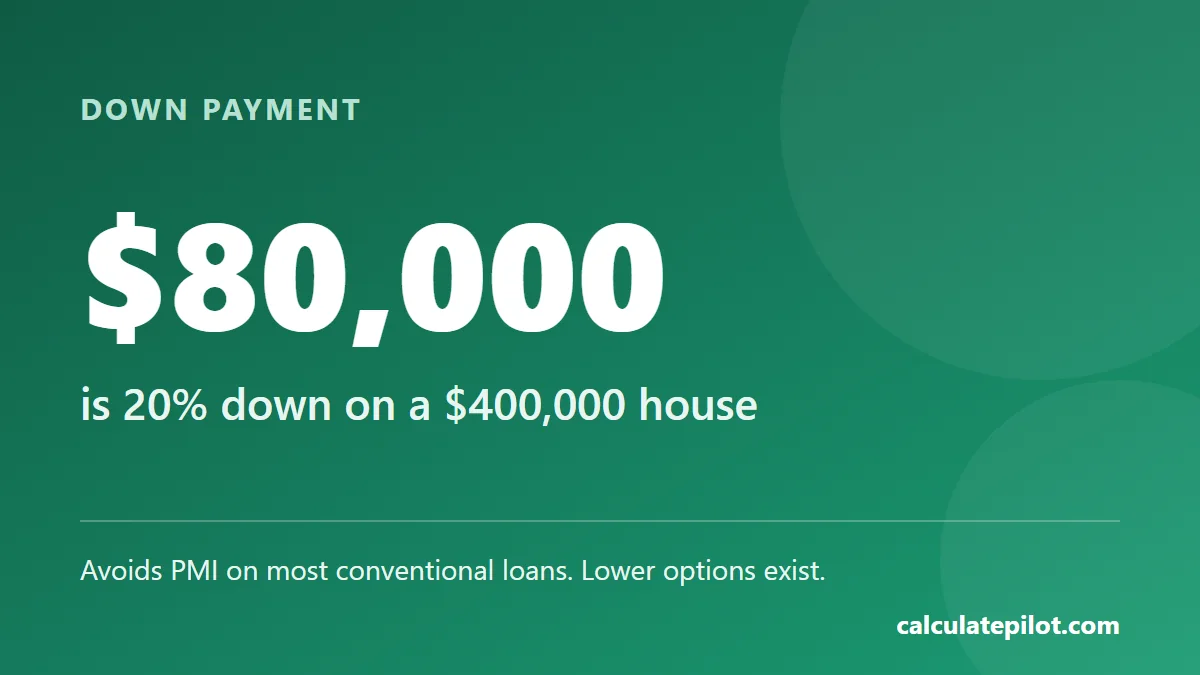
On a $400,000 house, 20% down is $80,000, which typically avoids private mortgage insurance (PMI) on a conventional loan. Many programs accept much less: some conventional loans start at 3% down ($12,000), and FHA loans start at 3.5% down ($14,000) for eligible borrowers. A smaller down payment means a bigger loan, a higher monthly payment and usually PMI.
1. What each down payment means for the monthly payment
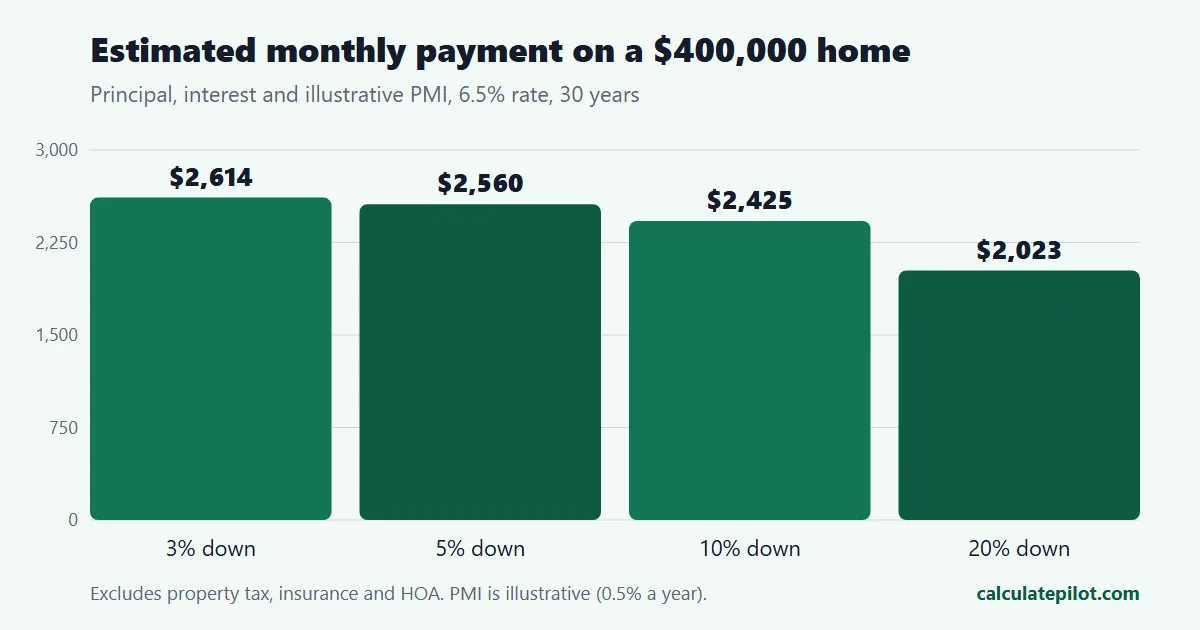
Assuming a 6.5% rate on a 30-year fixed loan and an illustrative PMI cost of 0.5% of the loan per year when you put down less than 20%.
| Down payment | Amount | Loan | Principal & interest | Est. PMI / month | Total / month |
|---|---|---|---|---|---|
| 3% | $12,000 | $388,000 | $2,452 | $162 | $2,614 |
| 5% | $20,000 | $380,000 | $2,402 | $158 | $2,560 |
| 10% | $40,000 | $360,000 | $2,275 | $150 | $2,425 |
| 20% | $80,000 | $320,000 | $2,023 | None | $2,023 |
Going from 3% to 20% down cuts the estimated monthly payment from about $2,614 to $2,023, a difference of roughly $591 a month, before taxes and insurance. Your own PMI cost depends on your credit score, loan type and insurer.
2. Why 20% is the usual target
- No PMI on conventional loans. PMI protects the lender, and it typically applies when your down payment is under 20%.
- A smaller loan. You borrow less and pay less interest over the life of the loan.
- PMI can come off later. For conventional loans it can be removed at your request when you reach 80% of the original value, and is generally dropped automatically at 78%.
3. Is waiting to save 20% worth it?
Not always. If saving the extra money takes years, home prices and rates may change in that time, and PMI is a cost you can eventually remove. The right choice depends on your savings, your rate, local prices and your plans. Compare both paths with the Down Payment Calculator.
4. Do not forget the other cash you need
- Closing costs. Often a few percent of the price, paid at closing on top of the down payment.
- Cash reserves. Depending on the loan, lenders may want a few months of mortgage payments left in the bank after closing.
- Documented funds. Lenders usually review bank statements, and gifts from family need a gift letter.
5. Common mistakes
- Judging affordability by the down payment alone. The full monthly cost includes tax, insurance, PMI and HOA.
- Emptying savings for the down payment. Keep an emergency fund after closing.
- Using the home price instead of the loan amount when estimating the payment.
To see the payment on your own numbers, use the Mortgage Calculator, check what you can borrow with the House Affordability Calculator, and see the formula in the monthly mortgage formula guide.
6. Frequently asked questions
How much down payment do I need for a $400,000 house?expand_more
20% is $80,000 and typically avoids PMI on a conventional loan. Some programs accept less: 3% is $12,000 and 3.5% (FHA) is $14,000 for eligible borrowers.
What is the minimum down payment on a $400,000 house?expand_more
Some conventional loans start at 3% down ($12,000) and FHA loans at 3.5% ($14,000) for eligible borrowers. VA loans can require no down payment for eligible veterans. Rules vary by lender and borrower.
What does PMI cost?expand_more
It depends on your credit score, loan size and down payment. This guide uses 0.5% of the loan a year only as an illustration.
Can I get rid of PMI?expand_more
On a conventional loan you can usually ask to remove it when your balance reaches 80% of the original home value, and it is generally terminated automatically at 78%.
7. Sources
- menu_bookConsumer Financial Protection Bureau — Private mortgage insurance and how it can be cancelled
- menu_bookHomeowners Protection Act of 1998 (PMI cancellation at 80% and termination at 78% of original value)
- menu_bookStandard mortgage amortization formula (see the CalculatePilot methodology)
Rates and PMI figures are illustrations, not offers. Programs and eligibility vary. Not financial advice.