Short answer
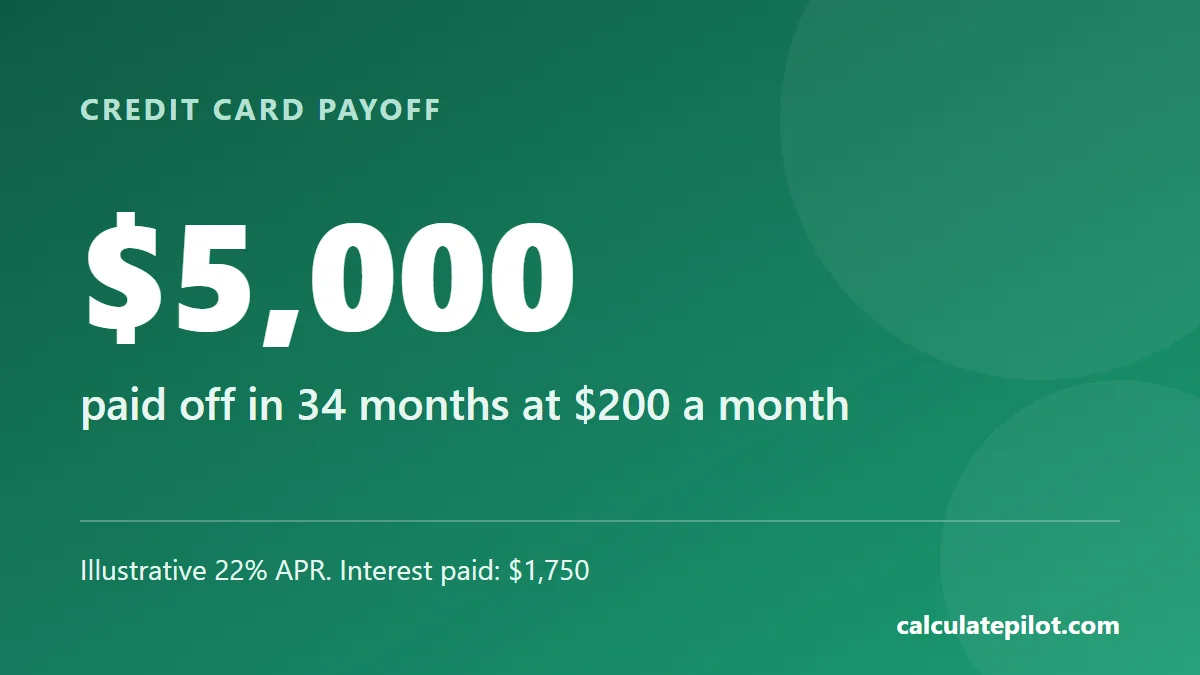
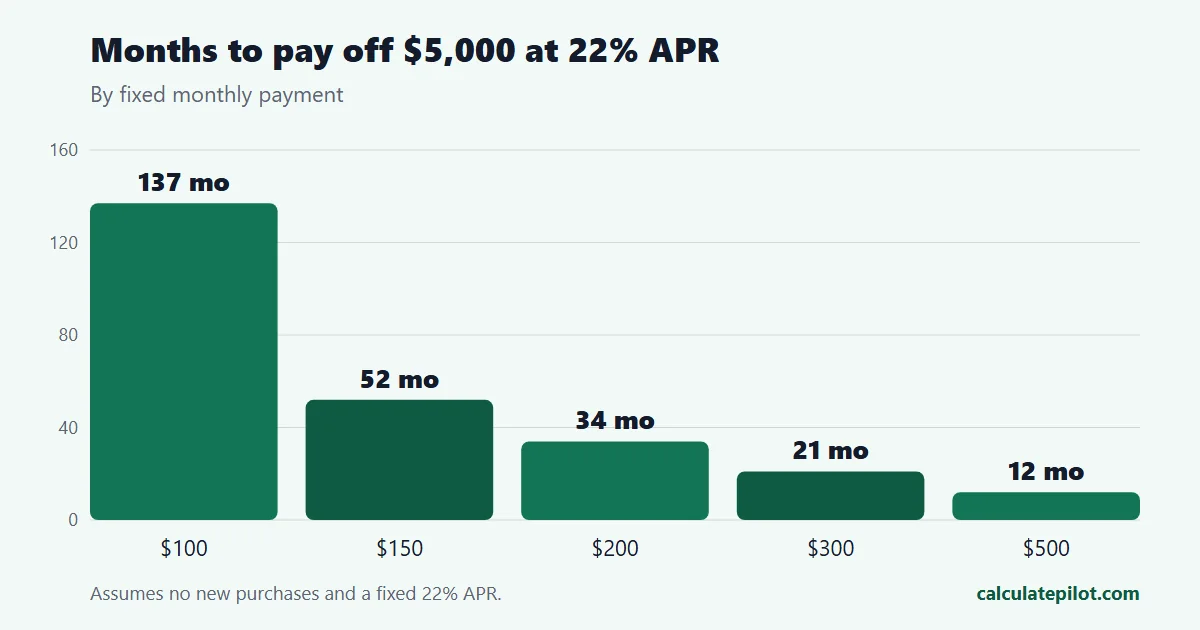
With an illustrative 22% APR and no new purchases, $5,000 takes 34 months at $200 a month and costs about $1,750 in interest. At $100 a month it takes 137 months. The card's own minimum payment, which shrinks as the balance falls, can take far longer.
B is the balance, r is the monthly rate (APR ÷ 12) and n is the number of months. Rearranged, the same formula gives the months a given payment will take. Your card statement shows your real APR; 22% is used here only as a round illustration.
1. $5,000 at 22% APR: payoff time by monthly payment
| Monthly payment | Time to pay off | Total interest | Total paid |
|---|---|---|---|
| $100 | 137 months (11 yr 5 mo) | $8,678 | $13,678 |
| $150 | 52 months (4 yr 4 mo) | $2,798 | $7,798 |
| $200 | 34 months (2 yr 10 mo) | $1,750 | $6,750 |
| $300 | 21 months (1 yr 9 mo) | $1,022 | $6,022 |
| $500 | 12 months (1 yr 0 mo) | $574 | $5,574 |
Doubling the payment from $100 to $200 does much more than halve the time, because less interest builds up while the balance falls faster.
2. What payment clears $5,000 by a target date?
| Pay off in | Monthly payment needed | Total interest |
|---|---|---|
| 12 months | $467.97 | $616 |
| 24 months | $259.39 | $1,225 |
| 36 months | $190.95 | $1,874 |
| 60 months | $138.09 | $3,286 |
3. What the minimum payment does
Many issuers set the minimum at the month's interest plus about 1% of the balance, with a small floor. Using that rule on $5,000 at 22% (floor $25), paying only the minimum takes about 230 months (19.2 years) and about $8,100 in interest, more than the original balance. Check your statement, because the minimum payment formula and the "time to pay off" disclosure differ by issuer.
4. Worked example: $200 a month
- 1Monthly rate r = 22% ÷ 12 = 1.833%.
- 2Month 1 interest = $5,000 × 0.01833 = $91.67, so $108.33 of the $200 reduces the balance to $4,891.67.
- 3Each month the interest part gets smaller and the principal part larger, until the last payment clears the balance in month 34.
5. Ways to pay off a balance faster
- Pay more than the minimum, and keep it fixed. A fixed payment shortens payoff much more than a shrinking minimum.
- Stop adding new purchases to the card while paying it down, or the calculation above no longer holds.
- Compare a lower-rate option. A balance-transfer offer or a personal loan may reduce interest, but watch for transfer fees and promotional periods that end.
- Use a payoff strategy for several cards. The avalanche method targets the highest APR first, the snowball method the smallest balance first.
Try your own balance and APR in the Credit Card Payoff Calculator. If you have several debts, compare strategies with the Debt Payoff Calculator and read the avalanche vs. snowball guide. To see how a card balance affects your score, use the Credit Utilization Calculator.
6. Frequently asked questions
How long will it take to pay off $5,000 on a credit card?expand_more
At an illustrative 22% APR with no new purchases: 137 months at $100, 34 months at $200 and 21 months at $300 a month.
How much interest will I pay on $5,000?expand_more
At 22% APR it is about $1,750 at $200 a month, or about $8,678 at $100 a month. A higher payment means less interest.
Why does paying only the minimum take so long?expand_more
The minimum is usually the month's interest plus about 1% of the balance, so it falls as the balance falls. Most of each payment goes to interest early on.
Is 22% a realistic credit card APR?expand_more
It is a round illustrative figure. Your actual APR is on your statement and varies by issuer and credit profile.
7. Sources
- menu_bookStandard amortization formula for fixed payments (see the CalculatePilot methodology)
- menu_bookConsumer Financial Protection Bureau — credit card minimum payments and APR disclosures
APR and payment figures are illustrations, not offers. Check your card statement for your actual terms. Not financial advice.