Monthly Mortgage Formula Explained Simply
The fixed-rate payment formula has three inputs. Once you know P, r, and n, a lender quote is something you can verify.
→ Use the free Mortgage Calculator
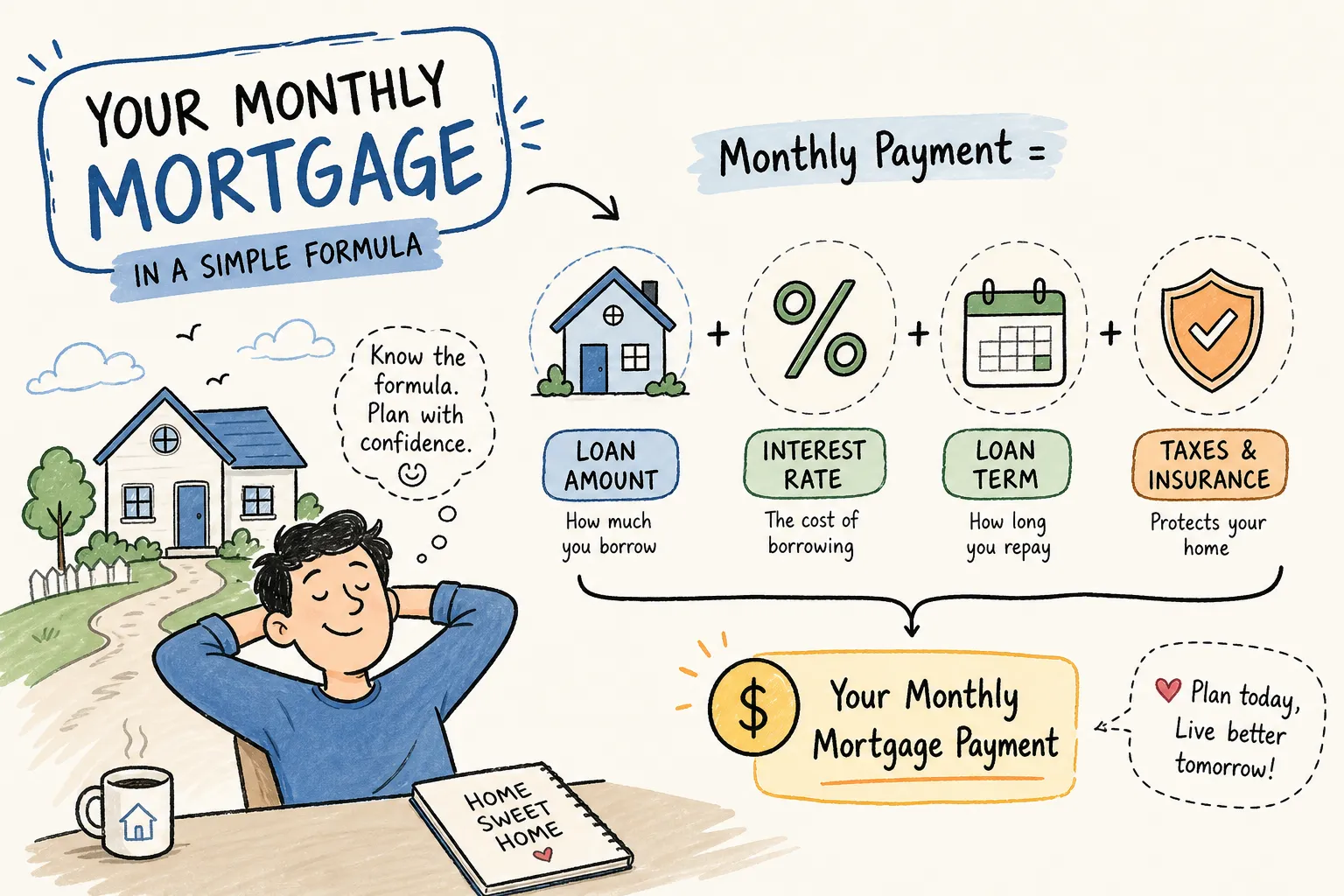
A lender hands you a monthly payment and expects you to sign. No formula, no breakdown — just a figure that either fits the budget or does not. A half-point rate change or a shorter term can move that number by hundreds of dollars.
The monthly mortgage formula behind every fixed-rate loan is:
CalculatePilot’s mortgage calculator runs this formula in the browser, shows the method next to the result, and does not require an account. The goal here is to understand the math first, so the tool is something you can trust.
What P, r, and n mean
Every variable is a number from the loan offer. There is no extra abstraction.
P: the amount you actually borrow
P is principal — the loan amount, not the home price. On a $320,000 home with 5% down ($16,000), P is $304,000. Lenders list this on the Loan Estimate as “loan amount.” Using purchase price instead of net borrowed amount is the most common replication error.
r: annual rate converted to a monthly figure
Divide the annual interest rate by 12 and write it as a decimal. A 6.5% annual rate becomes 0.065 ÷ 12 = 0.005417 per month. Most US lenders use this divide-by-12 method. The compounded monthly rate, (1 + annual rate)1/12 − 1, differs by less than $1 per month on a $300,000 loan at 6.5%.
n: total payment count, not years
Years × 12 = n. A 30-year mortgage has n = 360. A 15-year mortgage has n = 180. Shortening n is one of the strongest levers for cutting lifetime interest, even when the monthly payment rises.
Worked example: $300,000 at 6.5% for 30 years
Inputs: P = 300,000, r = 0.065 ÷ 12 = 0.005417, n = 360.
Numerator: r × (1 + r)n = 0.005417 × (1.005417)360. (1.005417)360 ≈ 6.848. Multiply by 0.005417 ≈ 0.03710.
Denominator: 6.848 − 1 = 5.848. Divide: 0.03710 ÷ 5.848 = 0.006321. Multiply by P: 300,000 × 0.006321 = $1,896.20 per month.
That payment covers that month’s interest first. In month one, about $1,625 of $1,896.20 is interest ($300,000 × 0.005417) and only $271.20 reduces the balance. After 12 payments the balance is about $296,647.
The formula result is principal and interest only. It does not include property tax, homeowners insurance, PMI, or HOA. Lenders often quote a total monthly payment that bundles those items, so the formula and the quote will not match until you add them separately.
See the formula live, no spreadsheet required
Readers who know P, r, and n can see which lever to pull when a payment comes back too high. A lower rate reduces r. A longer term increases n and total interest. A larger down payment reduces P.
The Mortgage Calculator applies the same formula client-side. Pair it with the Amortization Calculator for the payment split and lifetime interest, or the mortgage calculator guide when you want 15-year versus 30-year judgement rather than the algebra.
What the formula leaves out
Property taxes and homeowners insurance
Both are usually collected monthly and held in escrow: annual tax ÷ 12 plus annual insurance ÷ 12, added to P&I. On the $300,000 example, $4,800 tax adds $400/month and $1,500 insurance adds $125/month — $525 before PMI or HOA. US property taxes typically run between 0.5% and 1.5% of home value, with wide state variation.
PMI and HOA
PMI applies when the down payment is below 20%, commonly around 0.5% of the loan amount per year. On $300,000 that is about $125/month until equity reaches 20%. HOA fees are usually billed by the association, not escrowed, but they still belong in the housing budget.
Full monthly housing cost = P&I + tax/12 + insurance/12 + monthly PMI + monthly HOA.
Run that complete number before locking a price range. The House Affordability Calculator and Down Payment Calculator help test those levers.
Same calculation in Excel or Google Sheets
Both use =PMT(rate, nper, pv). Rate is annual rate ÷ 12, nper is years × 12, and pv is the loan amount as a negative so the payment prints positive.
That matches the hand calculation. Quick checks: $200,000 at 4% for 30 years ≈ $954/month; $400,000 at 6% for 20 years ≈ $2,866/month; $250,000 at 5% for 15 years ≈ $1,976/month.
Reading the amortization schedule
The formula answers “what do I pay each month?” The schedule answers “where does each dollar go?”
Interest each month is remaining balance × monthly rate. Early in a 30-year loan the balance is near its maximum, so most of the fixed payment is interest. In the $300,000 example, after 24 payments the balance is about $293,069 — less than $7,000 of principal after two years of $1,896 payments.
A $250,000 loan at 5% for 15 years is about $1,976/month. The same loan over 30 years at 5% is about $1,342/month. The 15-year borrower pays roughly $634 more each month and far less total interest because the balance falls faster. In month one of that 15-year loan, about $934 goes to principal versus $271 in the 30-year 6.5% example.
Use the Amortization Calculator for the split and totals, and the Refinance Calculator if you already have a loan and want to test a new rate.
Putting it together
Three inputs: P (amount borrowed), r (annual rate ÷ 12 as a decimal), n (monthly payments). Each payment covers that month’s interest first, then principal. That is why balances fall slowly at the start and faster later.
The formula result is P&I only. Add tax, insurance, PMI if applicable, and HOA for the true monthly housing cost. That complete number — not the base mortgage payment — is what decides whether a home fits the budget.
This is an educational estimate. Lender quotes can differ because of fees, rounding, points, and escrow rules. Not financial advice.