Quick answer
- check_circlePaying extra is a guaranteed return equal to your mortgage rate. Investing is a bet that your return beats that rate, after tax, with real market risk attached. Below are both paths priced out on the same loan.
→ Run your own numbers in our free Mortgage Calculator
1. Extra payments vs. investing: a $400,000 loan at 7%
Start with a standard 30-year fixed loan: $400,000 at 7%, a $2,661/month principal-and-interest payment, $558,036 in total interest over the full term. Now compare two uses for an extra $300 a month.
| Strategy | Outcome after 30 years |
|---|---|
| Do nothing extra | Loan paid off in 30.1 yrs; $558,036 total interest paid |
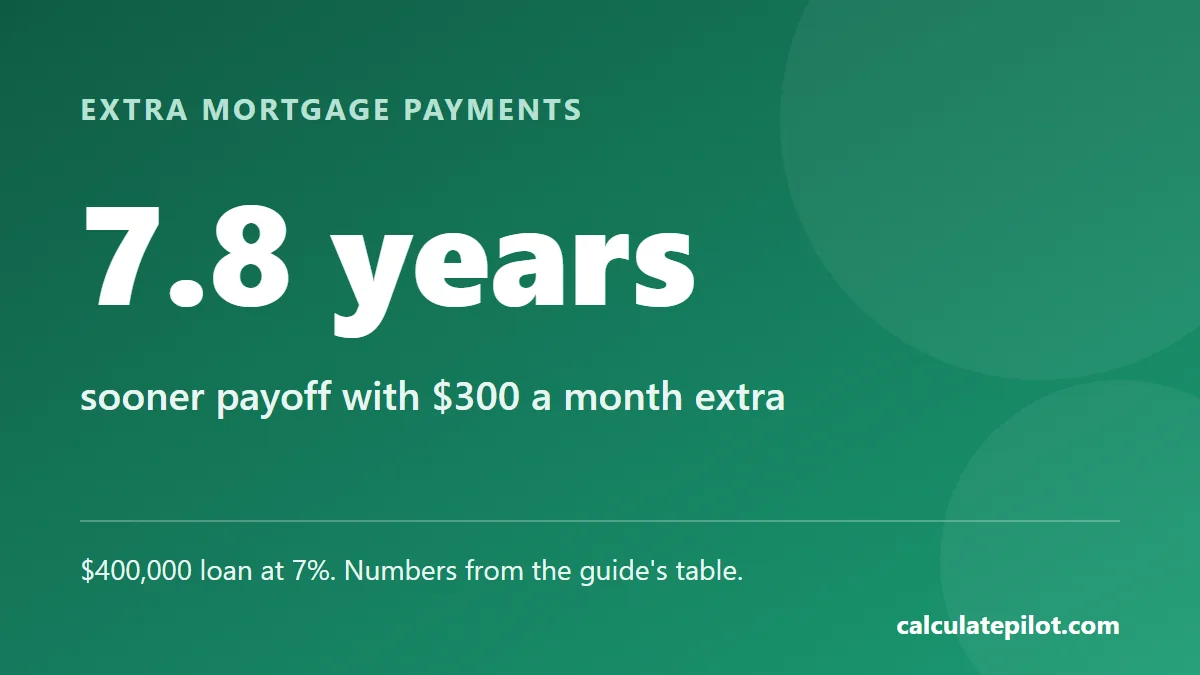
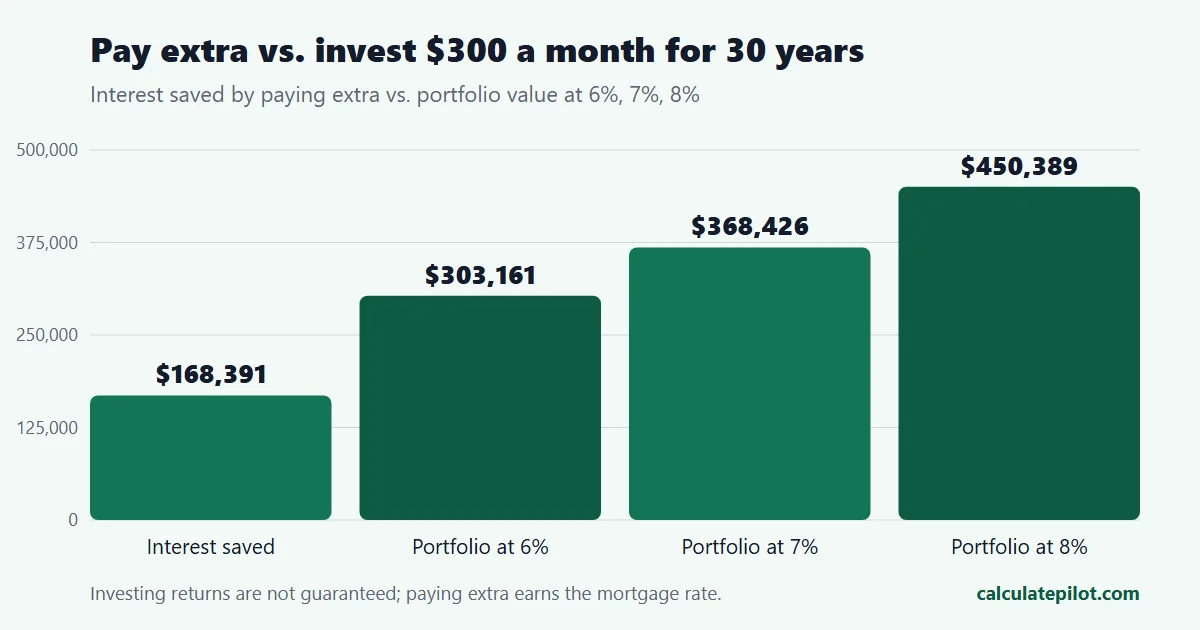
| +$300/mo to principal | Loan paid off in 22.2 yrs (7.8 yrs early); $168,391 less interest paid |
| Invest $300/mo instead, at 6% avg return | Portfolio worth ~$303,161 at year 30 |
| Invest $300/mo instead, at 7% avg return | Portfolio worth ~$368,426 at year 30 |
| Invest $300/mo instead, at 8% avg return | Portfolio worth ~$450,389 at year 30 |
The break-even is your mortgage rate itself. Paying down principal is mathematically identical to earning a guaranteed, tax-free 7% return with zero volatility — no down years, no sequencing risk. Investing only comes out ahead if your actual after-tax return clears that bar consistently, which historically has depended heavily on which years you happened to invest in. If your rate is 3–4% from an older loan, the math tilts toward investing much more easily than if your rate is 7%+.
2. Biweekly payments: the quiet 6-year shortcut
A biweekly schedule splits your payment in half and takes it out every two weeks instead of once a month. Since a year has 52 weeks, that works out to 26 half-payments — the equivalent of 13 full monthly payments instead of 12. You're not paying more per year in any way that feels different; you're just making one extra payment annually without a lump sum.
| Schedule | Payoff time | Total interest |
|---|---|---|
| Monthly ($350,000 loan, 6.75%) | 30.1 years | $467,234 |
| Biweekly (13 payments/yr) | 24.0 years | $356,822 |
That's 6.1 years shorter and $110,411 less interest — with no change to how much you're actually paying monthly, just the timing. One catch: confirm your servicer applies biweekly payments directly to principal rather than holding them until a full monthly amount accumulates. Some servicers charge a setup fee for an official biweekly program; you can get the identical result for free by just adding 1/12th of your payment to each monthly payment yourself.
3. When does PMI actually come off?
Under the federal Homeowners Protection Act, lenders must automatically cancel PMI once your loan balance falls to 78% of the home's original value, based on your original amortization schedule — regardless of what the home is worth now. You can also proactively request removal once you hit 80%, which most borrowers don't realize is available months before the automatic cutoff.
Example: $350,000 home, 10% down ($315,000 loan) at 6.75%:
| Milestone | Standard payments | +$200/mo extra |
|---|---|---|
| Reach 80% LTV (request removal) | 8.2 years | 5.2 years |
| Reach 78% LTV (automatic) | 9.3 years | — |
An extra $200/month moved the request-eligible date up by roughly 3 years. If PMI on this loan runs $130–$260/month (typical range at 0.5–1% of loan annually), that acceleration alone can be worth $4,000–$9,000 in avoided premiums.
4. Are mortgage points worth it?
One point costs 1% of the loan amount upfront and typically buys the rate down by about 0.25%. Whether it's worth it comes down to one number: how many months until the monthly savings repay the upfront cost.
| Points | Cost ($400k loan) | New rate | Monthly savings | Breakeven |
|---|---|---|---|---|
| 0 (baseline) | — | 7.00% | — | — |
| 1 point | $4,000 | 6.75% | $67 | 60 months (5 yrs) |
| 2 points | $8,000 | 6.50% | $133 | 60 months (5 yrs) |
If you plan to stay in the home (and keep this loan, un-refinanced) past the breakeven point, points pay for themselves. If there's a real chance you'll sell or refinance sooner — common with job relocation, growing families, or when rates are falling — that upfront cash is usually better kept liquid or put toward a larger down payment instead.
5. Frequently Asked Questions
Should I pay extra on my mortgage or invest the money instead?expand_more
On a $400,000 loan at 7%, $300/month extra saves $168,391 in interest and pays off the loan 7.8 years early — a guaranteed 7% return. Investing the same $300/month at an 8% average return would grow to about $450,389 over the same period. Investing wins only if your after-tax return reliably beats your mortgage rate and you can tolerate the risk; paying down the loan is the certain outcome.
How much do biweekly mortgage payments actually save?expand_more
On a $350,000 loan at 6.75%, biweekly payments (13 monthly-equivalent payments/year instead of 12) cut the term from 30.1 to 24.0 years and save $110,411 in total interest.
When can I remove PMI from my mortgage?expand_more
By federal law, PMI automatically terminates at 78% of original home value on schedule; you can request removal yourself once you hit 80%. On a $350,000 home with 10% down, that's 8.2 years on standard payments, or 5.2 years with $200/month extra toward principal.
Are mortgage points worth buying?expand_more
On a $400,000 loan, 1 point ($4,000) dropping the rate from 7.00% to 6.75% saves $67/month and breaks even in 60 months. Worth it if you'll keep the loan that long; skip it if you might sell or refinance sooner.
Figures are illustrative estimates based on standard amortization math, not a lender quote. PMI cancellation is governed by the federal Homeowners Protection Act of 1998; confirm your specific servicing terms with your lender. This is not financial or investment advice — talk to a licensed advisor about your own risk tolerance and tax situation before choosing between paying down debt and investing.