Short answer
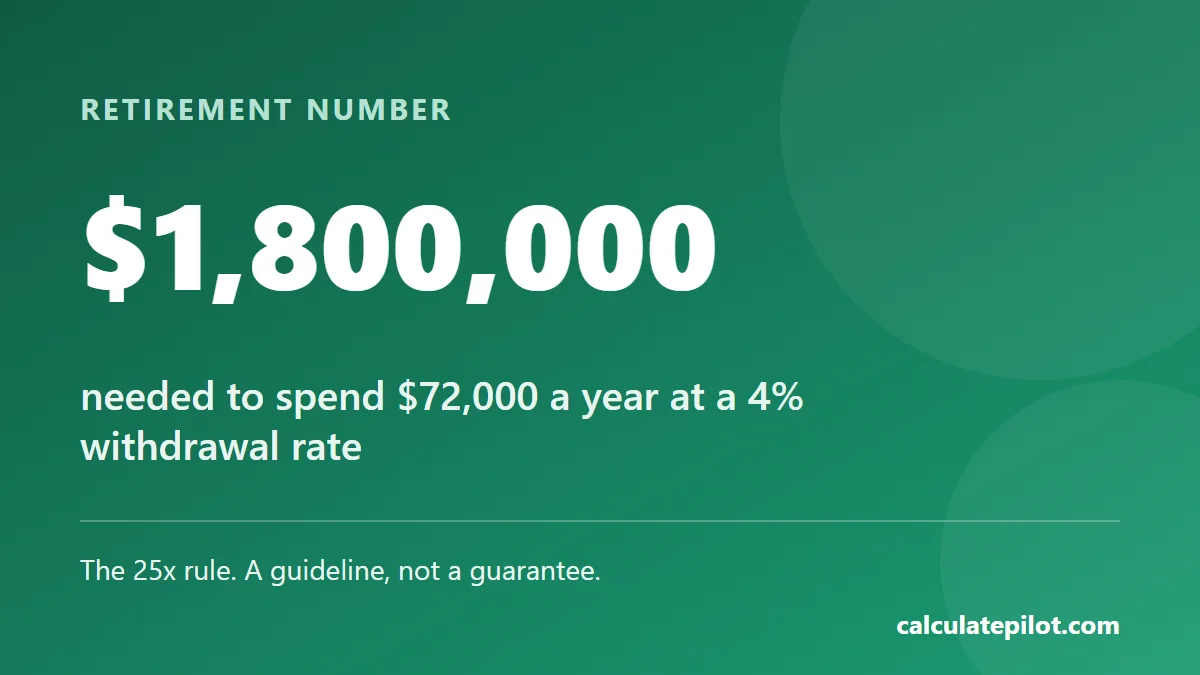
A common rule of thumb is to save 25 times your planned annual spending, which equals withdrawing 4% of your portfolio in the first year of retirement. If you expect to spend $72,000 a year, that is $72,000 ÷ 0.04 = $1,800,000. It is a starting point, not a guarantee.
1. How much you need by spending and withdrawal rate
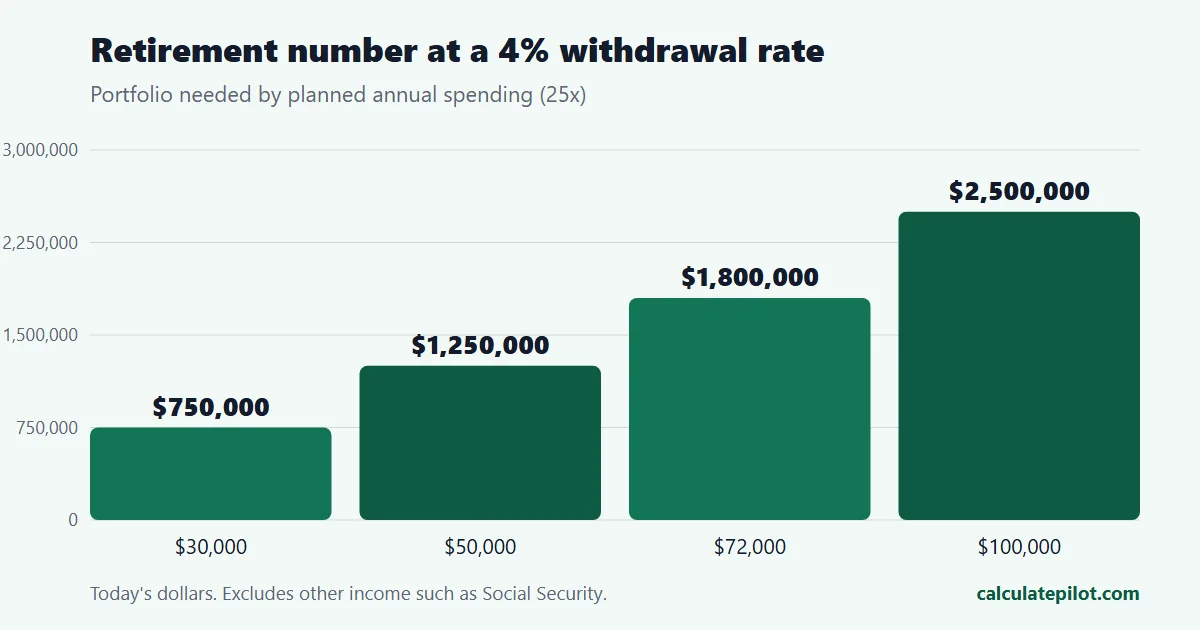
| Annual spending | At 4% (25x) | At 3.5% (28.6x) | At 3% (33.3x) |
|---|---|---|---|
| $30,000 | $750,000 | $857,143 | $1,000,000 |
| $50,000 | $1,250,000 | $1,428,571 | $1,666,667 |
| $72,000 | $1,800,000 | $2,057,143 | $2,400,000 |
| $100,000 | $2,500,000 | $2,857,143 | $3,333,333 |
A lower withdrawal rate means a bigger target but a larger margin for error, which people planning a long retirement often prefer.
2. Where the 4% rule comes from
The safe withdrawal rate was formalized in William Bengen's 1994 paper and extended by Trinity University researchers (Cooley, Hubbard and Walz) in 1998. It is the share of a diversified stock and bond portfolio a retiree withdraws in year one, then raises each year only for inflation. A 4% rate survived every historical 30-year period in Bengen's US data. That is a strong track record, not a guarantee.
3. What the number leaves out
- Sequence-of-returns risk. A sharp market fall in the first three to five years of retirement can do lasting damage when you are withdrawing money at the same time.
- A longer retirement. The 4% result was based on 30-year periods. Retiring early may call for a lower rate.
- Other income and taxes. Social Security, pensions and taxes change how much you need to draw from the portfolio.
- Healthcare and inflation. Spending can rise faster than general prices.
4. Ways to make the plan more resilient
- Guardrails: skip the inflation raise after losing years and trim spending when the withdrawal rate drifts too high.
- A cash buffer: hold 24 to 36 months of baseline living costs in cash or short-duration bonds so you avoid selling depressed stocks early.
5. Common mistakes
- Using income instead of spending. The target is based on what you plan to spend.
- Forgetting inflation. The number is in today's dollars and grows over time.
- Treating 4% as a promise. It is a historical benchmark.
Run your own numbers in the Retirement Calculator, which projects your balance and your FIRE number. See how savings grow in the Compound Interest Calculator and read how to calculate compound interest.
6. Frequently asked questions
How much do I need to retire?expand_more
A common rule of thumb is 25 times your planned annual spending, based on a 4% safe withdrawal rate. For $72,000 a year that is $1,800,000.
What is the 4% rule?expand_more
Withdraw 4% of your portfolio in the first year of retirement, then raise the amount each year for inflation. It survived every historical 30-year period in Bengen's US data, but it is not a guarantee.
Is 4% safe for a long retirement?expand_more
Longer retirements, such as early retirement, may call for a lower rate like 3.5% or 3%, which raises the savings target.
Should my target be based on income or spending?expand_more
Spending. The number comes from what you plan to spend each year in retirement.
7. Sources
- menu_bookBengen WP. Determining withdrawal rates using historical data. Journal of Financial Planning, 1994.
- menu_bookCooley PL, Hubbard CM, Walz DT. Retirement savings: choosing a withdrawal rate that is sustainable. AAII Journal, 1998 (Trinity study).
This is general education, not personal financial advice. Returns, inflation and spending vary.