Short answer
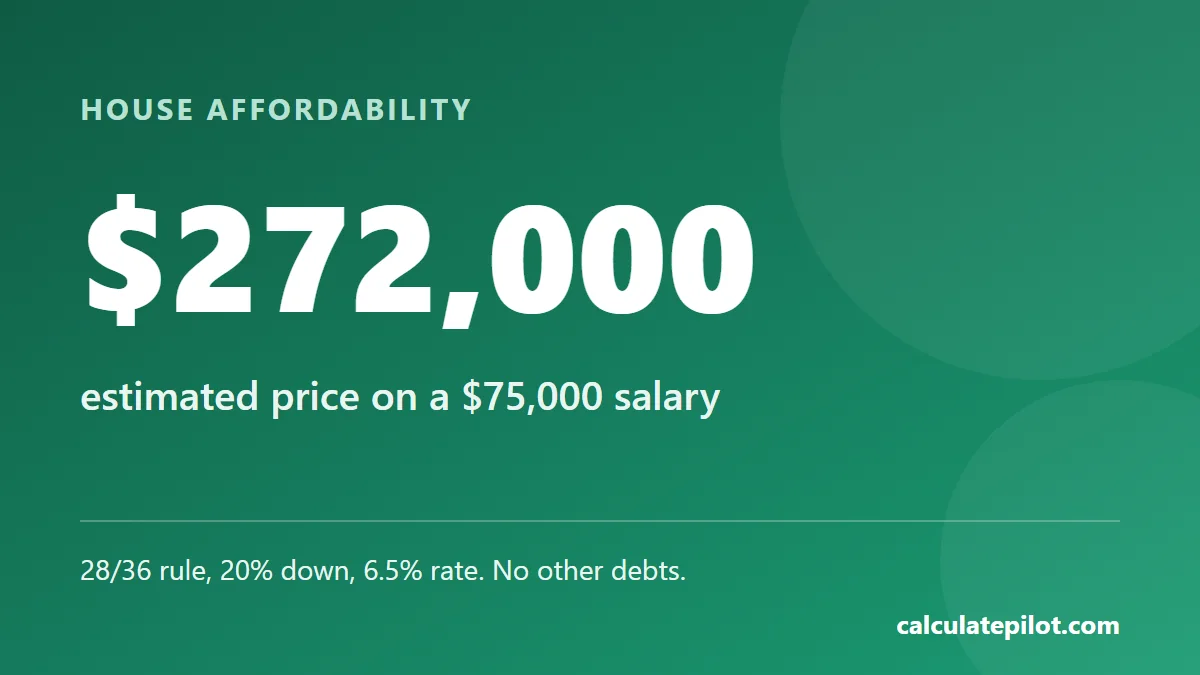
With a $75,000 salary, no other debts, 20% down, a 6.5% rate and typical taxes and insurance, the 28/36 rule suggests a home price of roughly $272,000. The rule limits your total housing cost to 28% of gross income ($1,750 a month here). Your result changes with your rate, down payment, taxes and debts.
PITI is principal, interest, property tax and insurance, plus PMI when the down payment is under 20%. Lenders commonly use two ratios: a front-end ratio capping housing costs at 28% of gross monthly income, and a back-end ratio capping all debt payments at 36%. Use whichever limit is lower.
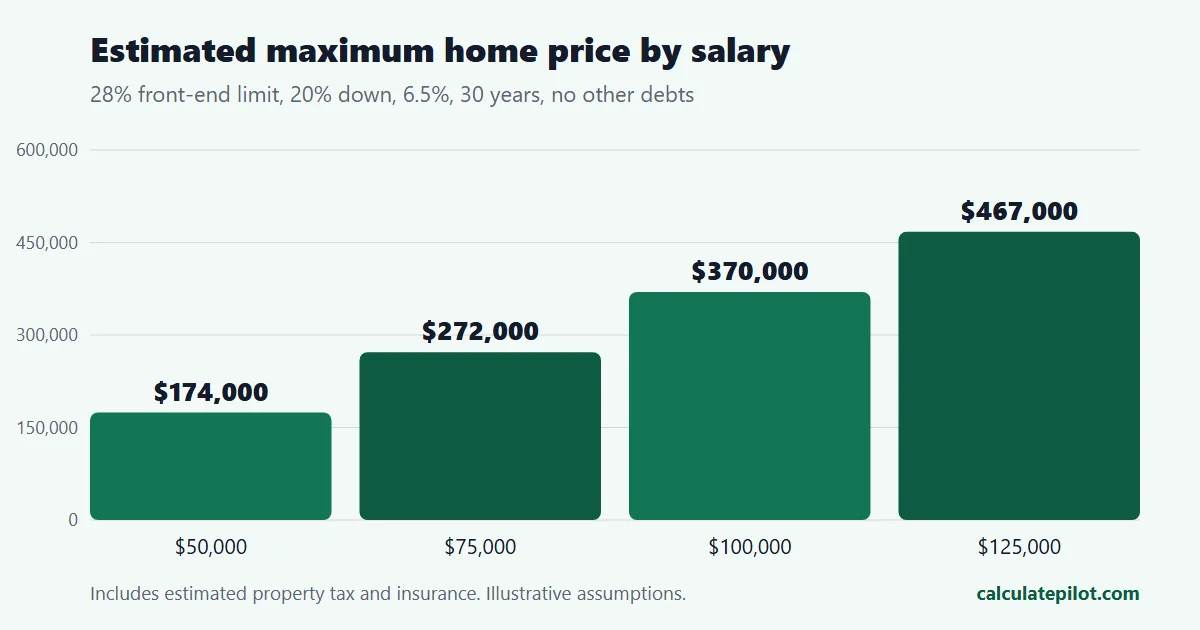
1. Estimated maximum price by salary
Assumptions: 6.5% on a 30-year fixed loan, 20% down (no PMI), property tax of 1.1% of the home price a year and $1,500 a year for homeowners insurance.
| Annual salary | Max PITI (no debts) | Est. max price (no debts) | Max PITI ($800 other debts) | Est. max price ($800 debts) |
|---|---|---|---|---|
| $50,000 | $1,167 | $174,000 | $700 | $96,000 |
| $75,000 | $1,750 | $272,000 | $1,450 | $222,000 |
| $100,000 | $2,333 | $370,000 | $2,200 | $347,000 |
| $125,000 | $2,917 | $467,000 | $2,917 | $467,000 |
Carrying $800 a month of other debt can lower the price you qualify for, because the 36% back-end limit then becomes the tighter one. At $75,000 a year it cuts the estimate from about $272,000 to about $222,000.
2. Worked example: $75,000 salary, no other debts
- 1Gross monthly income = $75,000 ÷ 12 = $6,250.
- 2Front-end limit = $6,250 × 0.28 = $1,750 a month for housing.
- 3Subtract insurance of $125 a month, leaving about $1,625 for principal, interest and tax.
- 4Solving for the price that fits gives roughly $272,000, with a 20% down payment of about $54,000.
3. What the rule doesn't include
- HOA fees and closing costs.
- Maintenance and repairs, often budgeted separately.
- Your comfort level. A payment that fits a ratio may still strain your budget.
Some lenders allow higher back-end ratios (up to 43% to 50%) for well-qualified borrowers, and cautious buyers may prefer to stay below these limits. Getting pre-approved by a lender is the most accurate way to know your real number.
4. Common mistakes
- Using net pay with a gross-income rule.
- Ignoring taxes and insurance. They are part of the housing payment in both ratios.
- Forgetting other debts. Car and student loan payments count toward the 36% limit.
Enter your own numbers in the House Affordability Calculator. Compare with the Mortgage Calculator, read how much down payment a $400,000 house needs, and see how much rent you can afford.
5. Frequently asked questions
How much house can I afford on a $75,000 salary?expand_more
Roughly $272,000 using the 28/36 rule with 20% down, a 6.5% rate and typical taxes and insurance, if you have no other debts. It falls to about $222,000 with $800 a month of other debt.
What is the 28/36 rule?expand_more
Housing costs should be no more than 28% of gross monthly income, and total debt payments no more than 36%.
Do lenders ever allow more than 36%?expand_more
Some lenders allow back-end ratios up to 43% to 50% for well-qualified borrowers, but higher ratios mean a heavier payment burden.
Does the estimate include closing costs?expand_more
No. It also leaves out HOA fees and maintenance.
6. Sources
- menu_bookThe 28/36 underwriting guideline for front-end and back-end debt-to-income ratios
- menu_bookStandard mortgage amortization formula (see the CalculatePilot methodology)
Rates, taxes and insurance are illustrations, not offers. Not financial advice. Pre-approval gives your actual limit.