Short answer
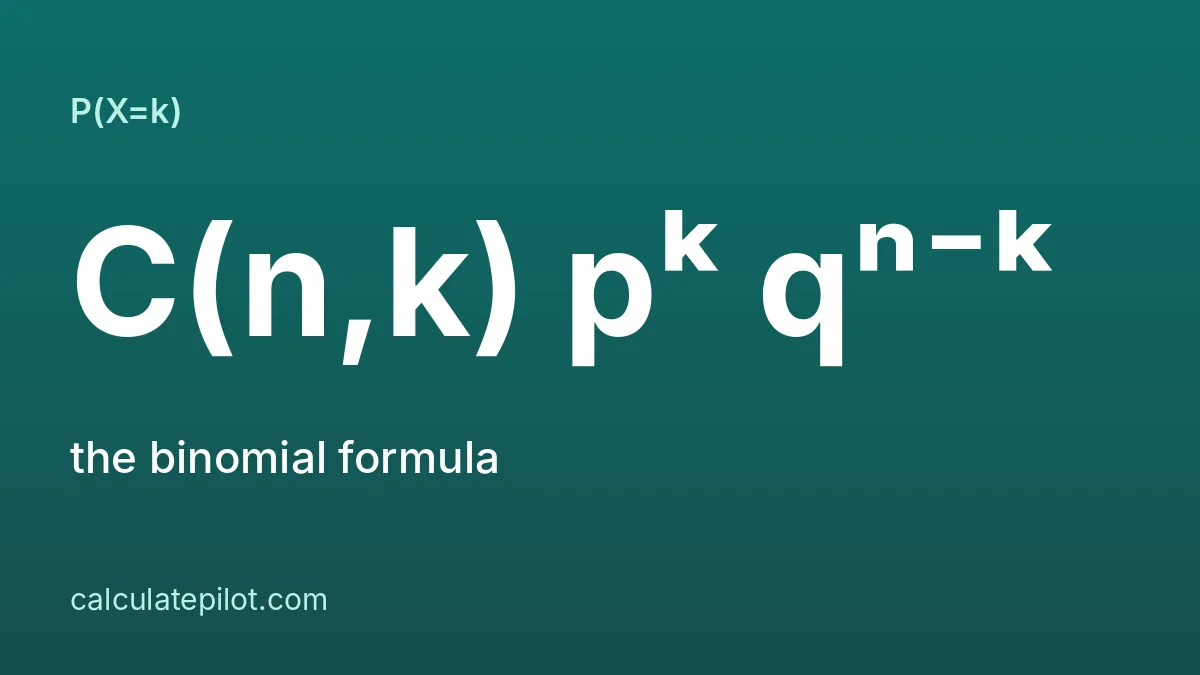
The probability of exactly k successes in n independent trials is P(X = k) = C(n, k) · p^k · (1 − p)^(n−k). For 3 sixes in 12 rolls, C(12,3) = 220, so P = 220 × (1/6)³ × (5/6)⁹ = 0.197396.
1. The formula
P(X = k) = C(n, k) · pk · (1 − p)n−k, where C(n, k) = n! ÷ (k! (n − k)!).
2. Example: 3 sixes in 12 rolls
- 1n = 12, p = 1/6, k = 3.
- 2C(12, 3) = 220.
- 3(1/6)3 × (5/6)9 ≈ 0.000897.
- 4220 × 0.000897 ≈ 0.197396.
3. At most, at least and between
| Question | How | n = 12, p = 1/6 |
|---|---|---|
| Exactly 3 | P(X = 3) | 0.197396 |
| At most 3 | P(X ≤ 3), sum of k = 0 to 3 | 0.874822 |
| At least 4 | 1 − P(X ≤ 3) | 0.125178 |
| At least one six | 1 − (5/6)12 | 0.887843 |
For a range, subtract two cumulative values: P(a ≤ X ≤ b) = P(X ≤ b) − P(X ≤ a − 1). With 10 fair coin flips, P(4 ≤ X ≤ 6) = 0.828125 − 0.171875 = 0.65625.
4. Second example: 6 heads in 10 flips
C(10, 6) = 210 and 0.510 = 1/1024, so P(X = 6) = 210 ÷ 1024 = 0.205078. At least 6 heads is 0.376953.
5. Check your work
Enter n, p and k in the Binomial Probability Calculator to see every tail, the mean and variance, and the working. Next: mean, variance and standard deviation.
6. Frequently asked questions
What is the binomial probability formula?expand_more
P(X = k) = C(n, k) · p^k · (1 − p)^(n−k).
How do I find at least k successes?expand_more
Add P(X = i) from k to n, or compute 1 − P(X ≤ k − 1).
What is C(n, k)?expand_more
The number of ways to choose which k trials are successes: n! ÷ (k! (n − k)!).
What is the chance of at least one six in 12 rolls?expand_more
1 − (5/6)^12 = 0.887843.