Short answer
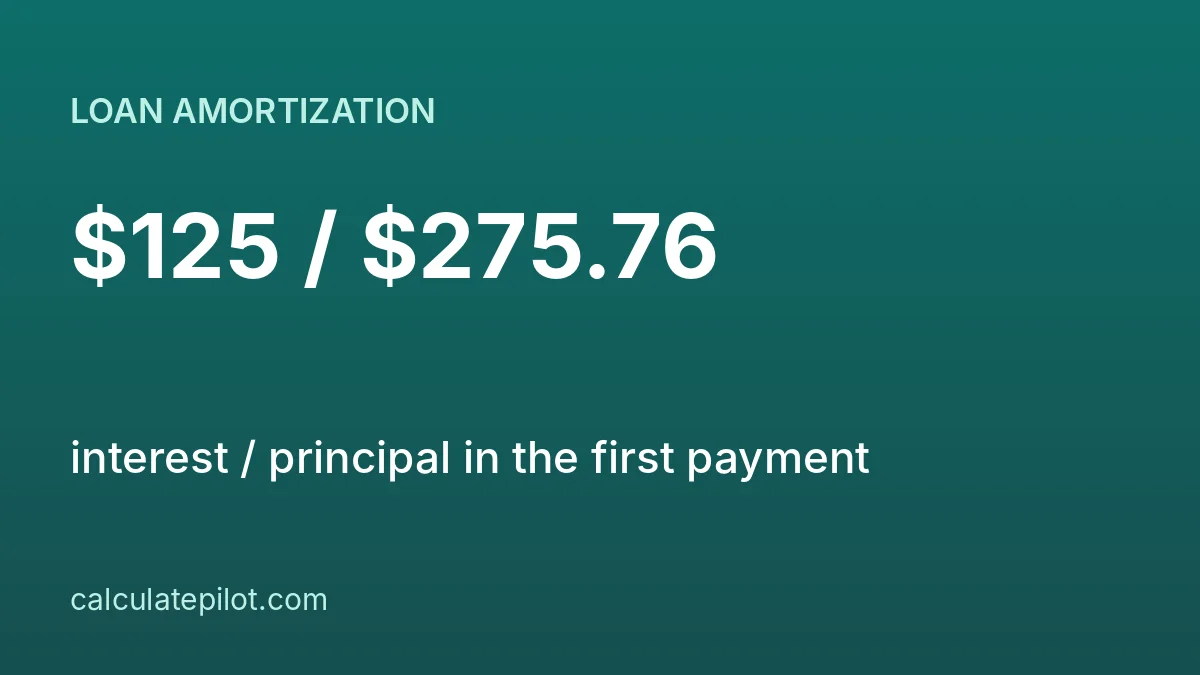
Each payment on an amortizing loan covers that month's interest first, with the rest reducing principal. On a $20,000, 7.5%, 60-month loan the $400.76 payment starts as $125.00 interest and $275.76 principal, and the interest share shrinks every month.
1. The payment formula
M = P × [ i(1+i)n ] ÷ [ (1+i)n − 1 ], where P is the loan amount, i is the monthly rate (annual rate ÷ 12) and n is the number of months. For $20,000 at 7.5% over 60 months, i = 0.00625 and M = $400.76.
2. How each payment splits
- 1Interest for the month = balance × i. First month: $20,000 × 0.00625 = $125.00.
- 2Principal = payment − interest = $400.76 − $125.00 = $275.76.
- 3New balance = $20,000 − $275.76 = $19,724.24. Repeat.
Because the balance falls, interest falls and principal rises, even though the payment never changes. Over 60 months the interest totals $4,046.
3. What this means for you
- Early extra payments save the most interest. See the table.
- Paying off a loan early in its life leaves you owing most of the original principal, so selling or refinancing soon after you borrow rarely leaves much equity.
- Some loans calculate interest daily, which can differ by a few cents from a monthly schedule.
The Loan Calculator shows the full month-by-month ledger and a balance chart.
4. Frequently asked questions
How is a loan payment calculated?expand_more
With M = P × [i(1+i)^n] ÷ [(1+i)^n − 1], where i is the monthly rate and n the number of months.
Why is my first loan payment mostly interest?expand_more
Interest is charged on the full balance, which is highest at the start. On $20,000 at 7.5%, $125 of the first $400.76 payment is interest.
Does the monthly payment change over time on a fixed-rate loan?expand_more
No. The payment stays level, but the split shifts from interest toward principal.
What is an amortization schedule?expand_more
A table showing each payment's interest, principal and remaining balance until the loan is paid off.