Short answer
The Widmark formula estimates BAC as alcohol in grams divided by body weight in grams times r, times 100, minus 0.015% per hour. For an 80 kg man who had 4 standard drinks (56 g) over 2 hours, that is 0.103% minus 0.030%, or about 0.073%.
1. The formula
BAC (%) = alcohol (g) ÷ (body weight (g) × r) × 100 − 0.015 × hours
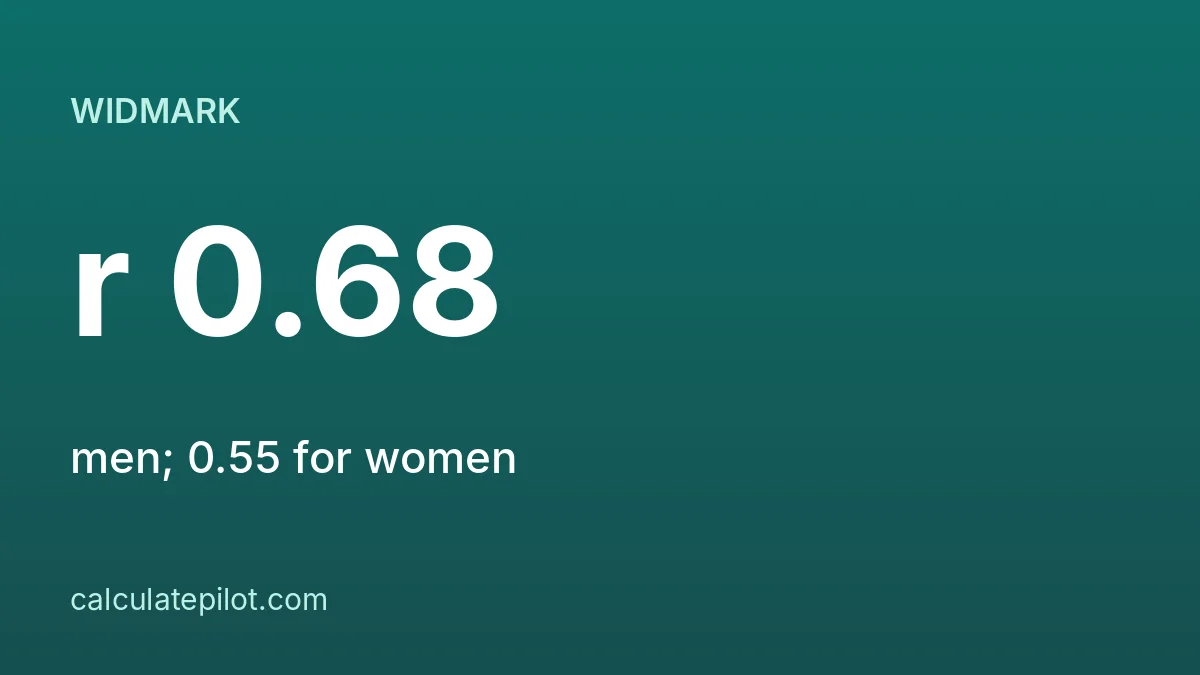
- r: body-water distribution factor, 0.68 for men and 0.55 for women (Widmark's averages).
- Alcohol (g): standard drinks × 14 g, or volume (mL) × ABV × 0.789.
- 0.015% per hour: a commonly used, conservative elimination rate.
2. Worked example
An 80 kg man, 4 standard drinks (56 g), measured 2 hours after starting:
- 56 ÷ (80,000 × 0.68) × 100 = 0.103%.
- Minus 0.015 × 2 = 0.030.
- Estimate: about 0.073%.
3. Limits of the formula
- It uses population averages, not your body composition.
- Food, drinking speed and medications change real BAC.
- Only a breath or blood test measures BAC.
Use the BAC Calculator, which applies this formula, and the BAC chart for quick comparisons.
4. Frequently asked questions
What is the Widmark formula?expand_more
A classic method for estimating BAC from alcohol consumed, body weight, sex and time.
What is r in the Widmark formula?expand_more
The body-water distribution factor: 0.68 for men and 0.55 for women.
How accurate is it?expand_more
It gives a rough average estimate. Real BAC varies with food, speed, body composition and metabolism.
Why subtract 0.015 per hour?expand_more
It models alcohol elimination at a commonly used average rate.
5. Sources
- menu_bookNIAAA: What is a standard drink?
- menu_bookNHTSA: Drunk Driving