Short answer
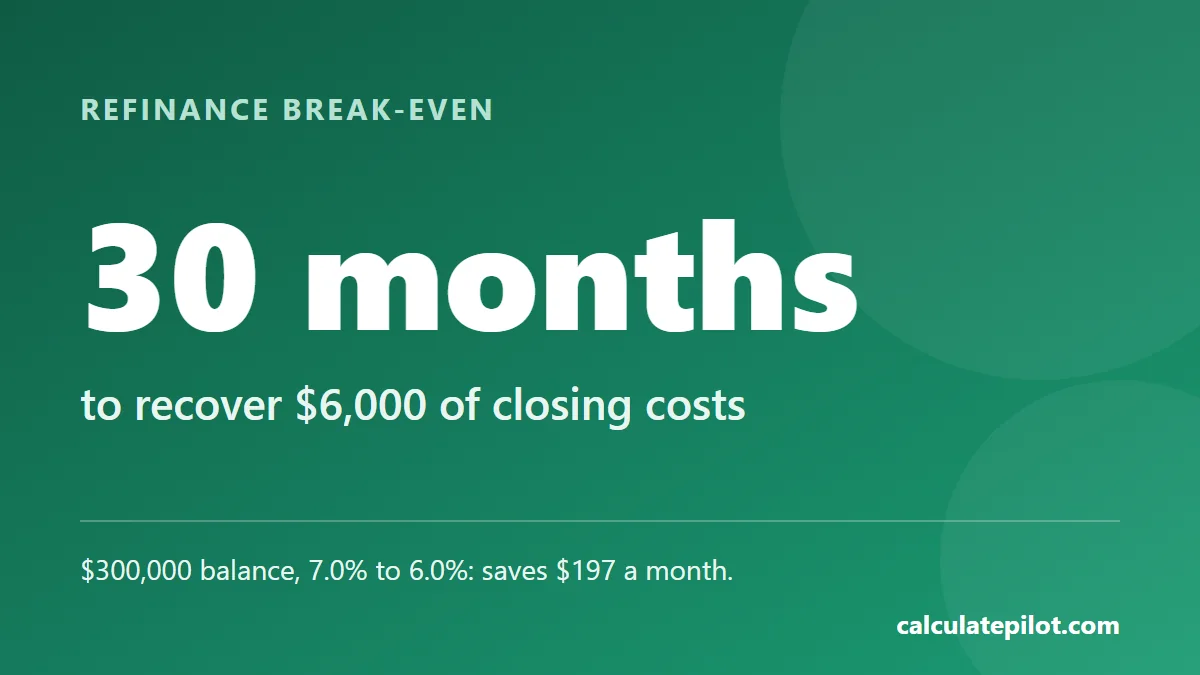
Divide your closing costs by your monthly payment savings. Refinancing $300,000 from 7.0% to 6.0% with $6,000 of closing costs saves about $197 a month, so you break even in about 30 months (2.5 years). If you keep the loan longer than that, the refinance pays off; if you sell sooner, it costs you.
Both payments are principal and interest. This is the quick method; a fuller version also tracks how the balance changes, because restarting a 30-year term lowers the payment partly by paying down principal more slowly.
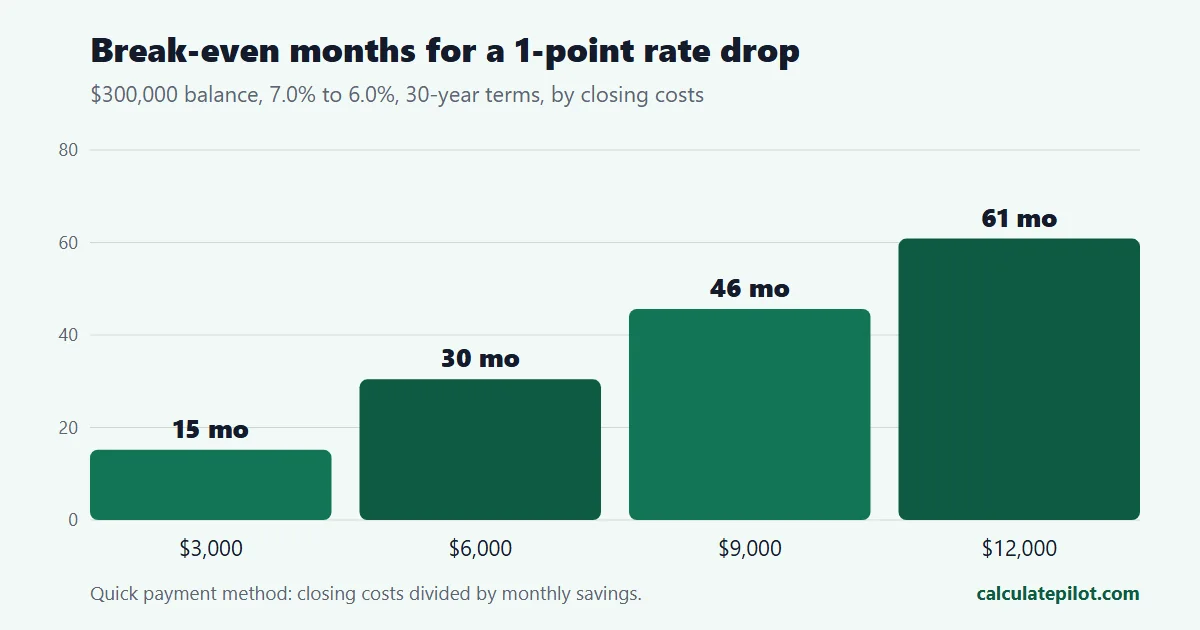
1. Break-even months by closing costs and rate drop
Example: a $300,000 balance currently at 7.0% (payment $1,995.91), refinanced into a new 30-year loan.
| Closing costs | Rate drops 0.50 pt | Rate drops 0.75 pt | Rate drops 1.00 pt |
|---|---|---|---|
| $3,000 | 30 months | 20 months | 15 months |
| $6,000 | 60 months | 40 months | 30 months |
| $9,000 | 90 months | 61 months | 46 months |
| $12,000 | 120 months | 81 months | 61 months |
A bigger rate drop and lower costs both shorten the break-even point. The table shows how fast a small drop with high costs can run past the time you plan to stay.
2. Worked example
- 1Old payment: $300,000 at 7.0% for 30 years = $1,995.91.
- 2New payment: $300,000 at 6.0% for 30 years = $1,798.65.
- 3Monthly savings = $197.26.
- 4Break-even = $6,000 ÷ $197.26 = 30.4 months.
3. When refinancing may not make sense
- You will move before break-even. Closing costs will exceed your savings.
- You are far into your current loan. Restarting a 30-year term puts you back in the interest-heavy early years, which can raise total interest even with a lower rate.
- You are switching from fixed to adjustable. An adjustable rate can reset higher.
4. Common mistakes
- Comparing only the monthly payment. A longer term lowers the payment but can increase total interest.
- Ignoring costs rolled into the loan. They still count as money you pay back with interest.
- Using the quick break-even as the only test. Check total interest and the new payoff date too.
Test your own numbers in the Refinance Calculator, which also shows the net benefit over time. See where each payment goes with the Amortization Calculator and the monthly mortgage formula guide.
5. Frequently asked questions
How do you calculate the refinance break-even point?expand_more
Divide the closing costs by the monthly payment savings. For $6,000 of costs and $200 of monthly savings, break-even is 30 months.
How long should I stay in the home after refinancing?expand_more
At least until the break-even point. If you expect to sell or refinance again sooner, the closing costs may outweigh the savings.
Does a longer new term change the break-even?expand_more
Yes. A longer term lowers the payment partly by paying principal more slowly, so the fuller net-benefit method can show a later break-even than the quick estimate.
Are closing costs always paid upfront?expand_more
No. They can be rolled into the loan, which raises the balance and the interest you pay.
6. Sources
- menu_bookConsumer Financial Protection Bureau — guidance on refinancing a mortgage and comparing loan costs
- menu_bookStandard mortgage amortization formula (see the CalculatePilot methodology)
Rates and costs are illustrations, not offers. Not financial advice.