Short answer
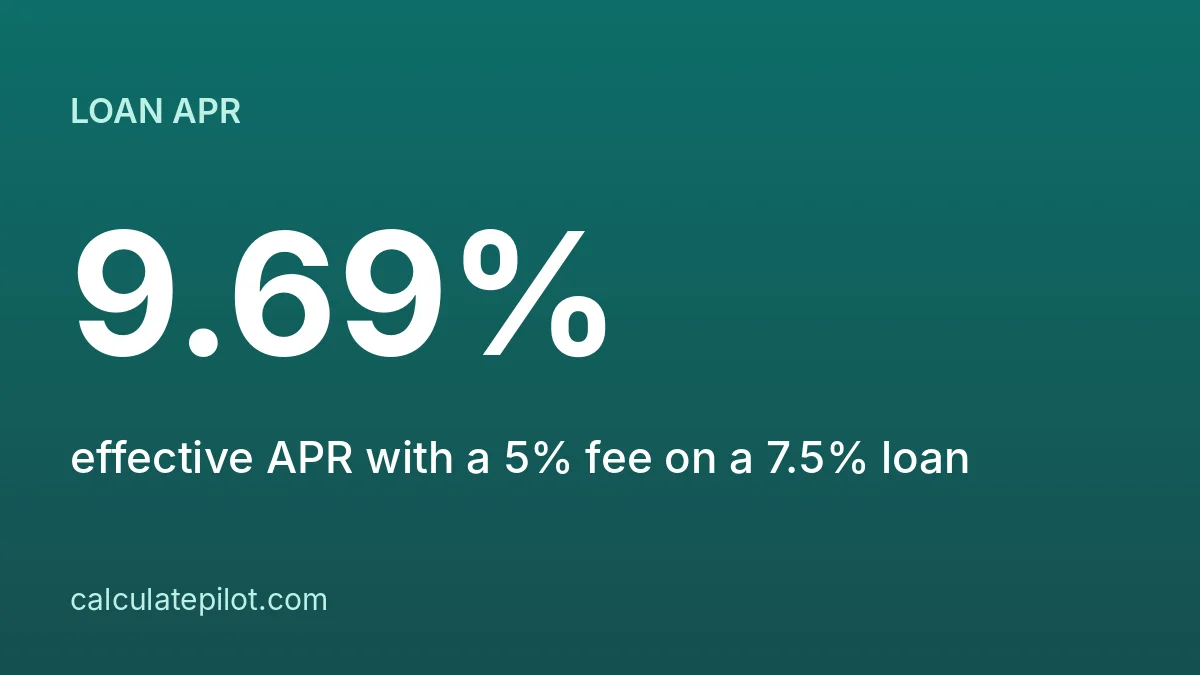
The interest rate is the price of the borrowed principal; the APR also reflects other charges you pay to get the loan. On a $20,000, 7.5%, 60-month loan, a 5% origination fee taken from the proceeds raises the effective APR to about 9.69%.
1. Interest rate vs APR
- Interest rate: the cost of borrowing the principal. It does not reflect fees.
- APR: the CFPB describes it as reflecting the interest rate plus other charges you pay to get the loan, which is why it is usually higher than the rate.
2. Worked example: a fee taken from the proceeds
You borrow $20,000 at 7.5% for 60 months. The payment is $400.76 whatever the fee. If the lender deducts the fee up front, you receive less but repay the full amount. The effective APR below is the rate that equates the cash you receive to the 60 payments.
| Origination fee | Cash you receive | Effective APR |
|---|---|---|
| 0% | $20,000 | 7.50% |
| 1% | $19,800 | 7.92% |
| 3% | $19,400 | 8.79% |
| 5% | $19,000 | 9.69% |
| 8% | $18,400 | 11.08% |
Your lender's official APR comes from its disclosure and may be computed slightly differently, so compare the figure on each offer.
3. How much to borrow to cover the fee
Divide the cash you need by one minus the fee. To receive $20,000 after a 5% fee, borrow $20,000 ÷ 0.95 = $21,053. Over 60 months at 7.5% the payment is about $421.85, which is $21.09 a month more than the no-fee loan.
4. Compare offers
- Compare APRs, not only rates.
- Compare the same term: a longer term lowers the payment but raises total interest.
- Ask about prepayment penalties. They are in the loan agreement, not the APR.
Use the Loan Calculator with the origination-fee option to see your own numbers, and read how extra payments cut interest.
5. Frequently asked questions
What is the difference between APR and interest rate?expand_more
The interest rate is the cost of borrowing the principal. APR also reflects other charges you pay to get the loan, so it is usually higher.
How does an origination fee affect APR?expand_more
On a $20,000 loan at 7.5% over 60 months, a 5% fee deducted from the proceeds raises the effective APR to about 9.69%.
How much should I borrow to cover an origination fee?expand_more
Divide the cash you need by one minus the fee. For $20,000 after a 5% fee, borrow about $21,053.
Is a lower interest rate always cheaper?expand_more
No. A lower rate with a large fee can cost more than a slightly higher rate with no fee, so compare APR and total cost over the same term.