Short answer
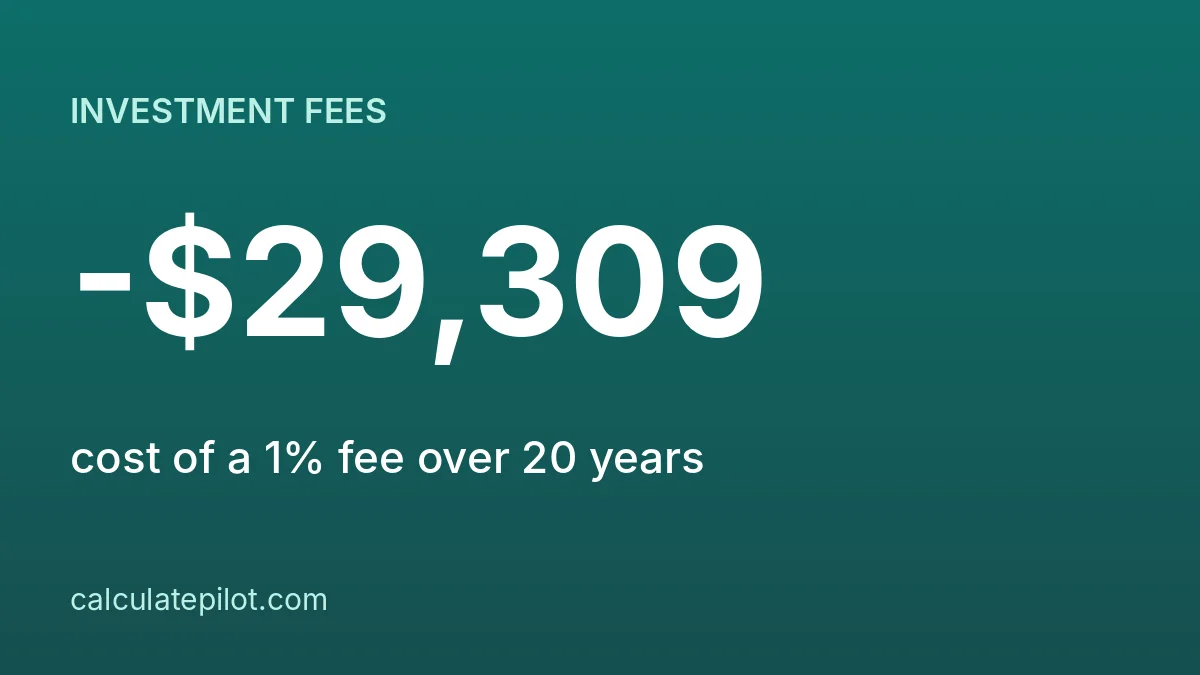
A 1 percentage point annual fee turns a $225,974 portfolio into $196,665 over 20 years, a loss of about $29,300, or 13%. Fees are taken from your return every year, so they compound the same way growth does.
1. How to model a fee
The simplest way to include an annual fee in the calculator is to subtract it from your expected return. If a fund returns 8% before fees and charges 1%, enter 7%. The tables below do exactly that.
2. 20 years, $10,000 plus $300 a month
| Annual fee | Return after fees | Ending balance | Lost to fees |
|---|---|---|---|
| None | 8.0% | $225,974 | $0 |
| 0.1% | 7.9% | $222,825 | $3,149 |
| 0.5% | 7.5% | $210,727 | $15,247 |
| 1% | 7.0% | $196,665 | $29,309 |
| 2% | 6.0% | $171,714 | $54,260 |
Contributions total $82,000 in every row, so the whole gap is lost growth. A 2% fee takes about 24% of the final balance.
3. 30 years, one $100,000 investment
| Return after fees | Ending balance |
|---|---|
| 7% | $811,650 |
| 6% | $602,258 |
One extra percentage point in costs over 30 years cuts the result by $209,392, about 26%.
4. Things to remember
- Fees are charged whether the fund gains or loses that year.
- Check the expense ratio, any advisory fee and trading costs. They add up.
- Projections assume a steady return. Real returns vary year to year.
5. Try your own numbers
Run the calculator twice, once at your expected return and once after subtracting your fees, and compare the two ending balances. The difference is what fees cost you. For the formulas behind it, see how to calculate investment return.
6. Frequently asked questions
How much do investment fees cost over 20 years?expand_more
On $10,000 plus $300 a month at an 8% return before fees, a 1% annual fee reduces the ending balance from $225,974 to $196,665, a loss of about $29,309.
Is a 1% fee a lot?expand_more
It is large relative to low-cost options. Over 20 years in our example it costs about 13% of the final balance, and over 30 years on a single $100,000 investment, one extra point costs about 26%.
How do I include fees in an investment calculator?expand_more
Subtract the annual fee from your expected return and enter the result. For example, use 7% for an 8% fund with a 1% fee.
Do fees matter if returns are high?expand_more
Yes. Fees compound against you every year whatever the return, so the gap in dollars grows as balances grow.
7. Sources
- menu_bookInvestor.gov: Fees and expenses