Short answer
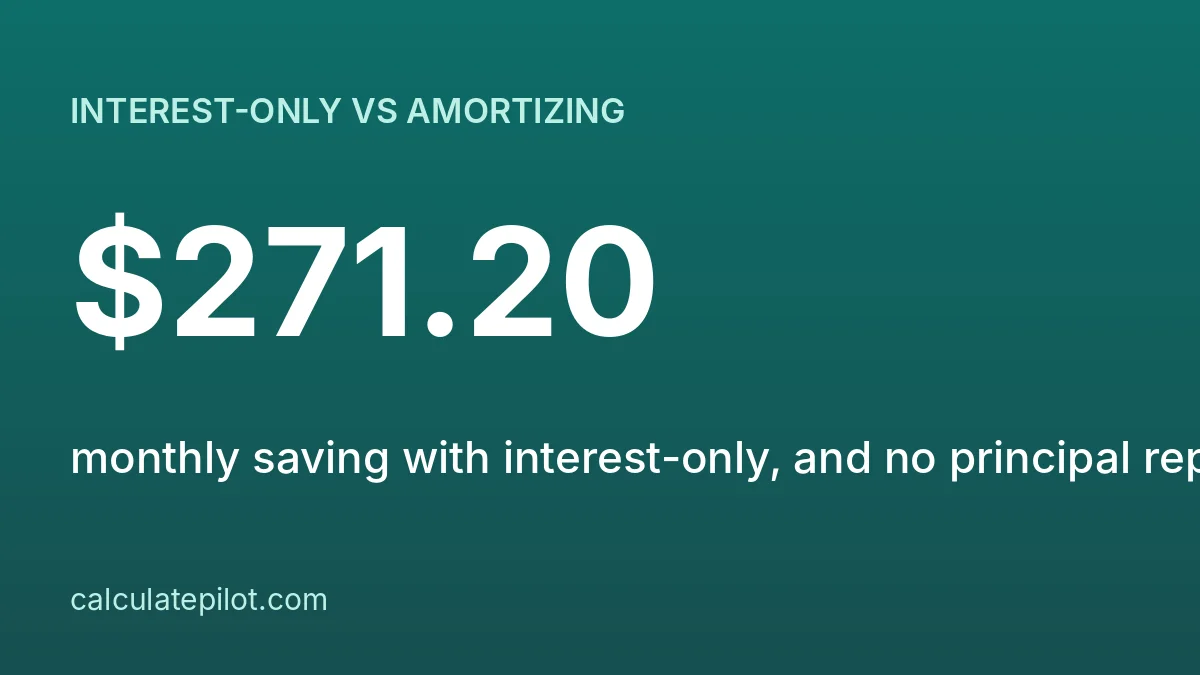
On $300,000 at 6.5%, an interest-only loan costs $1,625.00 a month but leaves the full $300,000 owed, while a 30-year amortizing loan costs $1,896.20 a month and cuts the balance to about $280,833 after 5 years. A balloon loan on a 30-year schedule would owe that same $280,833 in one lump at year 5.
1. Side by side
| Loan ($300,000 at 6.5%) | Monthly payment | Owed after 5 years |
|---|---|---|
| Interest-only | $1,625.00 | $300,000 |
| 30-year fully amortizing | $1,896.20 | $280,833 |
| Balloon (30-year schedule, due at year 5) | $1,896.20 | $280,833 due in one payment |
| 5-year fully amortizing | $5,869.84 | $0 |
2. How each works
- Interest-only: you pay only the interest for a period, so the balance stays the same. Later payments usually rise when principal repayment begins.
- Fully amortizing: payments are level and cover interest plus principal, ending at zero.
- Balloon: payments follow a long schedule but the remaining balance is due early, so you must repay, refinance or sell.
3. Risks to weigh
- With interest-only, you build no equity from payments.
- A balloon payment can be a large sum you may not be able to refinance if rates or your finances change.
- Compare total cost and the payment after the interest-only period, not just the first payment.
Build a fully amortizing schedule in the Amortization Calculator, and see how amortization works.
4. Frequently asked questions
What is an interest-only loan?expand_more
A loan where payments cover only interest for a set period, so the balance does not fall. On $300,000 at 6.5% that is $1,625 a month.
What is a balloon payment?expand_more
A large lump sum due at the end of a shorter term, after smaller payments calculated on a longer schedule.
Is an interest-only loan cheaper?expand_more
The payment is lower at first, but you owe the full balance, and later payments are typically higher once principal repayment starts.
What happens to the payment after the interest-only period?expand_more
It usually rises, because the full balance must then be repaid over the remaining term. Check the terms in your loan documents.