Short answer
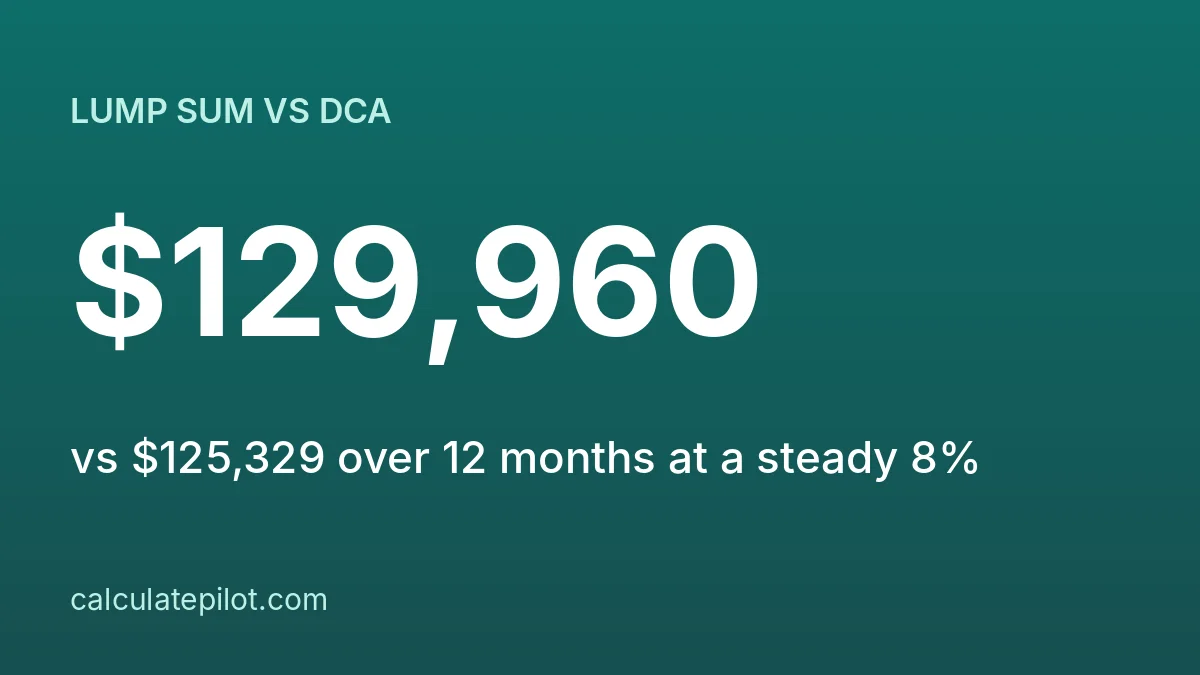
If returns were a steady 8% a year, investing $120,000 at once would end the year at about $129,960, while investing $10,000 a month would end near $125,329, because the lump sum has more time in the market. Dollar-cost averaging does not beat a steady return; its benefit is reducing the regret of buying just before a drop.
1. The two approaches
- Lump sum: invest the full amount on day one.
- Dollar-cost averaging (DCA): invest a fixed amount at regular intervals, such as $10,000 on the first of each month, until the money is all invested.
2. Worked example at a constant 8% return
You have $120,000. Investment growth is 8% a year compounded monthly. In the DCA plan, the money not yet invested earns nothing.
| Plan | Value after 12 months |
|---|---|
| Lump sum, $120,000 on day one | $129,960 |
| DCA, $10,000 at the start of each month | $125,329 |
| Difference | $4,631 in favour of the lump sum |
When the return is steady and positive, a lump sum wins because every dollar is invested longer. Real markets are not steady, so this is the best case for the lump sum, not a prediction.
3. What DCA is good for
- Regret control. If prices fall right after a lump sum, you feel the full loss. Spreading purchases out means part of your money buys at the lower prices.
- Income-based investing. If you invest from each paycheque, you are already doing DCA. That is what the monthly contribution box in the calculator models.
- Behaviour. A plan you can stick to beats a better plan you abandon in a downturn.
4. What it costs you
Because markets have tended to rise over long periods, money waiting in cash has often missed growth, as the example shows. Past performance does not guarantee future results, and your own outcome depends on the path prices take.
5. Model your own plan
Enter the lump sum as the starting amount to see the one-time case, or set the starting amount to zero and enter a monthly contribution to see regular investing. Compare the results at a conservative and an optimistic return. For how returns are measured, see how to calculate investment return.
6. Frequently asked questions
Is lump sum better than dollar-cost averaging?expand_more
With a steady positive return, yes: a lump sum has more time invested. In our example $120,000 at 8% ends the year at about $129,960 as a lump sum versus about $125,329 by DCA. Real markets are uneven, so DCA can look better when prices fall soon after you invest.
What is dollar-cost averaging?expand_more
Investing a fixed amount at regular intervals regardless of price. Regular monthly contributions from your income are a form of it.
Does the calculator model dollar-cost averaging?expand_more
Yes. The monthly contribution input adds the same amount each month, with an optional 3% yearly increase.
Should I invest a lump sum all at once?expand_more
That depends on your risk tolerance and time horizon. Many people split the difference by investing part immediately and the rest over several months. Talk to a qualified adviser about your own situation.