lightbulb
Short answer
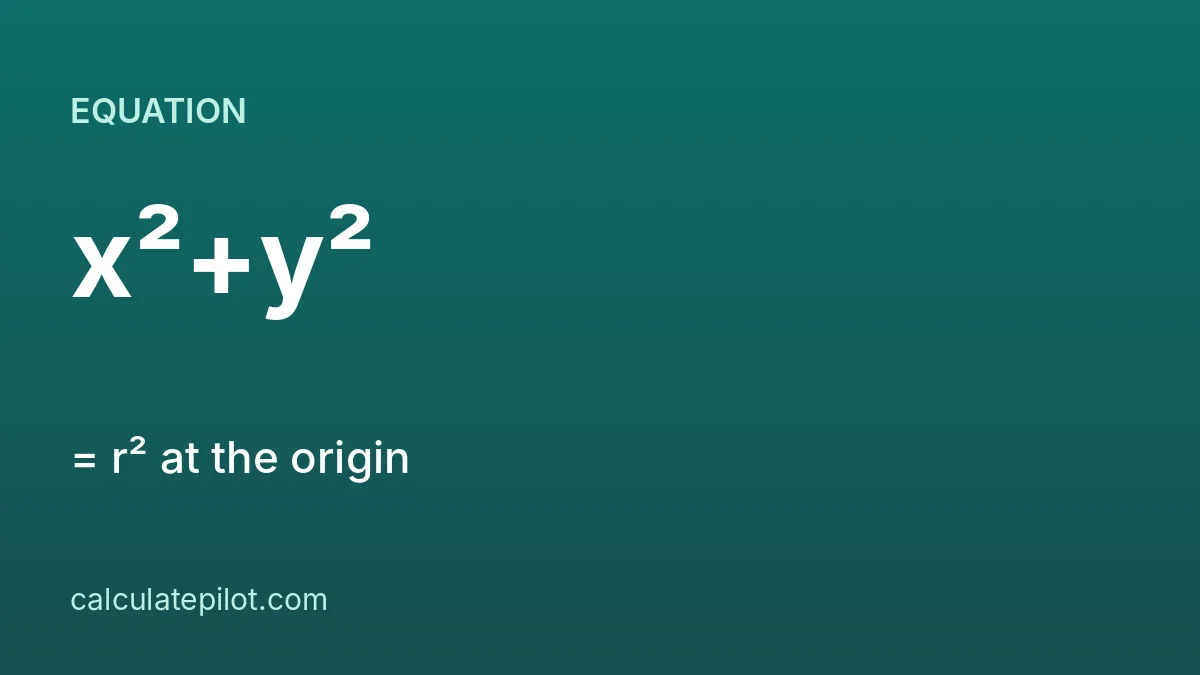
A circle with centre (h, k) and radius r has the equation (x − h)² + (y − k)² = r². At the origin it is x² + y² = r², so radius 5 gives x² + y² = 25.
1. Standard form
(x − h)² + (y − k)² = r², where (h, k) is the centre and r is the radius.
2. Examples
| Centre | Radius | Equation |
|---|---|---|
| (0, 0) | 5 | x² + y² = 25 |
| (3, −2) | 4 | (x − 3)² + (y + 2)² = 16 |
| (−1, 4) | 2 | (x + 1)² + (y − 4)² = 4 |
| (0, 0) | 10 | x² + y² = 100 |
3. Read the centre and radius
For (x − 2)² + (y + 1)² = 9 the centre is (2, −1) and the radius is √9 = 3. The signs are opposite to what appears in the brackets.
4. Area and circumference from the equation
Take the radius from the right side. For x² + y² = 25 the radius is 5, so the area is π × 25 = 78.54 and the circumference is 2π × 5 = 31.42.
5. Frequently asked questions
What is the equation of a circle?expand_more
(x − h)² + (y − k)² = r².
What is the equation of a circle at the origin?expand_more
x² + y² = r².
How do I find the radius from the equation?expand_more
Take the square root of the number on the right side.
How do I find the centre from the equation?expand_more
Reverse the signs inside the brackets. In (x − 3)² + (y + 2)² = 16 the centre is (3, −2).