lightbulb
Short answer
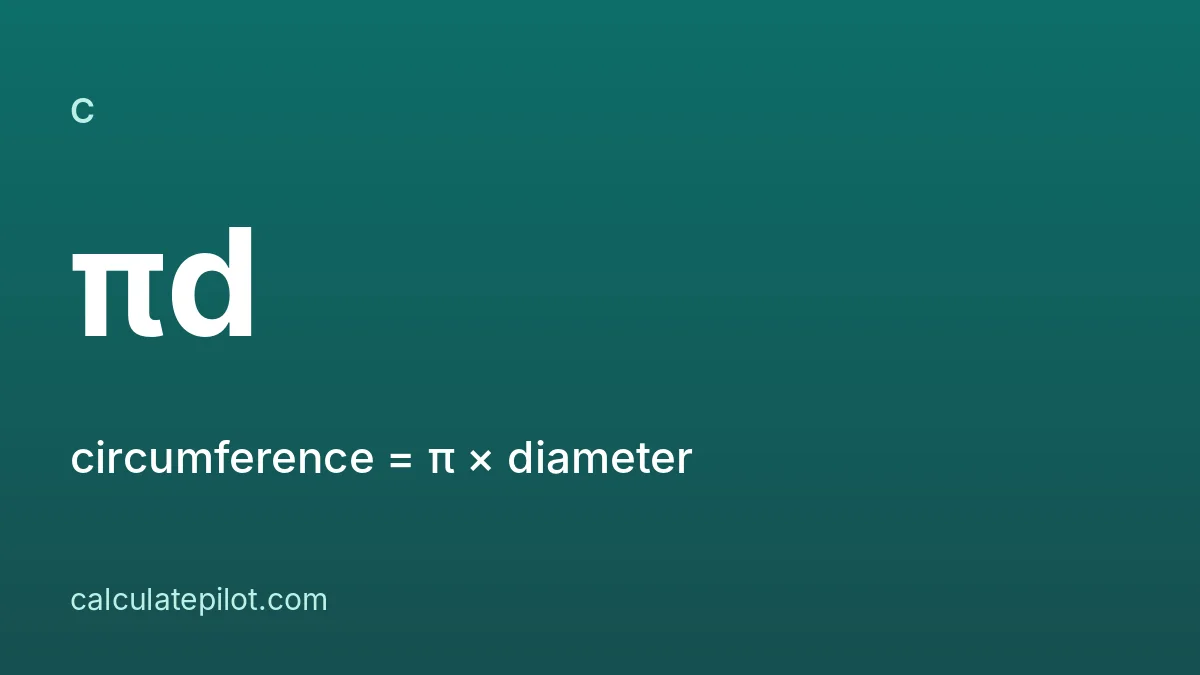
Circumference = πd = 2πr. A diameter of 10 gives a circumference of 31.42. To go back, divide the circumference by π to get the diameter.
1. The formulas
- From the diameter: C = πd
- From the radius: C = 2πr
- Diameter from the circumference: d = C ÷ π
- Radius from the circumference: r = C ÷ 2π
2. Worked examples
| Known value | Working | Result |
|---|---|---|
| Diameter 10 | π × 10 | 31.42 circumference |
| Radius 7.5 | 2π × 7.5 | 47.12 circumference |
| Circumference 44 | 44 ÷ π | 14.01 diameter |
| Circumference 44 | 44 ÷ 2π | 7.00 radius |
| Bicycle wheel, 26 in diameter | π × 26 | 81.68 in per turn |
3. Radius 1 to 10
| Radius | Diameter | Circumference |
|---|---|---|
| 1 | 2 | 6.28 |
| 2 | 4 | 12.57 |
| 3 | 6 | 18.85 |
| 4 | 8 | 25.13 |
| 5 | 10 | 31.42 |
| 6 | 12 | 37.70 |
| 7 | 14 | 43.98 |
| 8 | 16 | 50.27 |
| 9 | 18 | 56.55 |
| 10 | 20 | 62.83 |
4. Tip
Circumference is a length, so it is in the same unit as the radius. Area is in that unit squared.
5. Frequently asked questions
What is the formula for circumference?expand_more
C = πd or C = 2πr.
How do I find the diameter from the circumference?expand_more
Divide the circumference by π.
How far does a 26-inch wheel roll in one turn?expand_more
About 81.68 inches.
Is circumference the same as perimeter?expand_more
Yes, circumference is the perimeter of a circle.