lightbulb
Short answer
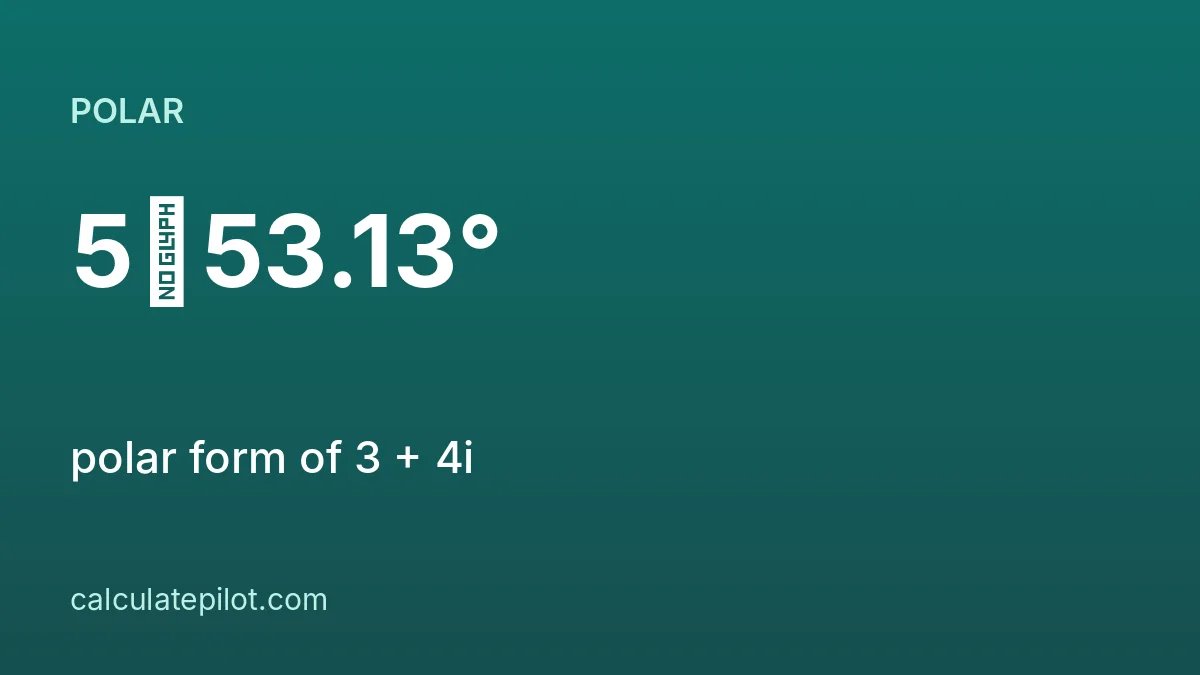
For a + bi, the modulus is √(a² + b²) and the argument is atan2(b, a). So 3 + 4i has modulus 5 and argument 53.13°, giving polar form 5(cos 53.13° + i sin 53.13°) = 5∠53.13°.
1. The formulas
- Modulus (magnitude, absolute value): r = √(a² + b²)
- Argument (angle, phase): θ = atan2(b, a)
- Polar form: z = r(cos θ + i sin θ) = r∠θ
- Exponential form: z = r·e^(iθ)
2. Conversion table (angles in degrees)
| Rectangular | Modulus | Argument | Polar |
|---|---|---|---|
| 1 + i | √2 (1.41) | 45° | √2∠45° |
| −1 + i | √2 (1.41) | 135° | √2∠135° |
| 3 + 4i | 5 | 53.13° | 5∠53.13° |
| −3 − 4i | 5 | −126.87° | 5∠−126.87° |
| 2i | 2 | 90° | 2∠90° |
| −2 | 2 | 180° | 2∠180° |
| 1 − i | √2 (1.41) | −45° | √2∠−45° |
| −1 − i | √2 (1.41) | −135° | √2∠−135° |
3. Worked example: 3 + 4i
r = √(3² + 4²) = √25 = 5. θ = atan2(4, 3) = 53.13°. Polar form: 5∠53.13°.
4. Why atan2
The ordinary arctangent of b ÷ a cannot tell opposite quadrants apart. 3 + 4i and −3 − 4i both give 4/3, but their arguments are 53.13° and −126.87°. atan2 uses the signs of both a and b.
5. Back to rectangular form
a = r cos θ and b = r sin θ. For 5∠53.13°, a = 5 × 0.6 = 3 and b = 5 × 0.8 = 4.
6. Frequently asked questions
What is the modulus of a complex number?expand_more
|a + bi| = √(a² + b²). For 3 + 4i it is 5.
What is the argument of a complex number?expand_more
The angle from the positive real axis, found with atan2(b, a). For 3 + 4i it is 53.13°.
Are magnitude and absolute value the same?expand_more
Yes. Magnitude, modulus and absolute value all mean √(a² + b²).
How do I get back to a + bi?expand_more
a = r cos θ and b = r sin θ.
7. Sources
- menu_bookWolfram MathWorld: Complex Number
- menu_bookWolfram MathWorld: De Moivre's Identity