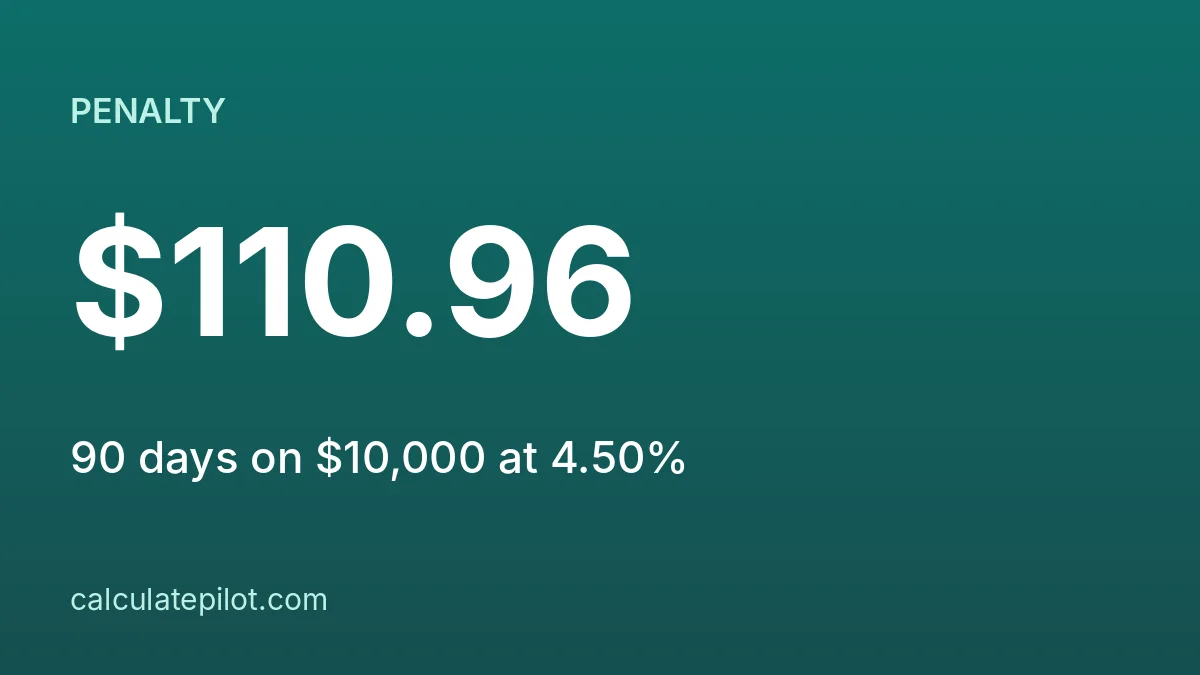
Short answer
Penalty ≈ deposit × rate × days ÷ 365. On $10,000 at 4.50%, a 90-day penalty is about $110.96.
1. How the penalty works
Banks usually charge a set number of days of interest. Longer terms often carry a larger penalty, but the rules vary, so read your account disclosure.
Penalty ≈ deposit × rate × days ÷ 365 (simple interest).
2. Worked examples
$10,000 at 4.50%:
| Penalty | Calculation | Cost |
|---|---|---|
| 90 days of interest | 10,000 × 0.045 × 90 ÷ 365 | $110.96 |
| 180 days of interest | 10,000 × 0.045 × 180 ÷ 365 | $221.92 |
| 365 days of interest | 10,000 × 0.045 × 365 ÷ 365 | $450.00 |
3. What you keep if you break it early
Break a 12-month CD after six months. You have earned about $222.52 (10,000 × (1.0450.5 − 1)). A 90-day penalty takes back about $110.96, leaving about $111.56 of interest.
Break it in the first month and the interest earned may be smaller than the penalty. In that case the bank can take the difference from your principal.
4. Is it worth breaking a CD?
Compare the penalty with the extra interest a new CD would pay over the time left. With a $110.96 penalty, $10,000 and six months remaining, the new CD must pay about 2.22 percentage points more: 110.96 ÷ (10,000 × 0.5) = 2.22%.
5. Ways to avoid a penalty
- Choose a no-penalty CD if you may need the money, accepting a lower rate.
- Build a CD ladder so one CD matures each year.
- Keep an emergency fund outside your CDs.
6. Frequently asked questions
How is a CD early withdrawal penalty calculated?expand_more
Most banks charge a set number of days of interest, approximately deposit × rate × days ÷ 365.
Can a CD penalty take my principal?expand_more
Yes, if you have not earned enough interest to cover the penalty, the bank can take the rest from your principal.
How much is a typical CD penalty?expand_more
It varies by bank and term, often from about 90 days of interest on short terms to 180 days or more on longer ones. Check your disclosure.
Is there a CD with no penalty?expand_more
Yes. A no-penalty CD lets you withdraw after a short waiting period without a fee, usually at a lower rate.