Short answer
APY = (1 + r ÷ n)^n − 1. It is the real yearly return after compounding, so compare CDs by APY, not by the stated interest rate.
1. Interest rate vs APY
The interest rate is the stated annual rate before compounding. The APY (annual percentage yield) is what you earn in a year once interest is added to the balance and earns interest too.
APY = (1 + r ÷ n)n − 1, with r the rate and n the compounding periods per year.
2. How compounding changes the result
$10,000 at a 5.00% stated rate for one year:
| Compounding | Balance | APY |
|---|---|---|
| Annually | $10,500.00 | 5.0000% |
| Semi-annually | $10,506.25 | 5.0625% |
| Quarterly | $10,509.45 | 5.0945% |
| Monthly | $10,511.62 | 5.1162% |
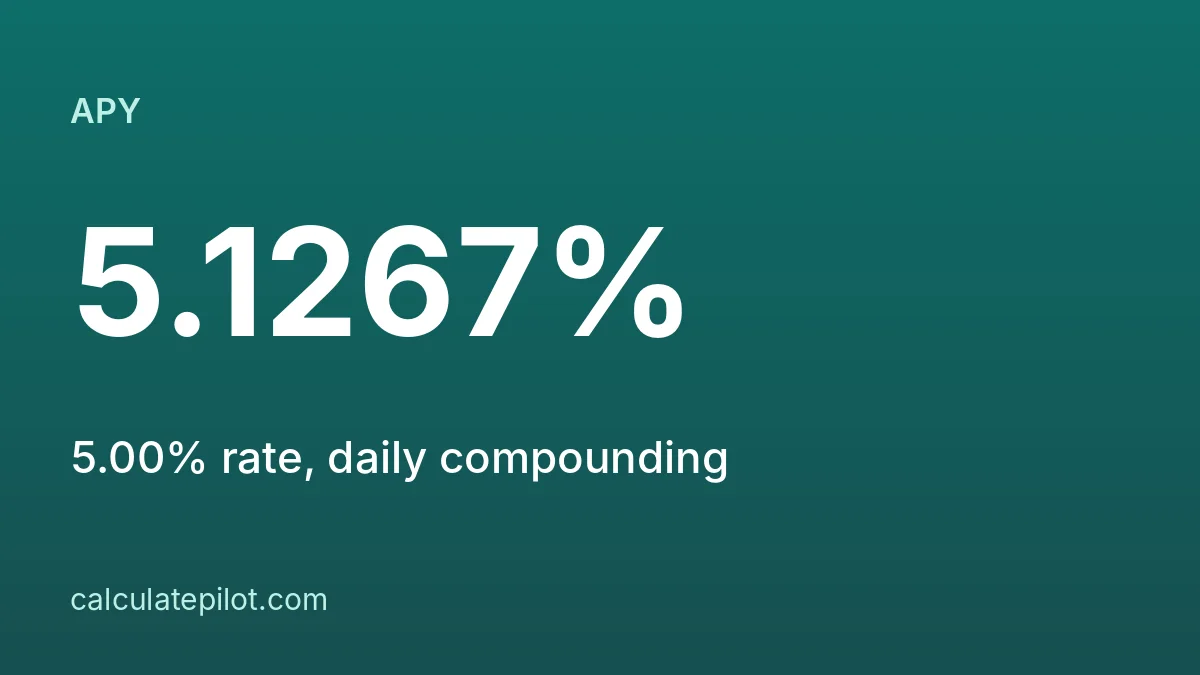
| Daily | $10,512.67 | 5.1267% |
3. From APY back to a rate
Rate = n × [(1 + APY)1/n − 1]. A 4.50% APY equals a 4.402% rate compounded daily, a 4.410% rate compounded monthly and a 4.500% rate compounded annually.
4. Comparing two CDs
CD A pays a 4.40% rate compounded daily, which is a 4.498% APY. CD B pays a 4.45% rate compounded monthly, which is a 4.542% APY. CD B pays more even though both rates look close, and the APY shows it at a glance.
5. Check your answer
- APY is never lower than the stated rate.
- With annual compounding, APY equals the rate.
- More frequent compounding raises APY, but by a small amount.
6. Frequently asked questions
What is the difference between APY and interest rate?expand_more
The interest rate is the stated rate before compounding. The APY includes compounding, so it shows the true yearly return.
Does daily compounding make a big difference?expand_more
Not much. On $10,000 at a 5.00% rate, daily compounding earns $12.67 more than annual compounding over a year.
Which should I compare when choosing a CD?expand_more
Compare APYs, because they already include compounding and put CDs on the same footing.
How do I convert APY to an interest rate?expand_more
Rate = n × [(1 + APY)^(1/n) − 1], where n is the number of compounding periods per year.