Short answer
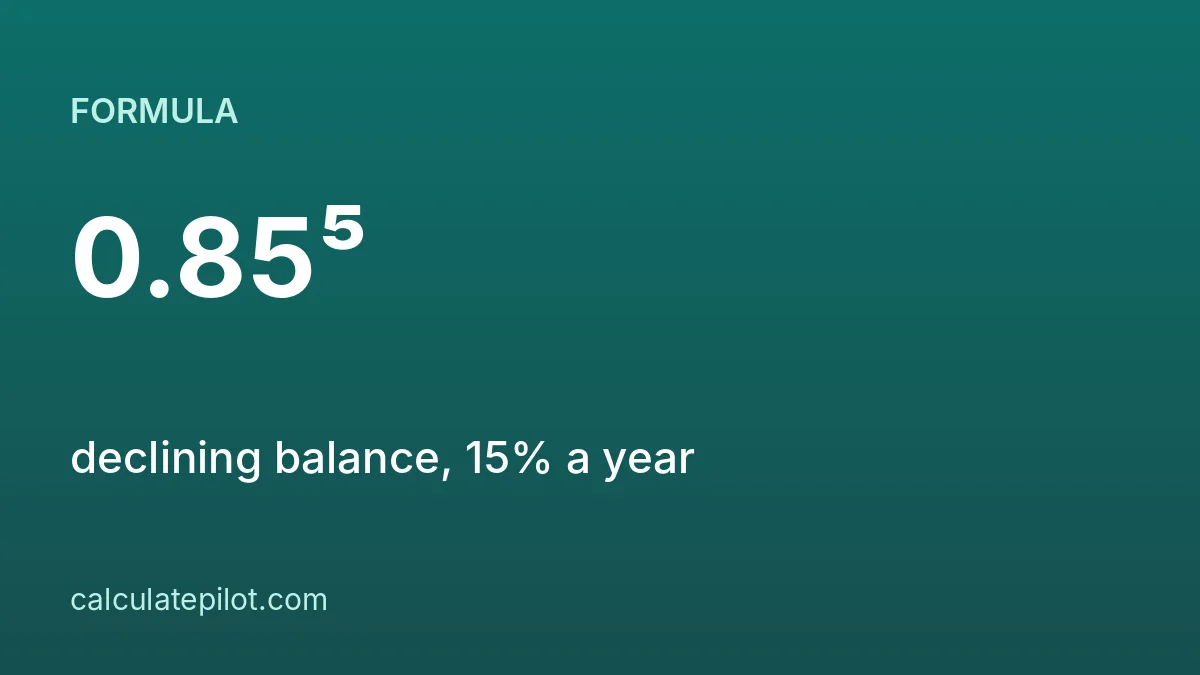
Declining balance takes a percentage of the current value each year: value = price × (1 − rate)^years. At 15% over 5 years a $30,000 car is worth $13,311; straight-line would give $7,500.
1. Declining balance
Value after t years = starting value × (1 − rate)^t. Each year the loss is a percentage of that year's starting value, so the dollar loss shrinks. This matches how used-car prices usually behave.
2. Straight-line
Annual loss = starting value × rate, the same every year. Value after t years = starting value × (1 − rate × t). It is simple and mainly used in accounting.
3. Worked example: $30,000 car at 15% a year
| Year | Declining balance | Straight-line |
|---|---|---|
| 1 | $25,500 | $25,500 |
| 2 | $21,675 | $21,000 |
| 3 | $18,424 | $16,500 |
| 4 | $15,660 | $12,000 |
| 5 | $13,311 | $7,500 |
By year 5 straight-line has removed far more than declining balance because it never slows down.
4. Find the yearly rate from a real sale
Rate = 1 − (resale value ÷ purchase price)^(1 ÷ years). A $30,000 car that sells for $15,000 after 5 years lost 1 − 0.5^(1/5) = 12.9% a year.
5. A better model for a new car
New cars lose more in year one than later. The Car Depreciation Calculator's typical curve uses 18% in year one for a midsize SUV, then 15%, then 10% a year, which is closer to the market than a single constant rate.
6. Frequently asked questions
What is the car depreciation formula?expand_more
Value = starting value × (1 − yearly rate)^years for declining balance.
Which method is more realistic for cars?expand_more
Declining balance, because cars lose more dollars in early years than later.
How do I work out my car's yearly rate?expand_more
Rate = 1 − (resale value ÷ purchase price)^(1 ÷ years).
Is straight-line depreciation ever used?expand_more
Yes, mainly for accounting and tax schedules rather than resale value.