Short answer
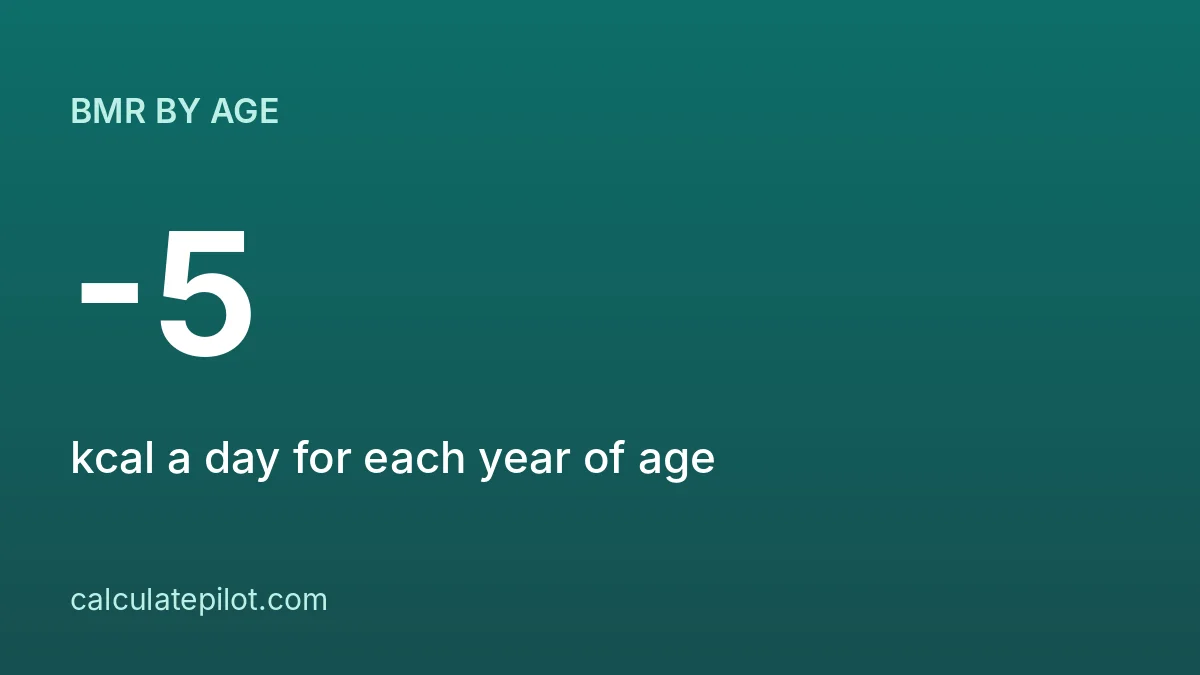
With weight and height held constant, Mifflin-St Jeor lowers BMR by 5 kcal a day for each year of age. A reference man (80 kg, 178 cm) drops from 1,818 kcal at age 20 to 1,518 at 80; a reference woman (65 kg, 165 cm) from 1,420 to 1,120.
1. BMR by age for a reference adult
Mifflin-St Jeor with weight and height held constant: a man of 80 kg and 178 cm, and a woman of 65 kg and 165 cm. This isolates the effect of age; it is not a population average.
| Age | Man (kcal/day) | Woman (kcal/day) | Man per hour |
|---|---|---|---|
| 20 | 1,818 | 1,420 | 76 |
| 30 | 1,768 | 1,370 | 74 |
| 40 | 1,718 | 1,320 | 72 |
| 50 | 1,668 | 1,270 | 69 |
| 60 | 1,618 | 1,220 | 67 |
| 70 | 1,568 | 1,170 | 65 |
| 80 | 1,518 | 1,120 | 63 |
2. What the table shows
- The equation lowers BMR by 5 kcal a day for every year of age, so 10 years costs 50 kcal a day.
- From 20 to 80 that is 300 kcal a day, if weight and height stay the same.
- Real life differs: muscle loss lowers BMR further, while gaining weight raises it.
3. Using it
- Enter your own weight, height and age in the BMR Calculator to see your figure and the age chart.
- Strength training helps preserve muscle; see how to increase BMR.
- For daily needs see BMR vs TDEE.
4. Frequently asked questions
What is the average BMR by age?expand_more
It depends on size and sex. For a reference man of 80 kg and 178 cm it is about 1,818 kcal at 20 and 1,518 at 80, and for a reference woman of 65 kg and 165 cm about 1,420 and 1,120.
How much does BMR drop with age?expand_more
The Mifflin-St Jeor equation lowers it by 5 kcal a day per year, holding weight and height constant.
Why might it drop more in real life?expand_more
Muscle mass tends to fall with age, and muscle burns more at rest than fat.
Can I slow the decline?expand_more
Resistance training helps preserve muscle, which supports resting energy use.