Short answer
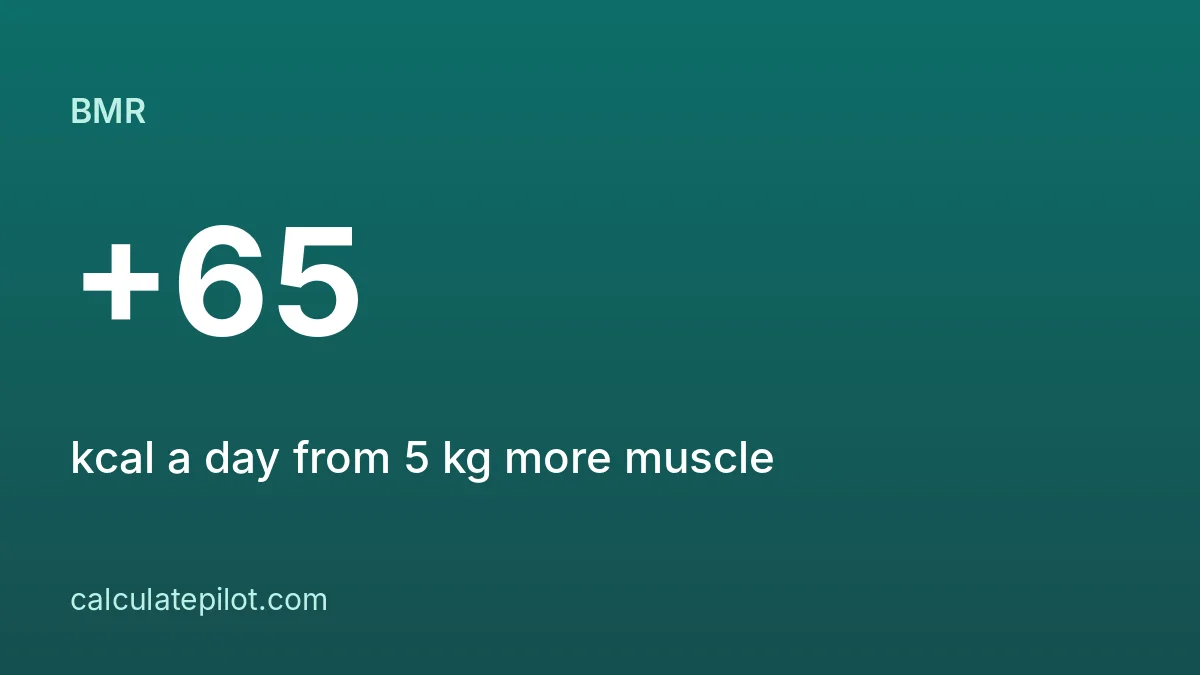
Muscle burns roughly 13 kcal per kg a day at rest against about 4.5 for fat (Wang et al., 2010), so adding 5 kg of muscle raises BMR by only around 65 kcal a day. Resistance training is the main lever and the effect is real but modest.
1. What moves BMR
- Muscle mass: muscle uses about 13 kcal per kg a day at rest against about 4.5 for fat.
- Body size: a larger body burns more at rest; the formulas scale with weight and height.
- Age: Mifflin-St Jeor lowers BMR by 5 kcal a day for each year of age.
- Genetics, hormones and thyroid function also play a role.
2. How large is the effect?
Adding 5 kg of muscle: 5 × 13 = about 65 kcal a day. Useful over years, but not a quick fix.
3. What helps
- Regular resistance training to build and keep muscle.
- Enough protein and overall food to support training.
- Not losing weight so fast that you lose muscle.
4. What to be sceptical about
Claims of big BMR boosts from supplements, special foods or single workouts are not well supported. If you suspect a thyroid problem, speak to a doctor.
See your estimate in the BMR Calculator, and how it fits into daily needs in BMR vs TDEE.
5. Frequently asked questions
Can you increase your BMR?expand_more
Modestly, mainly by building muscle through resistance training.
How many calories does muscle burn?expand_more
Roughly 13 kcal per kg a day at rest, against about 4.5 kcal per kg for fat.
Do supplements raise BMR?expand_more
There is little reliable evidence for large effects. Be sceptical of strong claims.
Does BMR drop with age?expand_more
Yes, on average. Mifflin-St Jeor lowers BMR by 5 kcal a day for each year, and strength training can offset some of it.