Short answer
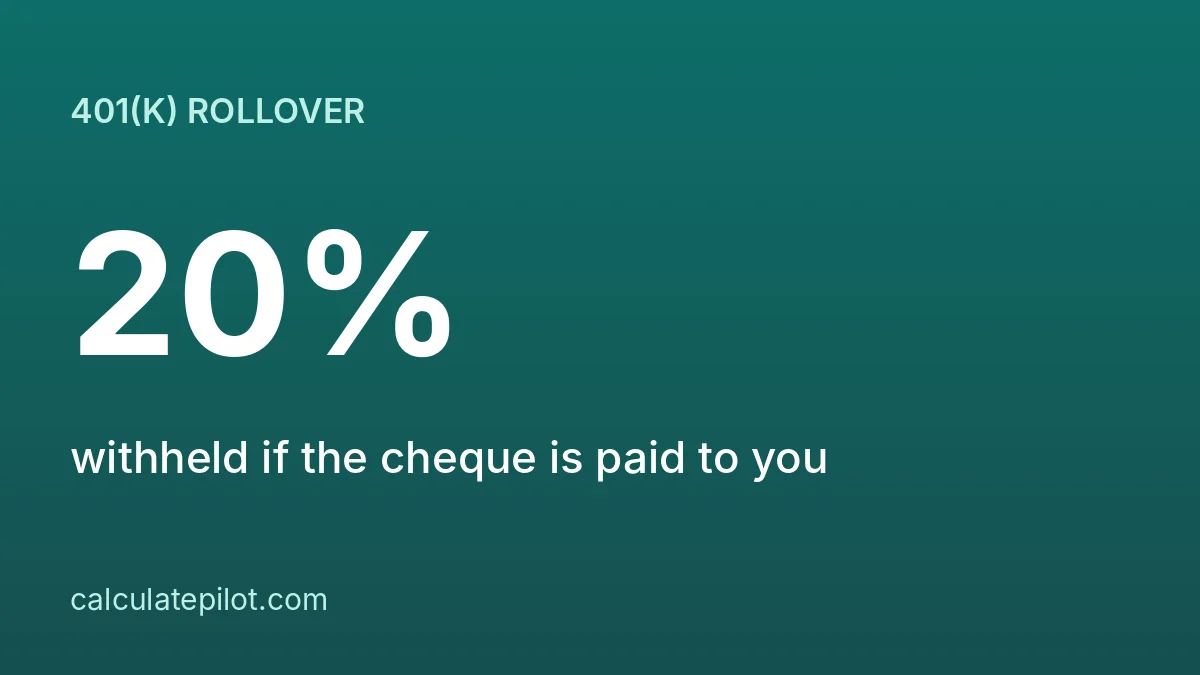
The safest way to move a 401(k) is a direct rollover, where the money goes straight to a new plan or IRA with no tax withheld. If a cheque is paid to you, 20% is withheld and you have 60 days to deposit the full amount, or the shortfall is taxable.
1. Your options
- Leave it in the old employer's plan, if the plan allows it.
- Roll it into your new employer's plan, if it accepts rollovers.
- Roll it into an IRA.
- Cash out, which is taxable and may carry the 10% early-withdrawal tax if you are under 59½.
2. Direct vs indirect rollover
| Direct rollover | Paid to you | |
|---|---|---|
| Tax withheld | None | 20% mandatory |
| Deadline | Handled by the plan | 60 days to redeposit |
| Risk | Low | You must replace the withheld 20% from other funds |
Example: on a $100,000 balance paid to you, $20,000 is withheld and you receive $80,000. To roll over all $100,000 you must add $20,000 of your own money within 60 days; otherwise the $20,000 is taxable and may incur the 10% early distribution tax.
3. What to compare
- Fees and investment choices in each account.
- Whether the money is traditional or Roth (roll like to like).
- Any vesting: you generally keep only the vested part of the employer match.
IRAs have a one-rollover-per-12-months rule across all your IRAs, but it does not apply to direct transfers or to rollovers between plans and IRAs. Project your savings with the 401(k) Calculator.
4. Frequently asked questions
How do I roll over a 401(k) without paying tax?expand_more
Ask for a direct rollover so the money goes straight to the new plan or IRA with no withholding.
What is the 60-day rollover rule?expand_more
If a distribution is paid to you, you have 60 days to deposit it into another plan or IRA. The IRS may waive the deadline for circumstances beyond your control.
Why is 20% withheld on my 401(k) distribution?expand_more
Plan distributions paid to you are subject to mandatory 20% federal withholding, even if you plan to roll them over.
Can I keep my old 401(k) after leaving my job?expand_more
Often yes, if the plan allows it. Compare its fees and investments with your other options.