Short answer
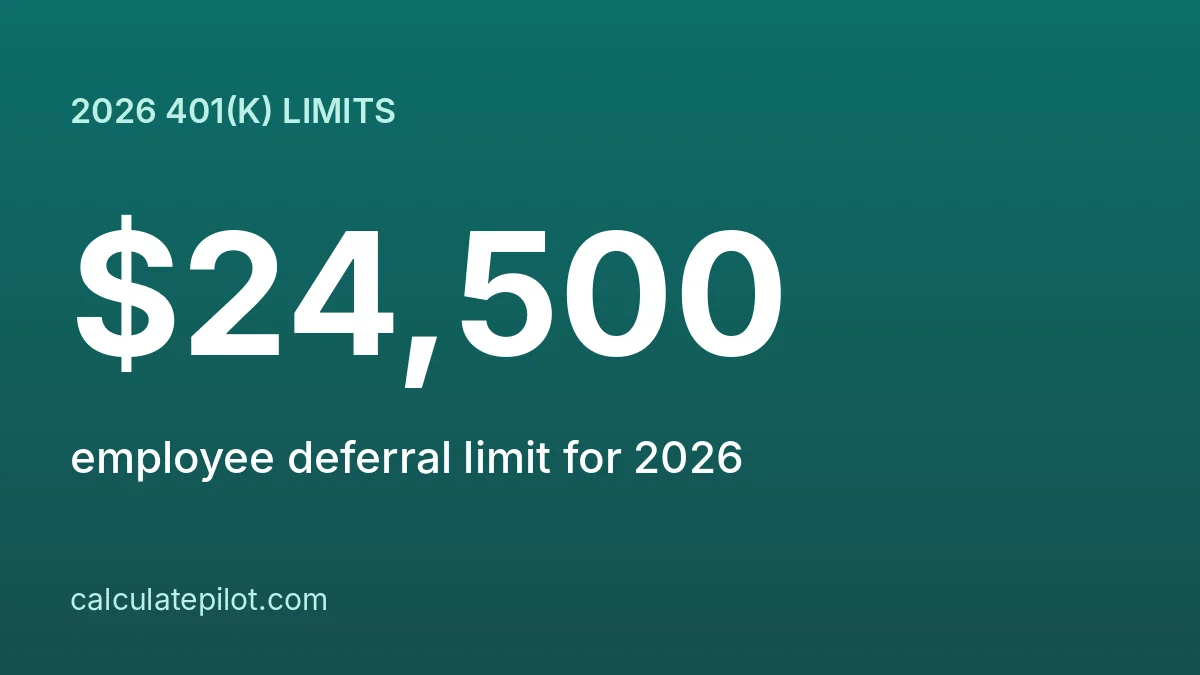
For 2026 you can defer up to $24,500 into a 401(k). Age 50 and over can add an $8,000 catch-up ($32,500 total), and ages 60 to 63 can add $11,250 instead ($35,750 total). The combined employee and employer cap is $72,000, not counting catch-up.
1. 2026 limits at a glance
| Your age in 2026 | Employee limit |
|---|---|
| Under 50 | $24,500 |
| 50 to 59, and 64 or older | $32,500 ($24,500 + $8,000 catch-up) |
| 60 to 63 | $35,750 ($24,500 + $11,250 super catch-up) |
- Combined limit. Total contributions from you and your employer are capped at $72,000 for 2026, not counting catch-up.
- Roth catch-up for higher earners. If your prior-year FICA wages from your employer were above $150,000, your catch-up contributions must be made as Roth contributions, if your plan offers a Roth option.
- IRA limit. The 2026 IRA limit is $7,500, separate from your 401(k) limit.
2. What the limits mean in practice
The employee limit applies to what you defer from your pay, across all of your 401(k) plans (traditional and Roth combined). Employer matching and profit-sharing contributions do not count toward it. To max out, divide the limit by your pay periods: $24,500 over 26 biweekly paycheques is about $942 each.
3. Model it
The calculator caps your contributions at the right limit for your age in every projected year and holds the 2026 amounts flat, which is conservative because the limits are indexed to inflation. If you set a high percentage, check the "remaining limit" line under the contribution box. For match examples see how much to contribute to get the full employer match.
4. Frequently asked questions
What is the 401(k) contribution limit for 2026?expand_more
$24,500 for your own deferrals. Age 50 and over can add $8,000, and ages 60 to 63 can add $11,250 instead.
What is the 401(k) super catch-up?expand_more
Workers aged 60 to 63 can contribute an extra $11,250 in 2026 instead of the standard $8,000 catch-up, for a total of $35,750.
Does my employer match count toward the $24,500 limit?expand_more
No. Employer contributions are separate, but total additions from you and your employer are capped at $72,000 in 2026, not counting catch-up.
Do I have to make Roth catch-up contributions?expand_more
Only if your prior-year FICA wages from the employer were above $150,000, and your plan offers a Roth option.