Key takeaways
- check_circleInputs: Three side lengths are enough to find the area, all three angles and the perimeter.
- check_circleValid triangle: Any two sides must add up to more than the third (the triangle inequality).
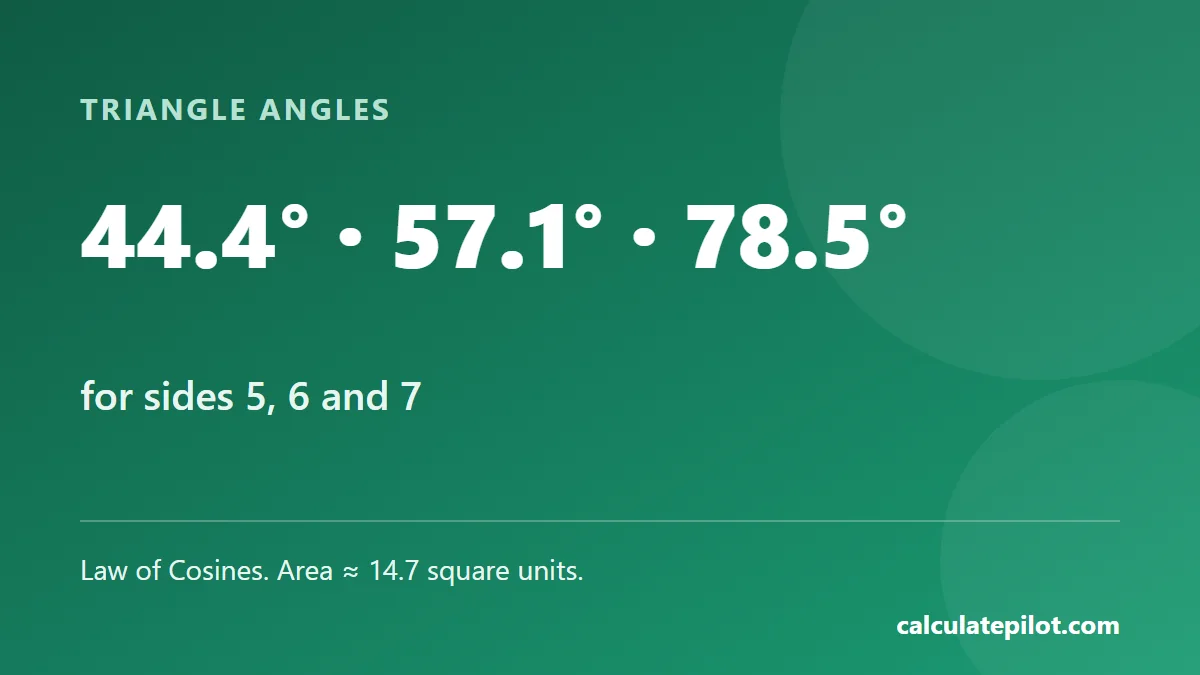
- check_circleExample: Sides 5, 6 and 7 give an area of about 14.7 square units and angles of about 44.4°, 57.1° and 78.5°.
→ Use the free Triangle Calculator to get sides, angles, area, and perimeter instantly.
1. What can a triangle calculator find?
A triangle calculator can help determine unknown measurements from known sides and angles. CalculatePilot's triangle calculator accepts three side lengths and returns the area, three angles, and perimeter.
2. Triangle inequality theorem
Three positive lengths can form a triangle only when the sum of any two sides is greater than the third. For sides a, b, and c: a + b > c, a + c > b, and b + c > a.
3. How to calculate triangle area
If you know a base and perpendicular height, use:
If all three sides are known, Heron's formula is useful. First calculate the semiperimeter s = (a + b + c) ÷ 2, then:
For other shapes, use the Area Calculator.
4. How to find the angle of a triangle
When all three sides are known, the Law of Cosines can find an angle. For angle A opposite side a:
After calculating the inverse cosine, convert the result to degrees if needed. The three interior angles should total 180°.
In an isosceles triangle the two base angles are equal. Find the vertex angle with the Law of Cosines, then each base angle is (180° − vertex angle) ÷ 2.
5. How to find a missing side
For a right triangle, the Pythagorean theorem is the standard method: a² + b² = c². Use the Pythagorean Theorem Calculator when one angle is 90°. For other triangles, the Law of Cosines or Law of Sines may be appropriate depending on which measurements are known. Sine, cosine, and tangent values are available in the Trigonometry Calculator.
6. Worked example: sides 5, 6, and 7
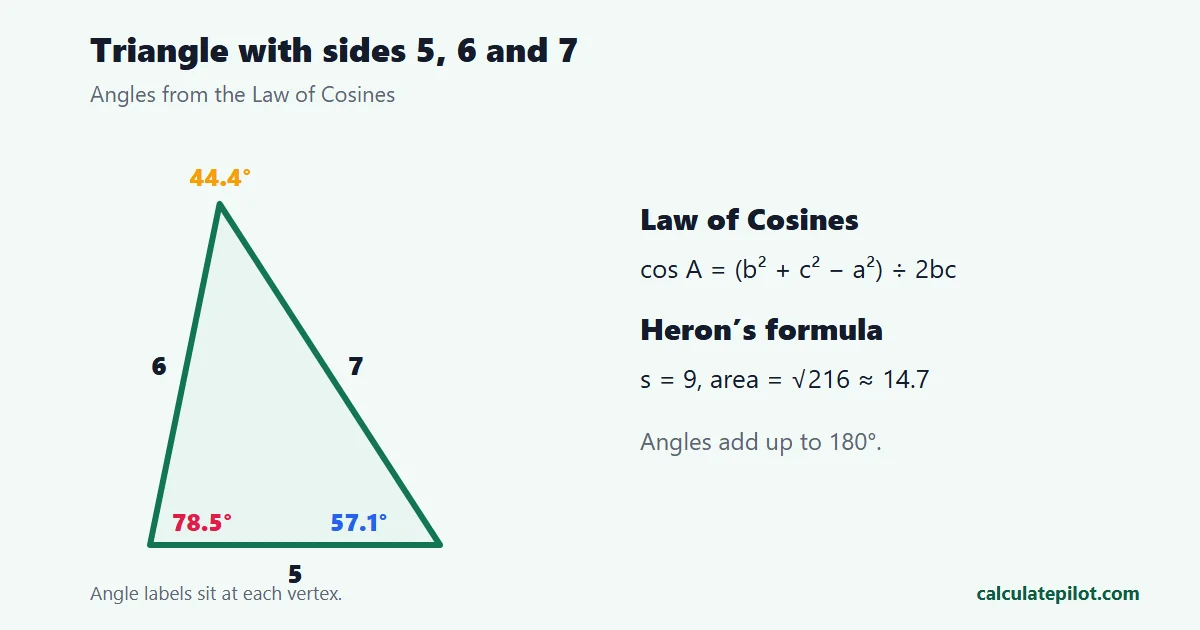
The semiperimeter is 9. Heron's formula gives an area of √216, approximately 14.7 square units. The corresponding angles are approximately 44.4°, 57.1°, and 78.5°.
7. Types of triangles
- Equilateral: three equal sides and three 60° angles.
- Isosceles: two equal sides and two equal angles.
- Scalene: all sides and angles are different.
- Right: one angle is 90°.
- Acute: all angles are below 90°.
- Obtuse: one angle is above 90°.
8. Frequently asked questions
How do you find the angle of a triangle?expand_more
With three sides known, use the Law of Cosines. If two angles are known, subtract their sum from 180° to find the third angle.
How do I find angles of a triangle with side lengths?expand_more
Label the sides a, b, and c. Compute each opposite angle with cos(A) = (b² + c² − a²) ÷ (2bc), then take arccos. Repeat for the other two angles, or compute two angles and subtract from 180°.
How do I find the base angles of a triangle?expand_more
If two sides are equal, the angles opposite those sides are the base angles and they are equal. Find the unique vertex angle first, then split the remaining 180° equally between the two base angles.
What is the formula for triangle area?expand_more
The basic formula is ½ × base × height. With three sides, Heron's formula can be used.
Why is my triangle invalid?expand_more
At least one side is greater than or equal to the sum of the other two. Check your measurements and units.
Do triangle angles always add to 180 degrees?expand_more
Yes, for a triangle in ordinary Euclidean geometry, the three interior angles sum to 180°.