Key takeaways
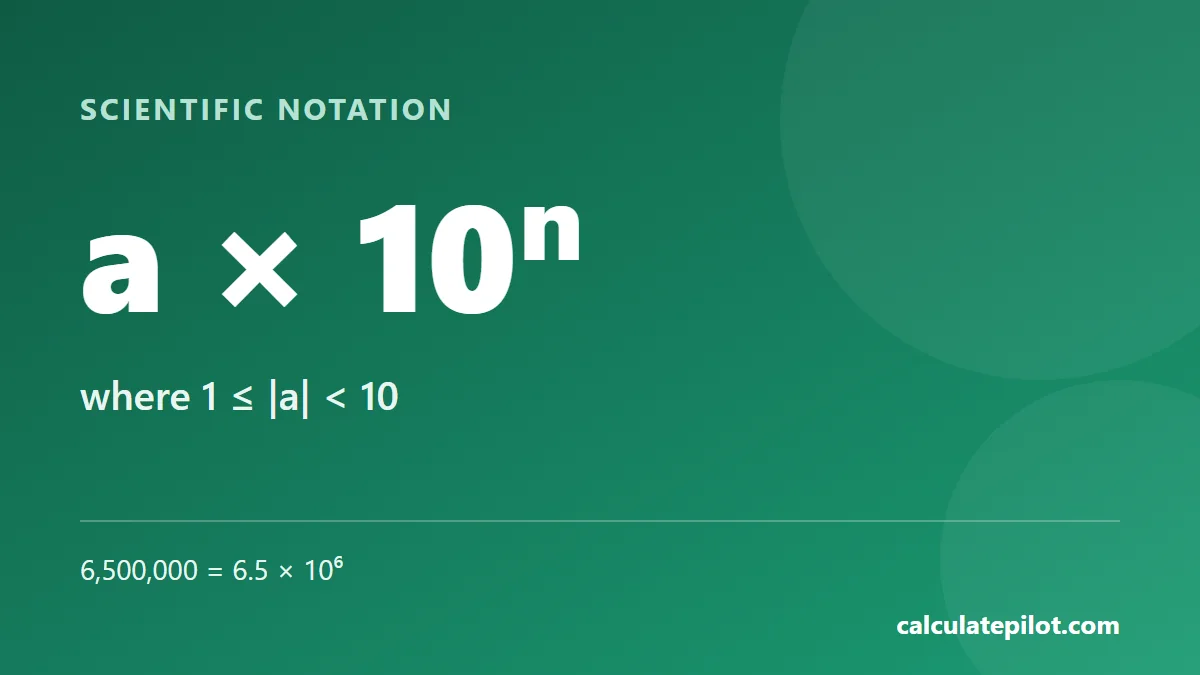
- check_circleThe format: Scientific notation writes a number as a × 10ⁿ, where 1 ≤ |a| < 10.
- check_circleLarge numbers: Move the decimal until one non-zero digit is to its left: 6,500,000 becomes 6.5 × 10⁶.
- check_circleSmall numbers: Moving the decimal right gives a negative exponent: 0.00032 becomes 3.2 × 10⁻⁴.
1. What is scientific notation?
Scientific notation writes a number as a coefficient multiplied by a power of ten. In standard form, the coefficient is at least 1 and less than 10.
2. How to convert a decimal to scientific notation
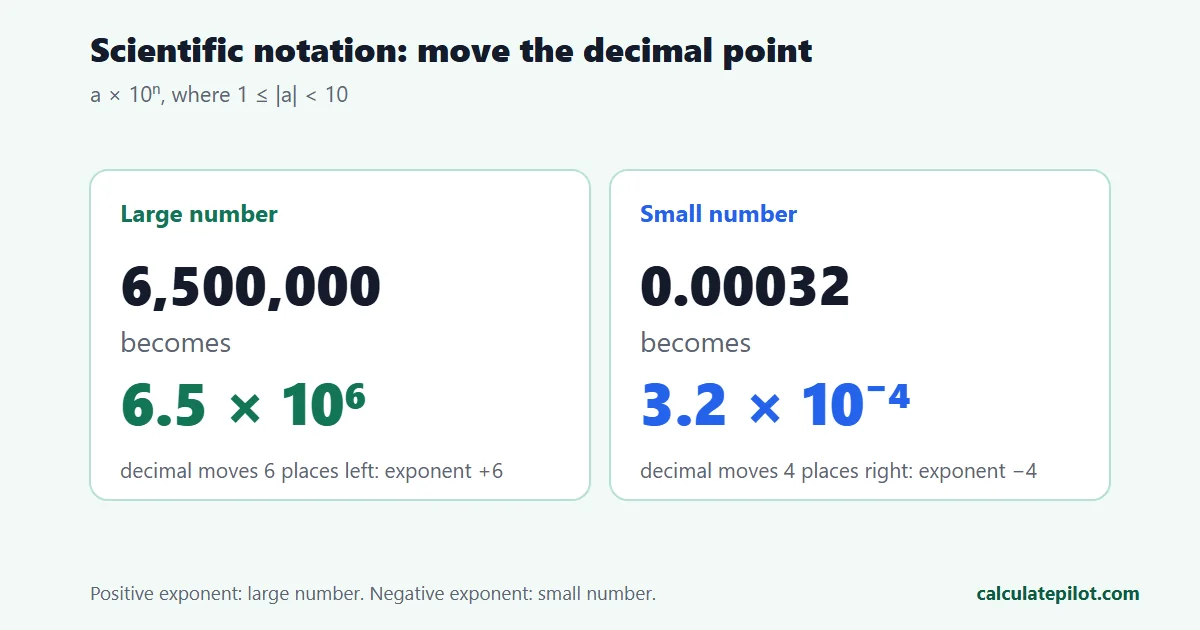
Move the decimal point until one non-zero digit remains to its left. Count how many places you moved. Moving left gives a positive exponent; moving right gives a negative exponent.
Large-number example
6,500,000 becomes 6.5 × 10⁶. The decimal moves six places to the left.
Small-number example
0.00032 becomes 3.2 × 10⁻⁴. The decimal moves four places to the right.
3. How to convert scientific notation to decimal form
For a positive exponent, move the decimal point right. For a negative exponent, move it left.
| Scientific form | Decimal form |
|---|---|
| 4.2 × 10³ | 4,200 |
| 7.5 × 10⁻² | 0.075 |
| 9.81 × 10² | 981 |
4. Why use scientific notation?
Scientific notation makes very large and very small values easier to read, compare, multiply, divide, and communicate. It is common in science, engineering, chemistry, astronomy, and computing.
5. Common mistakes
- Leaving the coefficient outside the standard 1-to-10 range.
- Using the wrong sign for the exponent.
- Miscounting decimal places.
- Dropping significant digits during conversion.
6. Frequently asked questions
What does a negative exponent mean?expand_more
It means the value is less than 1. For example, 3 × 10⁻⁴ equals 0.0003.
Does the coefficient need to be between 1 and 10?expand_more
In standard scientific notation, yes. A normalized result has one non-zero digit before the decimal point.
What is scientific form converter used for?expand_more
It converts ordinary decimal numbers into scientific notation and can reverse the process when you need a standard decimal representation.