Short answer
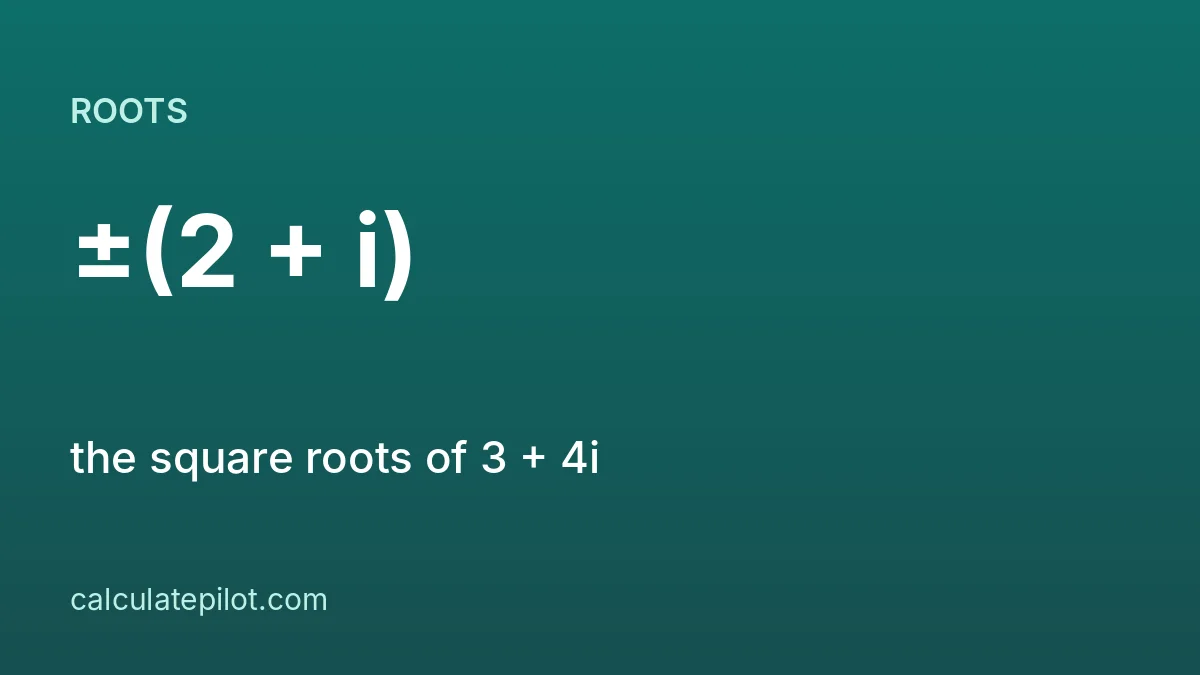
A non-zero complex number has n nth roots: take the nth root of the modulus and use angles (θ + 360°k) ÷ n for k = 0 to n − 1. The square roots of 3 + 4i are 2 + i and −2 − i.
1. De Moivre's theorem for roots
If z = r(cos θ + i sin θ), the nth roots are r^(1/n) [cos((θ + 360°k) ÷ n) + i sin((θ + 360°k) ÷ n)] for k = 0, 1, …, n − 1. They are spaced evenly around a circle.
2. Square root of 3 + 4i
r = 5 and θ = 53.13°, so the roots have modulus √5 and angles 26.57° and 206.57°. They simplify to 2 + i and −2 − i. Check: (2 + i)² = 4 + 4i + i² = 3 + 4i.
3. Cube roots of 1
| k | Angle | Root |
|---|---|---|
| 0 | 0° | 1 |
| 1 | 120° | −0.5 + 0.866i |
| 2 | 240° | −0.5 − 0.866i |
The four 4th roots of 1 are 1, i, −1 and −i at 0°, 90°, 180° and 270°.
4. Cube roots of 8i
The modulus is 8^(1/3) = 2 and the angles are (90° + 360°k) ÷ 3 = 30°, 150° and 270°. The roots are √3 + i, −√3 + i and −2i. Check: (−2i)³ = −8i³ = 8i.
5. Powers of i
The powers repeat every four: i, −1, −i, 1. Divide the exponent by 4 and use the remainder, so i²⁷ = i³ = −i.
6. Frequently asked questions
How many square roots does a complex number have?expand_more
Two, equal in size and opposite in sign.
How do I find nth roots of a complex number?expand_more
Use the nth root of the modulus and angles (θ + 360°k) ÷ n for k = 0 to n − 1.
What are the cube roots of 1?expand_more
1, −0.5 + 0.866i and −0.5 − 0.866i.
What is i to the 27th power?expand_more
−i, because 27 ÷ 4 leaves a remainder of 3 and i³ = −i.
7. Sources
- menu_bookWolfram MathWorld: Complex Number
- menu_bookWolfram MathWorld: De Moivre's Identity