Short answer
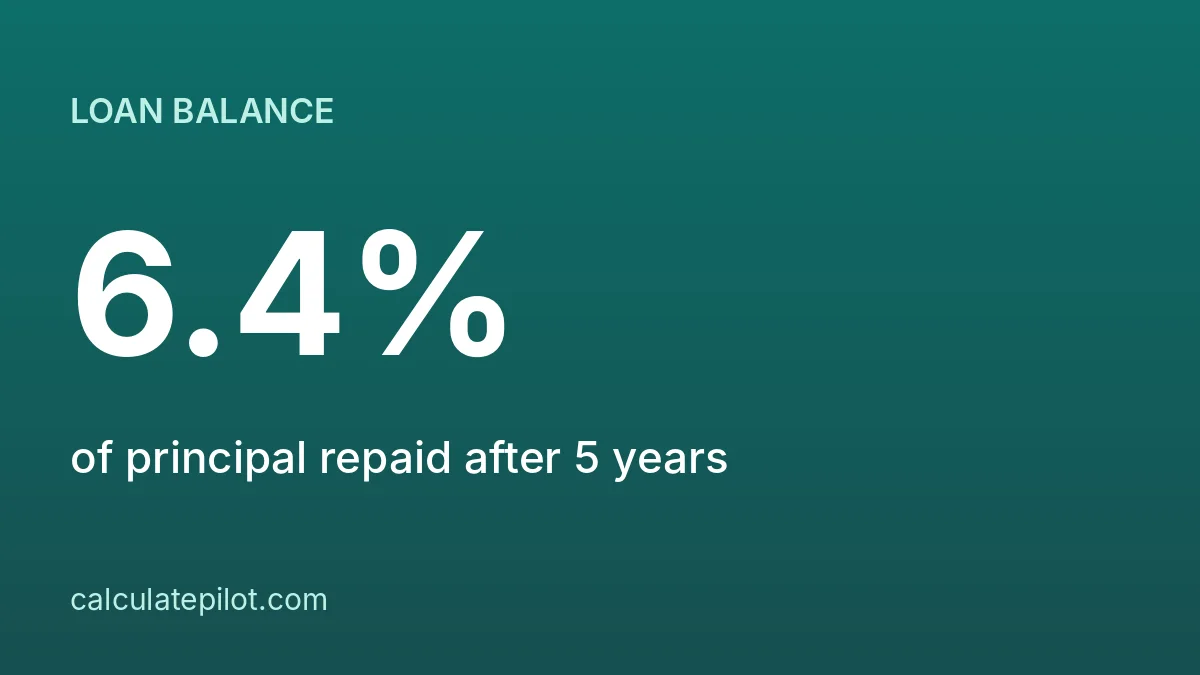
On a $300,000, 6.5%, 30-year loan, you have repaid only 6.4% of the principal ($19,167) after 5 years, 15.2% after 10 years and 27.4% after 15 years. The halfway point in principal arrives in year 21 or so, well after the halfway point in time.
1. Balance by year
$300,000 at 6.5%, 30-year fixed, payment $1,896.20 a month.
| After | Balance left | Principal paid | Share repaid |
|---|---|---|---|
| 5 years | $280,833 | $19,167 | 6.4% |
| 10 years | $254,328 | $45,672 | 15.2% |
| 15 years | $217,677 | $82,323 | 27.4% |
| 20 years | $166,996 | $133,004 | 44.3% |
| 25 years | $96,912 | $203,088 | 67.7% |
2. Why it starts slowly
Interest is charged on the balance. In payment 1, $1,625.00 of the $1,896.20 is interest and only $271.20 is principal. Principal does not overtake interest until payment 233, almost 20 years in.
3. What this means
- Selling or refinancing in the first few years leaves most of the balance still owed.
- Extra principal early shifts the whole curve. See lump sum vs monthly extra payments.
- A shorter term repays principal faster, at a higher payment. See short vs long loan terms.
Enter your loan in the Amortization Calculator to see your own year-by-year balance.
4. Frequently asked questions
How much of my loan is paid off after 5 years?expand_more
On a $300,000, 6.5%, 30-year loan, about 6.4% ($19,167). The remaining balance is about $280,833.
When do I own half of my loan?expand_more
In this example, you have repaid 44.3% after 20 years and 67.7% after 25, so the halfway point in principal comes around year 21.
Why is so little principal repaid early?expand_more
Interest is charged on the full balance, which is largest at the start, so most of each early payment is interest.
Does the balance schedule change with extra payments?expand_more
Yes. Extra principal lowers the balance faster, which reduces future interest and shortens the loan.