Short answer
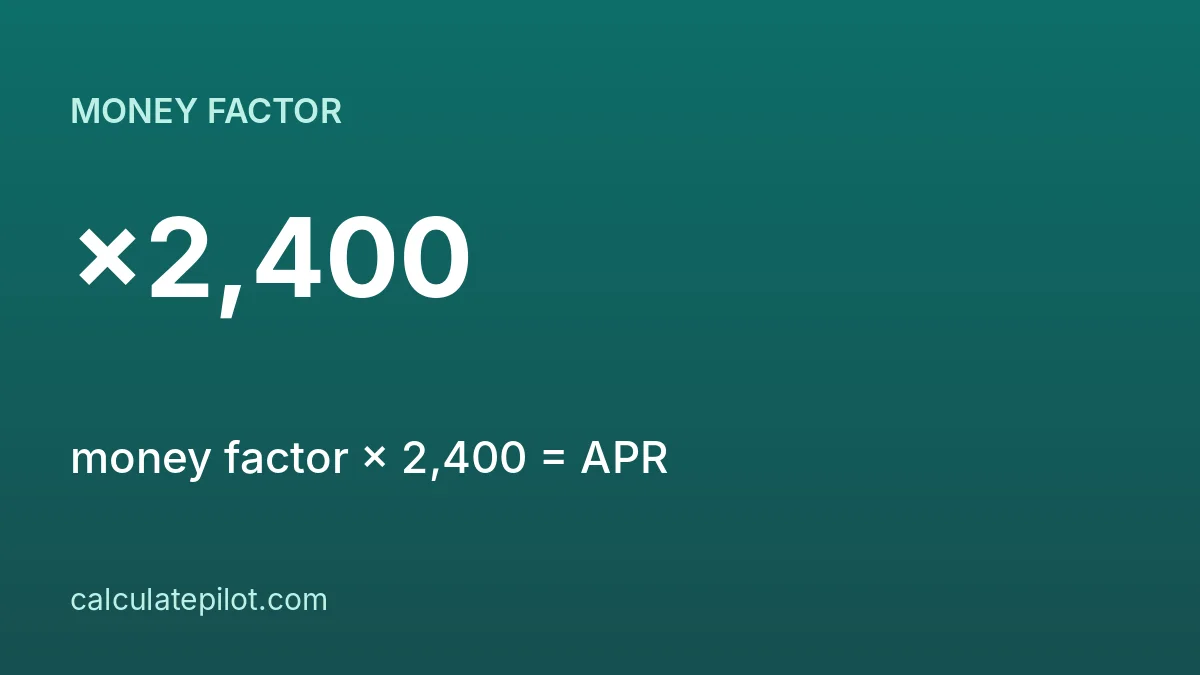
APR = money factor × 2,400, and money factor = APR ÷ 2,400. A money factor of 0.00225 equals a 5.4% APR.
1. The conversion
APR (%) = money factor × 2,400. The constant comes from 100 (percent) × 12 (months) × 2 (the average balance is half of cap cost plus residual). To go the other way, divide the APR by 2,400.
2. Chart
| Money factor | Equivalent APR | Monthly payment on the default car (with tax) |
|---|---|---|
| 0.00100 | 2.4% | $496.91 |
| 0.00150 | 3.6% | $533.57 |
| 0.00200 | 4.8% | $570.22 |
| 0.00225 | 5.4% | $588.55 |
| 0.00250 | 6.0% | $606.88 |
| 0.00300 | 7.2% | $643.53 |
3. What it shows
- Moving from 0.00225 to 0.003 raises the default payment by about $55 a month.
- Moving from 0.00225 to 0.001 lowers it by about $92 a month.
- The default car financed for 36 months at a 5.4% APR is the same rate as a 0.00225 money factor.
4. How to use it
Ask the dealer for the money factor, convert it to an APR and compare with your loan quotes. Remember that a lease finance charge applies to the average of cap cost and residual, not just the amount you borrow.
5. Frequently asked questions
How do you convert a money factor to APR?expand_more
Multiply by 2,400. For example, 0.00225 × 2,400 = 5.4%.
How do you convert an APR to a money factor?expand_more
Divide the APR by 2,400. A 6% APR is 0.0025.
Why 2,400?expand_more
It is 100 × 12 × 2: percent, months, and the double count of the average balance.
Is a lower money factor better?expand_more
Yes. It lowers the rent charge, which is part of the monthly payment.