Short answer
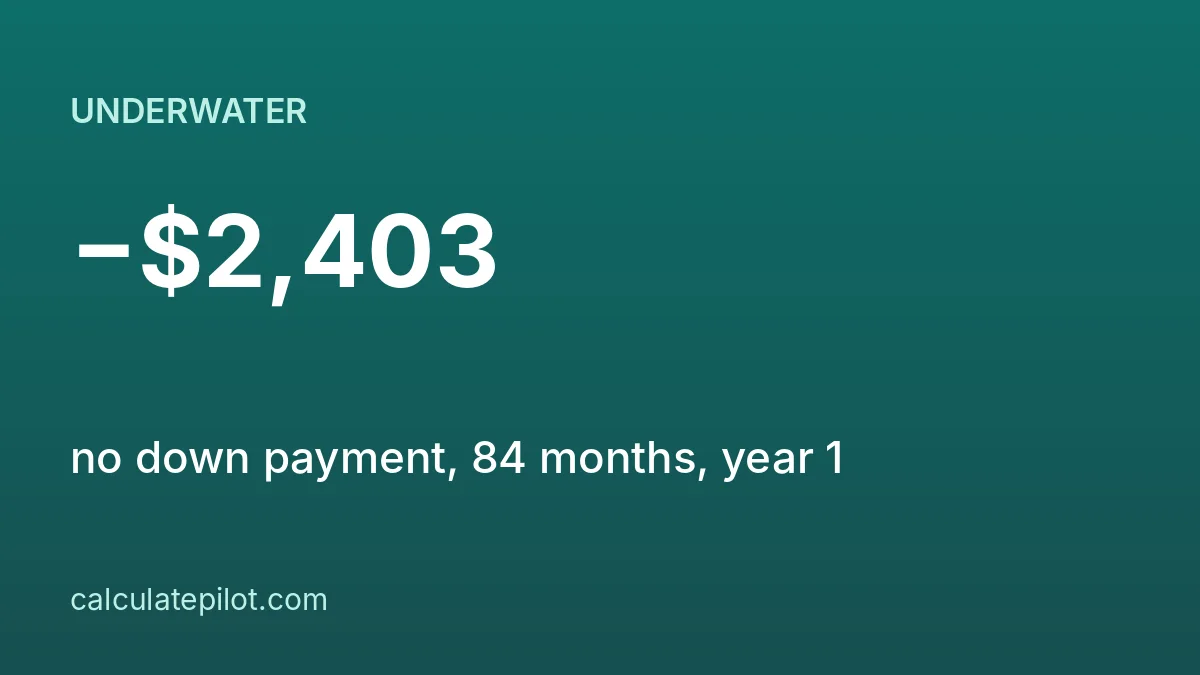
Negative equity means you owe more than the car is worth. On a $38,500 car with no down payment and an 84-month loan at 6.25%, you can be about $2,403 underwater after one year.
1. What negative equity is
Equity = car value − loan balance. When it is negative you are underwater: selling or insuring a total loss may not cover the loan.
2. Example: $38,500 car at 6.25% APR
Values use the Car Depreciation Calculator's typical curve for a midsize SUV (18% in year one, 15% in year two, 10% after). A plus sign means the car is worth more than you owe.
| Loan | Monthly payment | After 1 year | After 2 years | After 3 years |
|---|---|---|---|---|
| No down payment, 60 months | $749 | −$159 | +$2,312 | +$7,299 |
| No down payment, 84 months | $567 | −$2,403 | −$2,321 | +$123 |
| 20% down ($7,700), 60 months | $599 | +$6,187 | +$7,217 | +$10,669 |
3. What drives it
- Down payment: 20% down kept the car above the loan balance in every year shown.
- Loan term: an 84-month loan pays down slowly, so the balance stayed above the value for two years.
- Depreciation speed: a car that loses more than 18% in year one makes the gap wider.
4. How to avoid it
- Put down about 20% or more.
- Choose 60 months or less if the payment fits your budget.
- Pick a model with slower depreciation.
- Consider gap coverage if you must finance most of the price.
5. Frequently asked questions
What is negative equity on a car?expand_more
It means you owe more on the loan than the car is worth.
How long does negative equity last?expand_more
In the example, 0% down on an 84-month loan was underwater for about two years, while 20% down was never underwater.
How do I avoid being underwater on a car loan?expand_more
Make a larger down payment, use a shorter term and pick a car that holds its value.
What is gap coverage?expand_more
Gap coverage pays the difference between the car's value and the loan balance if the car is a total loss. Check the terms with your insurer or lender.