Short answer
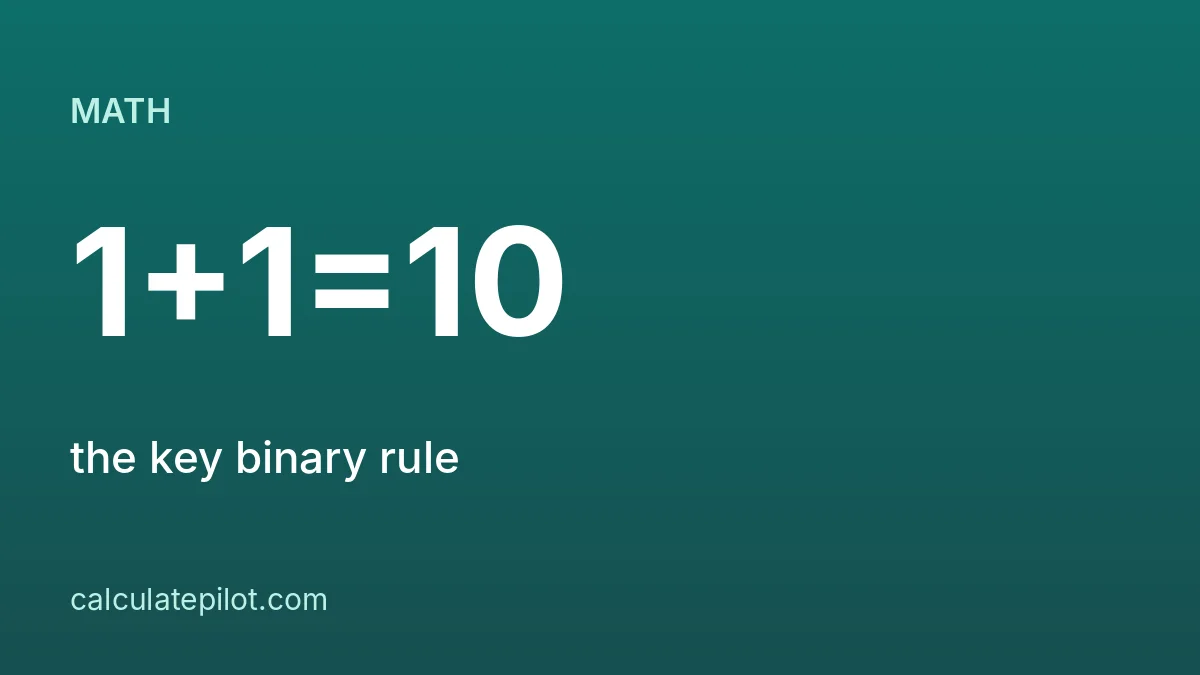
Binary addition uses 0+0=0, 0+1=1, 1+1=10 (carry 1) and 1+1+1=11. For example 1011 + 0110 = 10001 (11 + 6 = 17). Subtraction borrows from the next column, multiplication adds shifted copies, and division is repeated subtraction.
1. Addition
| Bits | Sum | Carry |
|---|---|---|
| 0 + 0 | 0 | 0 |
| 0 + 1 | 1 | 0 |
| 1 + 1 | 0 | 1 |
| 1 + 1 + 1 | 1 | 1 |
Example: 1011 + 0110. Right to left: 1+0=1; 1+1=0 carry 1; 0+1+1=0 carry 1; 1+0+1=0 carry 1; the last carry gives 10001. In decimal, 11 + 6 = 17.
2. Subtraction
Example: 1010 − 0011. The right column needs a borrow, and working through the columns gives 0111. In decimal, 10 − 3 = 7.
If the answer is negative, an unsigned register wraps: 0011 − 0101 at 8 bits gives 11111110, which is 254 unsigned or −2 in two's complement.
3. Multiplication
Multiply like long multiplication, but each partial product is either 0 or a shifted copy of the top number. Example: 1011 × 1101 = 1011 + 101100 (shifted by 2) + 1011000 (shifted by 3) = 10001111. In decimal, 11 × 13 = 143.
4. Division
Example: 1101 ÷ 0100. 13 ÷ 4 = 3 remainder 1, so the quotient is 11 and the remainder is 1.
5. Check with decimal
| Binary | Decimal | Result |
|---|---|---|
| 1011 + 0110 | 11 + 6 | 10001 = 17 |
| 1010 − 0011 | 10 − 3 | 0111 = 7 |
| 1011 × 1101 | 11 × 13 | 10001111 = 143 |
| 1101 ÷ 0100 | 13 ÷ 4 | 11 remainder 1 |
Check any sum with the Binary Calculator, which shows the step-by-step working. Background: how to use a binary calculator.
6. Frequently asked questions
How do you add binary numbers?expand_more
Add column by column from the right, carrying 1 whenever a column adds to 2 or more.
What is 1 + 1 in binary?expand_more
10 (zero, carry one).
How do you subtract binary numbers?expand_more
Subtract column by column, borrowing from the next column when you need to take 1 from 0.
What is 1011 × 1101?expand_more
10001111, which is 11 × 13 = 143.
7. Sources
- menu_bookBinary number (Wikipedia)