Short answer
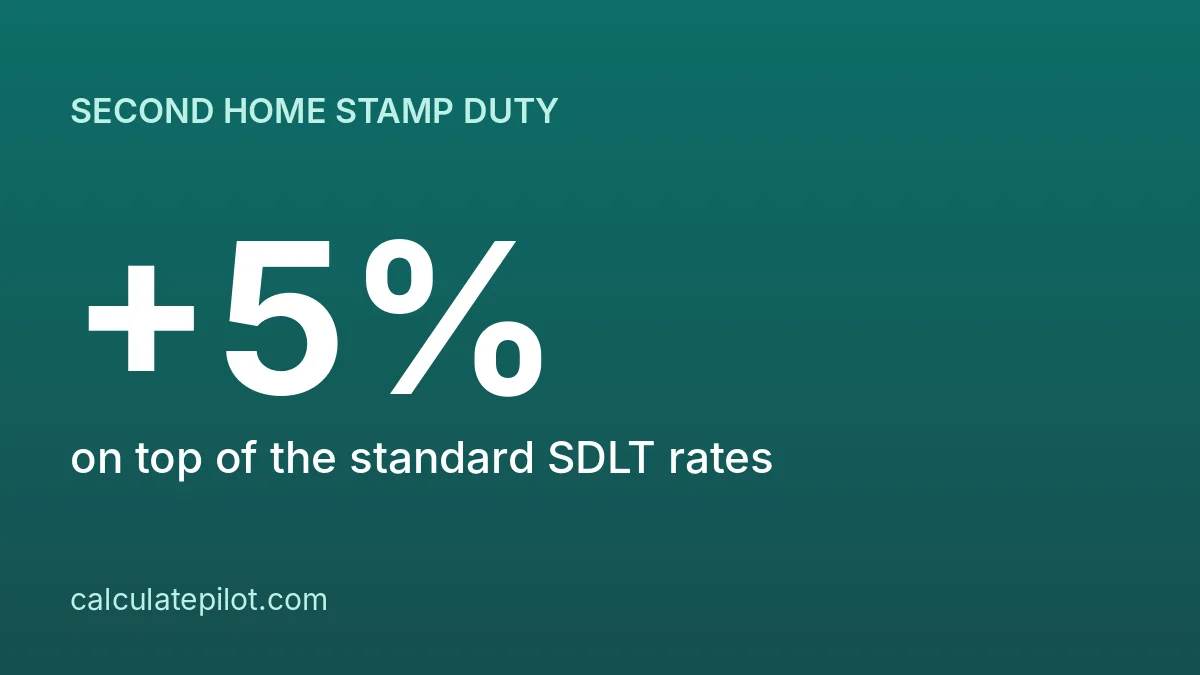
If you own another residential property when you complete on a purchase of £40,000 or more, you usually pay 5% extra Stamp Duty Land Tax on top of the standard rates in England and Northern Ireland. That applies to second homes and buy-to-lets, and a refund is possible if you sell your previous main home within 3 years.
1. When the higher rates apply
The higher rates apply when you buy a residential property for £40,000 or more and you own, or part-own, another residential property at the end of the purchase day. It is the whole transaction that is affected: if you buy jointly and any buyer must pay the higher rates, everyone's purchase is charged at them. Your spouse or civil partner's properties are counted too, and so is property held for children under 18.
It covers a buy-to-let, a holiday home and a second home. It also catches a new main home if you still own your old one on completion day.
2. How much it costs
The higher rates are the standard residential rates plus 5% on every band. Standard rates in England and Northern Ireland are 0% to £125,000, 2% to £250,000, 5% to £925,000, 10% to £1.5 million and 12% above.
| Price | Main home | Second home or buy-to-let | Extra cost |
|---|---|---|---|
| £250,000 | £2,500 | £15,000 | £12,500 |
| £300,000 | £5,000 | £20,000 | £15,000 |
| £400,000 | £10,000 | £30,000 | £20,000 |
| £500,000 | £15,000 | £40,000 | £25,000 |
If you are not resident in the UK, a further 2% applies on top of all residential rates. At £300,000 that makes a second home £26,000.
3. What does not count
- Properties worth less than £40,000.
- Mixed residential and non-residential property.
- Caravans, houseboats and mobile homes, unless permanently fixed.
- Leases of 7 years or less, and some long leases owned by someone else.
4. Replacing your main home: avoid or reclaim the surcharge
The 5% does not apply if the new property replaces your previous main home and you sold that home before completion. If you have not sold it by completion, you pay the higher rates, then you can claim a refund if you sell your previous main home within 3 years (36 months) of buying the new one.
- 1Pay the higher rates when you complete and file the SDLT return.
- 2Sell your previous main home within 3 years.
- 3Claim the refund. For sales on or after 29 October 2018, the claim must be made within 12 months of the later of the sale date and the filing date of the new home's return.
There is no refund if you or your spouse still own any part of the previous home. Exceptional circumstances, such as government restrictions, can extend the 3 years for purchases on or after 1 January 2017.
5. Check your own figure
The calculator has a separate option for an additional property and one for non-UK residents. Choose the buyer type that matches your case and compare it with the main-home figure to see the surcharge. For payment deadlines and late penalties, see when do you pay stamp duty.
6. Frequently asked questions
Do you pay stamp duty on a second home?expand_more
Yes. In England and Northern Ireland you usually pay 5% extra SDLT on top of the standard rates when you buy a residential property for £40,000 or more and own another residential property at the end of the purchase day.
Do buy-to-let landlords pay the 5% stamp duty surcharge?expand_more
Yes. A buy-to-let is an additional residential property, so the higher rates normally apply, and non-UK residents pay a further 2%.
Can you get the 5% stamp duty surcharge back?expand_more
If you replace your main home and sell the previous one within 3 years, you can claim back the higher-rate part. For sales on or after 29 October 2018 the claim must be made within 12 months of the later of the sale or the new home's SDLT filing date.
Does the surcharge apply to Scotland and Wales?expand_more
No. Scotland charges an 8% Additional Dwelling Supplement under LBTT and Wales has separate higher LTT rates. Both are covered in our comparison guide.