Short answer
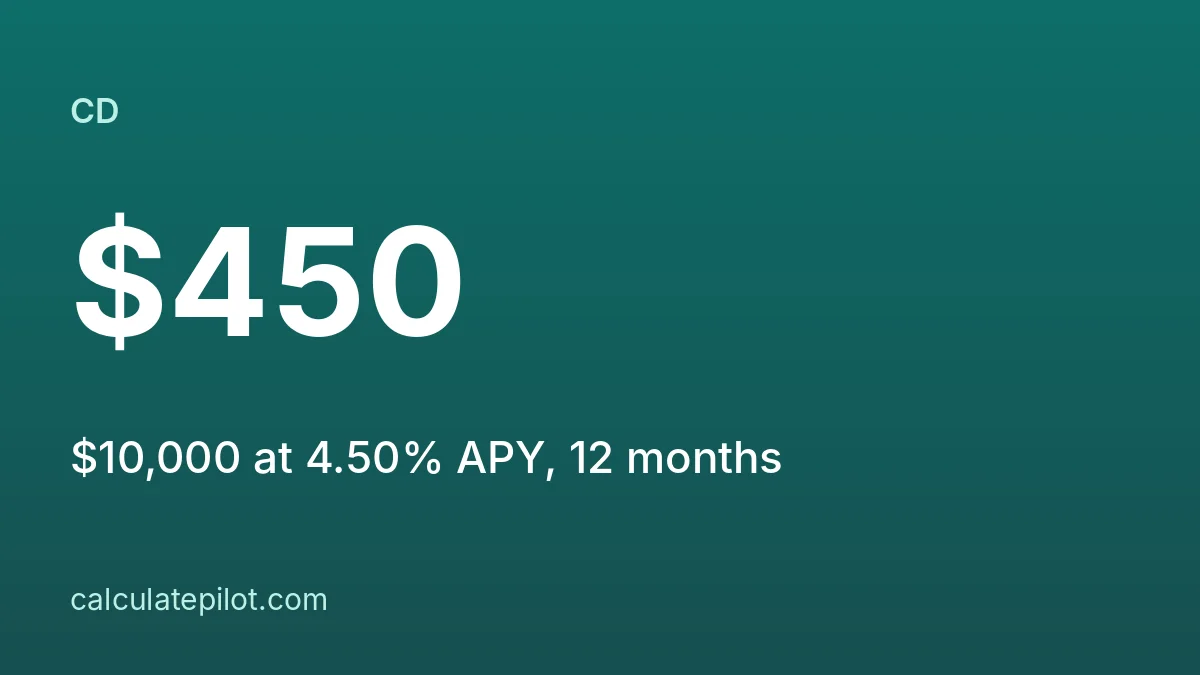
Maturity value = deposit × (1 + APY)^years. A $10,000 CD at 4.50% APY for 12 months grows to $10,450.00, so it earns $450.
1. The formula
Maturity value = deposit × (1 + APY)years
- APY already includes compounding, so you do not need the compounding frequency.
- Years can be a fraction, so 18 months is 1.5 years.
- Interest earned = maturity value − deposit.
2. Worked examples
| Deposit | APY | Term | Calculation | Interest |
|---|---|---|---|---|
| $10,000 | 4.50% | 12 months | 10,000 × 1.045 | $450.00 |
| $10,000 | 4.50% | 24 months | 10,000 × 1.0452 | $920.25 |
| $10,000 | 4.50% | 60 months | 10,000 × 1.0455 | $2,461.82 |
| $25,000 | 4.25% | 18 months | 25,000 × 1.04251.5 | $1,610.57 |
3. If your bank quotes a rate, not an APY
Convert the stated rate first: APY = (1 + r ÷ n)n − 1, where r is the rate and n is the number of compounding periods a year. A 4.40% rate compounded daily is (1 + 0.044 ÷ 365)365 − 1 = 4.498% APY. Then use the formula above.
4. Check your answer
- For one year, interest should be close to the APY times the deposit.
- A longer term earns more than the APY times the years, because interest earns interest.
- Your bank's figure can differ by a few cents because of rounding and the day count.
5. Frequently asked questions
What is the formula for CD interest?expand_more
Maturity value = deposit × (1 + APY)^years, and interest = maturity value − deposit.
How much does $10,000 earn in a CD at 4.50% APY?expand_more
It earns $450 in 12 months, $920.25 in 24 months and $2,461.82 in 60 months.
Should I use the rate or the APY?expand_more
Use the APY in this formula. If you only have a rate, convert it to APY using the compounding frequency first.
Why is my bank's number slightly different?expand_more
Banks round interest each period and may count days differently, so a few cents of difference is normal.