Short answer
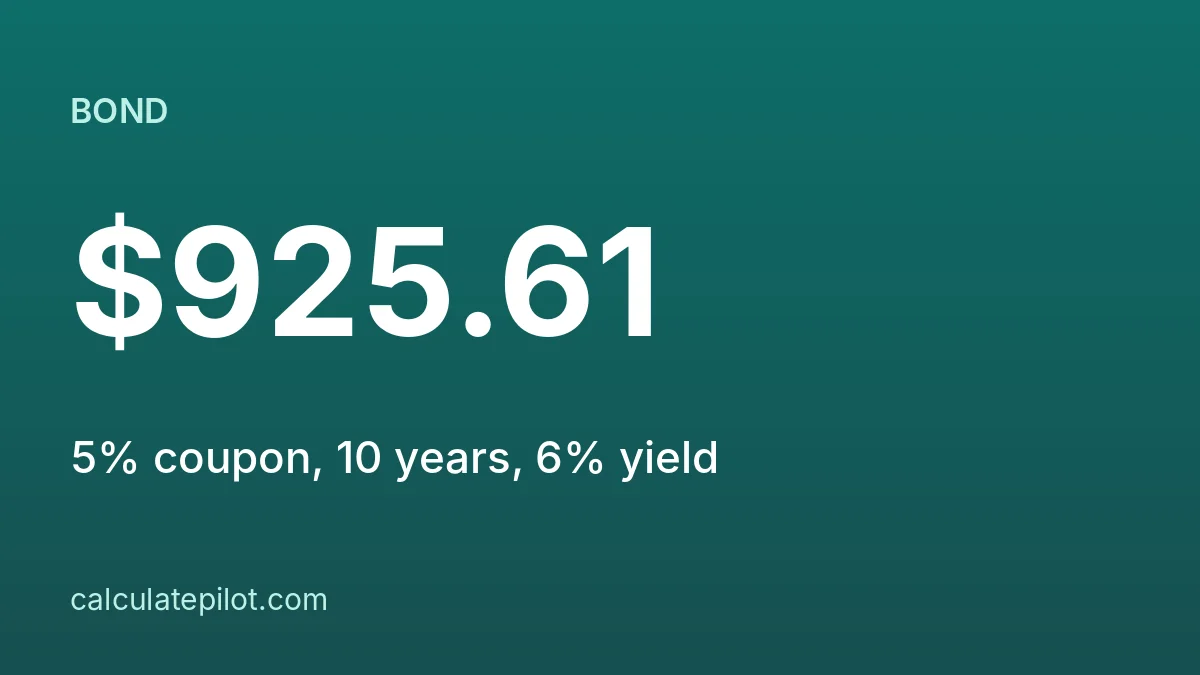
Bond price = coupon × [1 − (1 + y)^−n] ÷ y + face value ÷ (1 + y)^n, where y is the yield per period and n the number of periods. A $1,000 5% bond with 10 years left at a 6% yield (semi-annual) is $925.61.
1. The formula
Price = C × [1 − (1 + y)−n] ÷ y + F ÷ (1 + y)n
- C = coupon payment per period (face value × coupon rate ÷ payments per year)
- y = market yield per period (annual yield ÷ payments per year)
- n = number of periods (years × payments per year)
- F = face value repaid at maturity
2. Worked example
A $1,000 bond, 5% coupon, 10 years to maturity, semi-annual payments, market yield 6%.
| Step | Calculation | Result |
|---|---|---|
| Coupon per period | $1,000 × 5% ÷ 2 | $25 |
| Yield per period | 6% ÷ 2 | 3% |
| Periods | 10 × 2 | 20 |
| PV of coupons | $25 × [1 − 1.03−20] ÷ 0.03 | $371.94 |
| PV of face value | $1,000 ÷ 1.0320 | $553.68 |
| Price | $371.94 + $553.68 | $925.61 |
3. Reading the result
The price is 92.56% of par. It is below $1,000 because the 6% market yield is above the 5% coupon, so the bond trades at a discount.
4. Check your answer
- If yield equals the coupon rate, the price should equal face value.
- If yield is above the coupon rate, the price should be below face value.
- If yield is below the coupon rate, the price should be above face value.
5. Frequently asked questions
What is the formula for bond price?expand_more
Price = coupon × [1 − (1 + y)^−n] ÷ y + face value ÷ (1 + y)^n, using the yield and number of periods for the payment frequency.
What yield should I use?expand_more
Use the current market yield to maturity (YTM) for bonds with similar maturity and credit quality.
Why divide the rate by the payments per year?expand_more
Coupons and discounting happen each period, so both the coupon and the yield are converted to a per-period amount.
Is this the price I will pay?expand_more
It is the theoretical clean price on a coupon date. Real trades add accrued interest and are affected by credit risk and liquidity.