Short answer
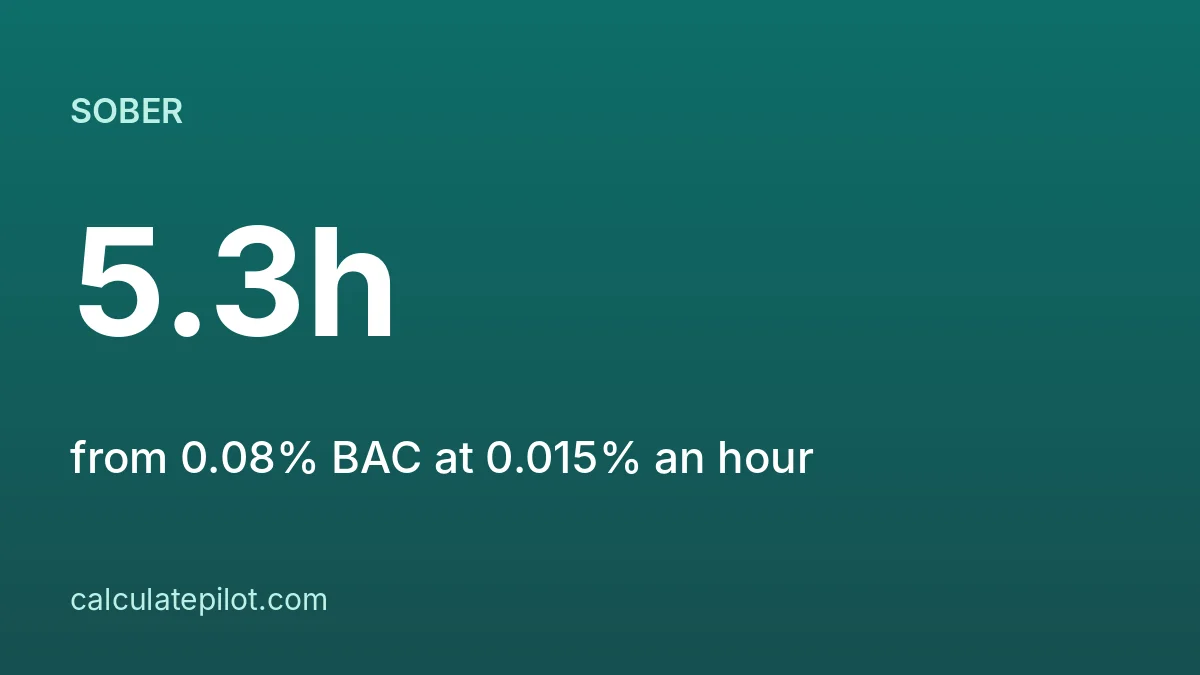
The body clears roughly 0.015% BAC per hour on average, so 0.08% takes about 5.3 hours to reach zero, 0.10% about 6.7 hours and 0.15% about 10 hours. Measured rates vary roughly from 0.009% to 0.035% per hour.
1. Time to zero
| BAC | Time to 0.00% |
|---|---|
| 0.04% | 2.7 hours |
| 0.08% | 5.3 hours |
| 0.10% | 6.7 hours |
| 0.15% | 10.0 hours |
| 0.20% | 13.3 hours |
This uses 0.015% per hour, a commonly used conservative rate. Real elimination ranges roughly between 0.009% and 0.035% per hour from person to person.
2. What does not help
Coffee, cold showers and exercise do not speed up elimination. Only time lowers BAC.
3. Alcohol can still be absorbing
BAC can keep rising for a while after the last drink, so an estimate taken soon afterwards can be too low.
4. Planning
- Arrange a sober ride before drinking.
- Do not use the time to zero to decide when it is safe to drive.
Try the BAC Calculator for an hour-by-hour estimate.
5. Frequently asked questions
How long does it take to sober up?expand_more
About 5.3 hours from a 0.08% BAC at the average estimated rate of 0.015% per hour.
Does coffee help me sober up?expand_more
No. Only time lowers BAC.
Is the elimination rate the same for everyone?expand_more
No. Measured rates range roughly from 0.009% to 0.035% per hour.
Can I drive when the calculator says zero?expand_more
Do not rely on it. It is only an estimate.
6. Sources
- menu_bookNIAAA: What is a standard drink?
- menu_bookNHTSA: Drunk Driving